10 Reasons to Hire An Agency. Reason #2


Day 2 in a 10-day series on reasons to hire an agency.

So yesterday, we examined perhaps the most-often cited reason for hiring an agency, which was to have access to great, talented people.  See Yesterday’s Post >

Today, we’ll look at perhaps the second most popular reason, and perhaps the most dangerous (for both parties.)

Reason #2:  The agency has experience in my vertical.

This is another very popular reason that small and midsize companies choose an agency.  And also a very typical path for b-to-b companies.  These marketers are looking for some assurances that they’ll be in the hands of experts – and previous experience in a particular vertical (like steam pipe fittings, or enterprise servers, or mattresses,) provides them on some level.

Why is vertical knowledge so valuable?  There are many reasons, but the main one is definitely money/investment.  When a company wants to market itself in a particular industry – again, especially in b-to-b – it needs to speak to a specific audience through specific channels and create differentiation and memorability.  And quickly.  They last thing they can afford is to pay some agency to navigate a learning curve.  Plus, in these specialized industries, it’s easy to slip up, even innocently, and ruin a campaign, or an entire marketing plan with a wrong word here or a mis-usage there. That’s way too risky and expensive a proposition for any company to make, so you may hear a lot of the “let’s just find a shop who knows our business” being whispered between decision-makers as they sign off on the marketing budget.

Is it possible that an agency full of talented and intelligent people could do some research, and learn about your vertical?  Absolutely.  And in some ways (not all,) it may provide better, cleaner marketing expressions as a result.  It’s something I call “creative curiosity.” But it almost never happens.

But be warned.  Choosing an agency for vertical experience can also be dangerous for both you and the agency.  When an agency has been doing, let’s say, automotive retail for the better part of the last 15 years, it’s not likely to try anything remarkably new or daring…it’ll go to what works, it’ll run your ads in the media it knows, it’ll do what it thinks will generate results.  And chances are, if they’ve been successful for the last decade and a half, it probably will generate your requisite ROI.  And you’ll like the results, and you’ll be content that your message is out there.

But it may end up being boring.  Or just mildly effective.  Or worst of all, it’ll just look like everything else in your space.  This is why marketers have to learn to ask themselves hard questions.  Questions like “do I want to be safe and effective, or do I want to be different and daring?”  Both are valuable, depending on what kind of marketer you are, and what you instruct your agency to do. Remember, even if you hire an agency that has loads of experience in your vertical, you’re still going to want something new, something fresh.  So why not give that same charge to an agency who doesn’t have experience in that vertical, too, and see what comes out?

Tomorrow:  Reason #3:  They’re great in this medium.

10 Reasons to Hire An Agency. And what’s wrong (or right) with them.

A series of 10 posts in 10 days.

There are a zillion reasons to hire an agency.  And pretty much a zillion types of agency out there from which to choose.  Whether the agency calls itself a marketing communications company, an advertising agency, a consultancy, a PR firm, a branding firm, a branded entertainment company, an experiential marketing service, whatever…it’s not always easy to figure out what an “agency” is, or which type you need.  But it is, generally, good business to hire one of these types of companies to help move your brand/initiative/program/product/service forward in the marketplace, no matter what your size, what your goals or what your budget.

Figuring out which type of agency to engage is a tough task.  It largely depends on what YOU do, who your audience is, and a host of other factors.  If you’re a large company, it’s likely you have several types of agencies to handle specific tasks:  media, social, digital, etc.  But if you’re a small or midsize company (and let’s face it, 99% of you are,) it’s really hard to determine what kind of agency you should hire.  Because you probably need some PR.  And some social media help.  And some advertising.  And a bunch of other stuff.  So choosing one type over another is a challenge.

But once you’ve figured out which type of agency you need, a far more difficult question to ask is this: is there a good reason to hire one agency over another?  As gray areas go, this is pretty light, and fading fast.  So over the next 10 days, I’ll post 10 reasons typically cited for hiring an agency to perform marketing services on some level, and together, we’ll examine what they mean on a broader level and explore the good, the bad, and the “really?”

Reason #1:  “The agency has great, talented people.”

Many companies claim they hire an agency because the agency has great people working there.  Maybe a highly-awarded creative director.  Or a senior executive who’s written a bestseller or even a Hollywood screenplay. Or a former client-side manager who’s come over to the dark side to bring a particular expertise.  Or a celebrity CEO.  Or fantastic, motivated support staff in every department.

And while this is a very good reason to hire an agency, it’s also the most ambiguous.  If you walk into 10 ad agencies today (and I just use that as an example,) and start talking to various people in different departments, chances are you’ll find a cast of incredibly diverse, wildly interesting and extremely talented people at all of them.  Some may be brilliant fine artists.  Some may write gorgeous poetry.  Some may play Brazilian jazz in the evenings.  Some may have insightful business acumen that makes you think in ways you’ve never thought before.  Some may be gifted orators, and others, witty humorists, talented coders or concerned environmentalists.

That’s because ad agencies typically hire people with diverse backgrounds who have either an artistic or functional business talent that can be exploited (in a good way.) It’s almost a redundancy to say that an agency (marketing, advertising or otherwise) has talented people. After all, that’s why you seek their services.  Hiring an agency to execute your marketing because they have talented people is akin to saying you’ve hired a band for your wedding because they sound good.  It’s the baseline. It’s the expectation.

Now, can there be a serviceable agency that doesn’t have “great” or “talented” people?  I suppose so.  Drawing on the wedding band reference, I’ve met plenty of musicians who are neither great nor exceptionally talented, but can still play serviceably and get people on the dance floor.

But wouldn’t you rather have something exceptional?  On some level?  Wouldn’t it be great to have that exceptional talent working on behalf of your brand, and trying to stimulate demand for your services?  I should think so.

Tomorrow:  Reason #2:  “The Agency Has Experience in My Vertical”

This offer expires soon.

I’ve just read Jay Goltz’ blog post on NYTimes.com entitled “Is Groupon Ruining Retailing?”  A good read, and lots of good points that got me thinking about couponing as a marketing tool.

A classic sales promotion method, couponing has grown steadily over the past several decades.  According to a recent report issued by NCH Marketing (a Valassis company,) shoppers saved $3.7 billion with coupons in 2010.

Sort of a perfect time for Groupon to be coming out of its shell, eh?

However, there are some important rules of the channel that the Groupons of the world might be missing.  Couponing is not for everyone, is more of an awareness-building tool, less of a customer acquisition tool, and it has a limit.  There are also many factors at play besides redemption rates that have to be taken into consideration.

So why do marketers coupon?  A solid coupon program will create:

  • Incremental sales (for either new products or labels past maturity)
  • Brand Awareness
  • Program ROI
  • And maybe some additional opportunities for sell-in at the store level.

A colleague of mine, David Adelman of OCD Media, also reminded me that couponing has to be looked at in context of what the running sales trend has been for the particular brand, and then re-evaluated months after the program.  Sure, there can always be a spike in sales in the short term, but some coupon programs can hurt, since, on some level, you’re discounting future sales for that spike this week.

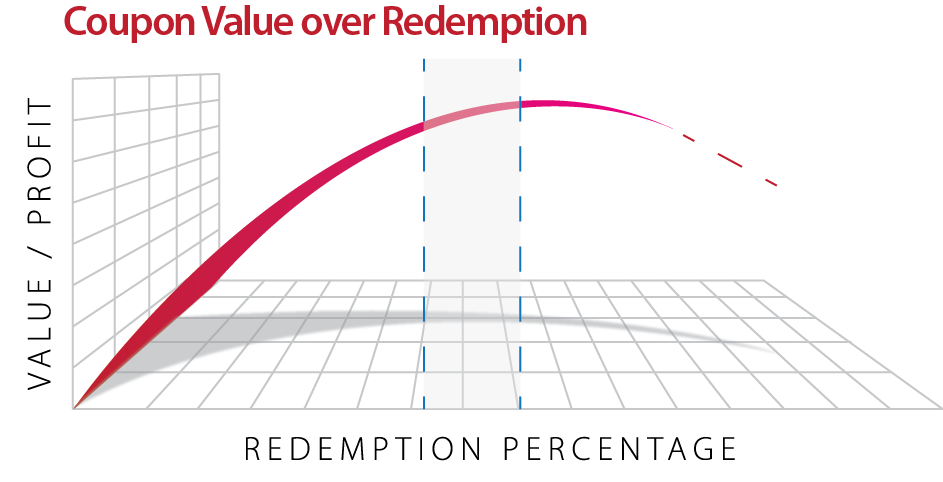
The real balancing act with couponing is about redemption:  too little redemption and the program won’t deliver the requisite ROI.  Too much redemption, and the value of the program ALSO goes down…how is this?

Coupon Redemption Scale


Turns out that too many redemptions can erode the brand in several ways:  super-redemption can cut into overall margins, so while moving more volume, the marketer can be incrementally losing share on every purchase.  Look for a redemption range [in the blue dotted lines] that helps move sufficient volume without over-saturating the market. Better to under-estimate, since you can always pump more coupons into the market, or hand-distribute in stores.  Also, if the coupon is on a 1+ offer, (most are) you can erode repeat purchase by an even longer period…further delaying the product sales rebound…a deadly combination with over-redemption.

So coupon carefully.

Three cheers for Verizon.

I LOVE the new spot that Verizon has launched to introduce its marriage with iPhone 4.  It’s honest.  It’s simple.  And it resonates in a way that many other strategies may have missed.

For a long time, Verizon has been poking fun at iPhone, mostly because of its alliance with the AT&T network.  By mocking the rival network, it invariably knocked the phone.  The best example of this is the “Island of Misfit Toys” spot it ran more than a year ago.  Funny.  And smart.  And a great way to make the points about the phones you CAN get on Verizon’s network.

But now, the hatchet is buried.  The bygones have gone by.  And the tone is spot-on.  Using a series of images of clocks ticking and fingers tapping and eyes shifting, the spot creates tension focused on “waiting.”  The voiceover begins by addressing the audience directly: “To our millions of customers, who never stopped believing this day would come…THANK YOU.”

Cheer #1:  Good strategic approach.
How smart is this strategy?  No attacks on the “other” network.  No knocks on the device.  No more touting OTHER phone’s app capacities.  Just a simple, singular message that affectionately bonds the two companies.

Cheer #2:  Truthfulness.
The spot gets honest, and does it elegantly.  It essentially ADMITS that (despite its efforts to sell you a zillion other devices,) Verizon customers have wanted THIS phone all along.

Cheer #3:  Bonding with customers.
What’s more impactful than saying “thank you?’  How often do big corporations do that, especially when the context is “thank you for being patient, while we tried to shove other things down your throat for the last three years.”

Bonus Cheer:  Create anticipation.
By putting the forthcoming launch date as a super, the spot creates anticipation.  This is “appointment advertising” at its simple and singular (ooh, a pun!) best.

Cola Wars are back. But this time, it’s Airlines.

At last!  Airline advertising is interesting again.  And competitive again.  And at least for Southwest, good again.

As you know by my recent rant, I’ve just about had it with airlines.  Not just because the experience of interacting with their brands isn’t enjoyable, but because their advertising and other marketing isn’t enjoyable either.  American’s “we know why you fly” spots are cheeky, sort of, but targeted at business travelers.  Continental has been running a nice mix of print ads, but “work hard fly right” doesn’t resonate with the headlines in most of the ads.  And have you seen Delta’s in-flight video?  Check out the “smoking is not allowed” bit at 1:50.  Yikes.  Cheeky. In a literal way.

So here comes Southwest.  First, they entertained us with the “bags fly free” spots, poking fun at airlines on a key consumer hot-button, the checked baggage fees that most larger airlines are charging.  Good, solid, features-based advertising that tells a story, entertains and communicates clear benefits. (And, by the way, support Southwest’s casual attitude brand position.)

More recently, they’ve launched a new series of spots that is simply sublime.  The “fee court” campaign takes aim at another big airline peever, the dreaded “change fees.”  In the spots, from GSD&M’s Idea City, we see plaintiffs, called “real travelers” seeking restitution from “big airline executive,” who simply can’t be bothered.  The casting is perfect, the performances are wonderfully glib, and the big airlines are comically vilified in spots that make their points brilliantly.  In one spot, real traveler and big airline executive have approached the bench, and big airline executive rolls his eyes and asks, “will we be here very long?”  The court gasps, the jury whispers, and the verdict is returned:  GUILTY.

In another spot, a business traveler asks a simple question:  “how can three clicks of a mouse cost me $150?”  Big airline executive stumbles and mumbles his response about personnel, computer time and how we “can’t afford to do this for free.”  Jury giggles under their breath.  And in the real payoff, a family of travelers pleads their case.  When a young girl, who was scheduled to fly to see “grammy and grampy” fractures her leg and has to change the flight, big airline executive charges the $150 change fee for all three family tickets.  The spot wins with everyone repeating the basic math “that’s $450.”  The judge looks at the defendant, who arrogantly retorts “it’s an honest dollar, your honor.”

Using the courtroom convention engages viewers in a familiar dramatic setting, (which garners attention) and also allows a lot of content to transpire in a very short time.  These spots are :30s.  The timing is perfect, and the lo-fi production ethos is not an accident or a shortsight, it’s a perfect riff on the afternoon court television format.

And the best part of all these spots is that the focus is singular:  the entire campaign is centered on a specific and definable objective:  communicating the simple benefit that Southwest is the only airline with no change fees.  The creative, the execution, the fun…all of it is able to blossom as a result of such clear focus.

In my last post, I wrote that it’s only a matter of time before the big airlines get “corrected” by the market.  Southwest has done a marvelous job at truncating that timeline by invading unaware enemy territory in the new “cola wars.”  Check out more of the spots at youtube.