Dos and Don’ts to Beef Up Your B-to-B Advertising

If you’re in a business that sells to other businesses, you know how difficult it can be.  Whether you’re a small business or a global enterprise, the daily challenges of communicating can add up to quarterly headaches and annual recalibrations.  But if you’re marketing as actively as you need to, then some simple rules can help.

For much of my career, I’ve been involved with businesses that need to convince other businesses to engage.  From media companies to industrial businesses to distributors and exhibitors, I’ve seen the challenges of articulating compelling messages that resonate and drive response. B-to-b marketing is indeed a unique discipline, and it has rules that its consumer counterpart cannot even imagine having to navigate.  However, that doesn’t mean that it has to be cold, or impersonal or the mother of all sins:  boring.

Here are a few do’s and don’ts when it comes to formulating business-to-business advertising or other marketing outreach:

DO talk to a PERSON
Despite what we may think about business-to-business marketing, we’re still in the persuasion business.  And it’s critical to talk directly to one person, understand his or her needs, promise him or her benefits and build a case for your product or service.  You can’t do any of that to “an organization.”

DO be willing to SELL
A fair amount of b-to-b advertising approaches will highlight some random case study about Bob, of Company Y, who increased productivity 400% while using Solution X.  No call to action, no contact name, no direct connection.  Now, in fairness, not all b-to-b advertising has to be direct response, but it should have an articulated point of view, and should clearly define what the value proposition is through some means.  It should sell in whatever way works best for your brand and in whatever way makes it easiest for your prospect.

DON’T run a competitive ad unless you can back it up with verified third party data.
Your opinion of your competition means nothing unless there’s a tangible difference to your prospect.  It’s okay to establish a clear difference between your brand and competitive offerings – but if you’re just beating your chest over a nominal difference in features, you’ll coming out looking mean.  And nobody wants to do business with a meanie.

DO use a strong CTA
Someone I admire very much constantly reminds me of the phrase “don’t ask, don’t get.”  While I’ve just said that all b-to-b advertising doesn’t have to be direct response, the best business conversations do include an appeal to interact.  So propose a demo.  Ask for the call.  Heck, ask for the business!  But do it in a way that makes the prospect’s life/business/daily challenges easier, and then ensure that at the end of the road, things get even brighter! Remember the important lesson that hope is not a strategy for success.

DON’T be afraid to be emotional
Regardless of the “professional” nature of b-to-b, every buying decision – whether it’s technology, or information or industrial steel – is an emotional process.  The CEO, or the CTO or the procurement manager of a municipality still has to “feel” good about your offering, your pricing, your service guarantee.  Don’t abandon this core principle.  It could mean the difference between getting a response or not.

DO be visually arresting whenever possible
Advertising, in my opinion, is one of the most powerful forces in global business. We have the opportunity to persuade and entertain using interrelated words and pictures.  Many executives agonize over the words, (because we all have opinions, whether or not we can articulate them,) but leave the pictures to an afterthought (because not everyone is a visual thinker or an artist.)  When you can be visually arresting (in print or moving pictures,) you can elevate the corresponding language to a level that the words alone could not have achieved.  Sure, use a chart or a graph to visually demonstrate, but make sure it’s designed to delight as much as it is to inform.

DON’T be blah
As mentioned above, it’s important to talk to a PERSON.  Unfortunately, a lot of b-to-b advertising tries to sell to the whole organization, or a department or an executive team.  But the only way to do that is to use generic, bland, SAFE language.  I’ll remind you that generic, bland and safe do not compelling advertising make.  Be excited!  Be visual.  Dramatize the benefit.  Claim the highest possible ground for your brand and then differentiate the snot out of it.  Get out of techno-speak for techno-speak’s sake…start using hard-hitting language that proves you understand the prospect’s challenges, proves your product or service can meet and exceed those challenges, and proves that choosing you will make that singular prospect feel empowered, excited and engaged.

Image source:  DeviantArt

Writing Advertising? Shorter is Always Sweeter.


Illustration:  Bruce Crilly

In the history of advertising, some of the most lauded taglines have also been the shortest.  Why is this?  (And while we’re at it, why does the leggy blonde always seem to go out with that short guy?)

Why do we not seem to gravitate to long, multi-syllabic complex thoughtforms?  At first glance, it would seem to be useful if we could pack more bullet points into our advertising signoff, so people would remember lots of stuff about our product or service.  But for American consumers, it just doesn’t work.  Maybe it’s because we’re American.  We like it punchy.  We like it now.  We like Ricky Bobby and light beer, dammit.

Okay, that’s cynical, and not so helpful.  Let’s get serious.  For the most part, shorter taglines work for a number of reasons. Primarily, its because they’re easy to remember.  And if you’re in the business of stimulating demand (that’s what advertising is supposed to do, bee-tee-dubs,) then a short, pithy line is simply more memorable, more recall-able than, say, an advertising haiku. So there’s a form-follows-function overtone there.

Second, there’s an actual meter to consider, a rhythm, a tempo, a little bounce that shorter lines provide over their more verbose counterparts.  With a short line, the consumer can file a meme away into a corner of her mind that only your brand (in the best cases,) can occupy.

Finally, it’s about time.  The modern consumer is busier than ever, and is literally overwhelmed with messages, media, and now devices that carry and deliver information, including advertising messages.  Whether it’s social media applications, or websites, or traditional media, or a sporting event, or the floor at the local grocery store, there simply isn’t time in the consumer’s day to focus on all that content – especially your bloody marketing message.  Now, more than ever, being short and to the point is not just a welcome deviation from the discord in the din, but also a way to stand apart from it.  Brevity is indeed the essence of wit.

Although this might seem confining, remember that you can say an awful lot with a few small words.  Case in point:  ‘Be all you can be.’ for the US Army.  This line lasted more than 20 years and defined perhaps the most successful articulation of any military marketing message. Five words, of two or three letters each.  And yet, the meaning is monumental.  Partly because it’s personalized to the individual reading it via “you,” and “all” is just broad enough to cover virtually every aspect of that individual’s life.  Brilliant.

Some of the most notable short advertising taglines:

Just do it.
Think Small. (This was actually a headline but it rocked so hard, it has to be included.)
We try harder.
Got Milk?
Be all you can be.
A diamond is forever.
Think different.
It’s not TV.  It’s HBO.
Intel Inside.
Priceless.
Because You’re Worth It.
Great taste. Less filling.
I want my MTV!

Putting it into practice:

Let’s not forget, there have been immortal taglines that are not short.  (The Ultimate Driving Machine/When it absolutely, positively has to be there overnight/Melts in your mouth, not in your hands, etc.) So when you set out to craft advertising for your business, keep your audience front and center, and let that dictate what you write.  What are they doing?  What do they need?  How can you help them?

Keep it simple.  Better yet, keep it short.  Pack as much into the idea that you can, without leaving too much to the imagination, (although leaving to interpretation is okay.)  Generally, basic language works best – small words, single syllables if you can help it, and a clear, declarative tone.  And NEVER make your slogan – strapline, tagline, whatever you want to call it – a question, okay?   (A really good one only happened, like, once.)

Now,  get your eraser out and start writing.

The Law of Failure

Illustration:  Bruce Crilly

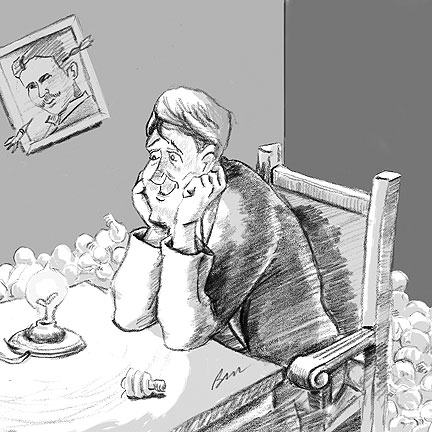
It’s been noted in many places that Thomas Edison [caricatured above] may have failed as many as 1,000 times at inventing an electric-powered light bulb, and when asked about his string of failures, he turned the tables by saying (and I’m paraphrasing,) “I didn’t fail 1,000 times. I succeeded at inventing a light bulb, and it took 1,000 steps to arrive at it.”

A recent New York Times article asked the question “What if the Secret to Success is Failure?” when discussing education and character among school-age children. Do a search on “failure,” and you’ll find inspiring stories of heroes of history who have failed mightily on the way to great successes: Churchill, Einstein, Darwin, Pasteur, Ford and on and on.

And at the recent DMA International Conference in Boston, Biz Stone, co-founder of Twitter, turned failure on its head relative to social media, stating “if someone posts a negative comment about your product, it demonstrates a level of investment and passion about your brand.”

Okay, that’s a lot of fluffy and warm and puppies. But in business – and particularly in marketing – we’re trained otherwise. For most of us, “failure is not an option” for our next product rollout, or our next advertising plan, or our next event. However, if we embrace The Law of Failure, we might find that failing helps to reveal what success really looks like.

In almost every business, professionals fail their way into success, typically in a process of elimination continuum: try › fail › tweak › repeat until try ultimately leads to success. At which point, you test the snot out of that success to ensure repeatability and reliability. This is true in engineering; in medicine; in sports; in fashion; in entertainment; in technology; in a zillion other categories.

In marketing and advertising, (direct, media, creative,) we call it “testing.” But testing is simply an accepted euphemism for “financing failure to yield better strategies.” Why else would almost every big campaign be run through focus groups first?  Why test your spots on samples of your target demographic? It’s not so much that you can see what WORKS, but rather that you can reveal what DOESN’T.

My theory on why it is so vehemently avoided in the marketing/advertising arena is simply because of the money flow. When doing medical testing, for instance, the medical company has an R&D budget to cobble away in a lab for sometimes years at a time. In engineering or technology, all the sunk costs are stacked upfront – sometimes financed by venture capitalists – and millions or tens or hundreds of millions of dollars might be spent to arrive at a new design/product/solution that then gets recouped upon selling/distributing/launching.

But in advertising, the money flow is different. The typical relationship is an outsourcing model (company x hires agency y to develop the marketing program) that puts the pressure on the marketer to justify that spend and that agency choice. It’s our money, so you better spend it wisely. No marketer I’ve ever met wants to hear in the pitch “yeah, we’re gonna spend a percentage of the budget on failing.”

But that’s essentially what’s happening. Sure we do research, we do cluster analyses, we create predictive models. My colleague David Adelman at OCD Media is a media planner who creates predictive models in order to yield what he calls the most “testable propositions.”

The only problem (in advertising and marketing) is that those propositions are tested out in the marketplace, and failure is seen as a scarlet letter on the breast of the marketer (and in many high-profile cases, the agency, too.)

But I propose that failure is not a sad end to high hopes, but rather an intelligent investment in future successes.

When you fail at strategy X, you now have saved an innumerable amount of money because you KNOW that strategy X won’t work (under the current conditions.) You can instead pursue strategies Y and Z. And if they fail, you save proportional amounts, and so on. KNOWING is powerful.  Failure leads to knowing, whereas success is sometimes an intoxicating mix of planned well, guessed right, timed it right, chose a good director, etc.

This might not fly at your company if you’re a slave to the quarterly conference call with the board and have to explain that you’re failing. But if you’re a small to midsize marketer – you’ll never spend money any more wisely than by failing and KNOWING what to avoid in the future.

The Four Cornerstones of Driving Traffic

I recently held a garage sale (how suburban of me, eh?) and, while it was a success, it could have been much better. Definition:  I didn’t sell everything I would have liked to sell.

The issue, I have surmised, was not a question of our inventory or our location or our quality level – it was simply a matter of driving the appropriate traffic. [Note:  a follow-up report from the garage sale indicated that we converted sales at approximately a 25% ratio:  for every four people that came by, one made a purchase.  Not bad.]

While I covered all the requisite bases, there was a lot more I could have done.  It reminded me that small and midsize brands face the same traffic issues every day.  Whether you’re a website, a local retail shop, a restaurant or even a midsize b-to-b service provider, driving and sustaining traffic is central to your survival.

Irrespective of the media you choose, or the vertical you’re in, or the market(s) in which you operate, here are four critical cornerstones to understanding and driving traffic that I’ve branded as the “TMX2” approach.  These are in no certain order, and in many respects, have to be considered simultaneously.

The first cornerstone:  Targeting
Driving traffic begins with a clear understanding of the prospects you WANT.  If you’re working with a media company who’s doing planning for you, you can probably get to a very decisive target.  But if you’re not (maybe you’re small, maybe you’re not sure,) you can ask yourself important questions:  who is the “ideal” customer?  What is the ideal “deal” for that customer?  How can I provide that structure?

Two important targeting sub-themes here:  think virally and think in segments.
First, in the age of social media, ask yourself another targeting question:  Who will be likely to “spread” my message post-purchase?  Second, don’t be afraid to segment.  You can’t be all things to all people, but you can be one valuable thing to one segment, another valuable thing to another segment and so on.  For more information on segmentation, check out the VALS Framework, pioneered by SRI.

The second cornerstone:  Timing
Two facets of timing are essential.  First, give your offer or your brand or your new product launch ample time to sink in and make the requisite impressions.  So often, marketers have great ideas and fantastic solutions to offer, but we bail when we don’t think it’s happening quite quickly enough.  We already know that the American consumer (or business owner) is inundated with zillions of marketing messages every day.  Sure, you have to cut through the clutter with good messaging and solid creative, but you also have to allow for the message to seep in…there’s a reason “frequency” is a cornerstone of every media plan.

The second facet of timing is more delicate – you have to offer your consumer what they’re looking for, at a price he or she is willing to pay, at the right moment.  Not quarter.  Not month.  MOMENT.  This is why the term “real-time” is being bandied about so often in marketing seminars and business conferences around the world.  See articles on real-time marketing on Mashable.

The third cornerstone:  Message
While it’s impossible to cover everything about messaging in an overview, be clear about this:  you can target the right customer, deliver your communications over the right medium, time it perfectly and still not influence or stimulate demand if your message doesn’t resonate with your customer.  So how do you make that happen?

It’s not simple, but make sure you cover at least the following:  Claim the highest possible emotional benefits that speak to your audience (or segment.) Add rational support for choosing your product or service.  Be absolutely relevant.  And don’t be afraid to be a little unexpected – a little cooky.  As long as those other aspects are covered, cooky can work and usually does because it’s more memorable and more entertaining and more differentiating.

The fourth cornerstone:  Mission
Here’s a cornerstone of driving traffic that can easily get overlooked.  Very often, we achieve results when we undertake a marketing effort.  But sometimes, the early returns can influence our perceptions about what we’re trying to achieve.  If things are going great in the first month of a new campaign, everybody starts to project HUGE numbers for the program, and forgets that you had an objective to only move the needle by 10%.  If things start out slow, we may assume that “this is never going to work,” and we forget that we only want to move the needle by 10%, so we crush the program before it has time to sink in.

The best way to avoid abandoning the mission is to document it.  Write it down where EVERYONE involved can see it.   That’s right.  Everyone.  The client.  The agency.  The vendors.  The investors.  Everyone.  “WE WANT TO SELL 22 MILLION WIDGETS AT 19¢ IN THE NEXT YEAR.”  Or “WE WANT TO INCREASE WEB TRAFFIC TO 100,000 UNIQUES PER MONTH IN THE NEXT TWO QUARTERS.”  Whatever it is, keep it sacred and don’t abandon it.  You’ll find that it absolutely aligns every stakeholder and, if you build on the other cornerstones, you’re likely to be pleasantly surprised at the traffic jam just up ahead.

Article first published as The Four Cornerstones of Driving Traffic on Technorati.

Three cheers for Verizon.

I LOVE the new spot that Verizon has launched to introduce its marriage with iPhone 4.  It’s honest.  It’s simple.  And it resonates in a way that many other strategies may have missed.

For a long time, Verizon has been poking fun at iPhone, mostly because of its alliance with the AT&T network.  By mocking the rival network, it invariably knocked the phone.  The best example of this is the “Island of Misfit Toys” spot it ran more than a year ago.  Funny.  And smart.  And a great way to make the points about the phones you CAN get on Verizon’s network.

But now, the hatchet is buried.  The bygones have gone by.  And the tone is spot-on.  Using a series of images of clocks ticking and fingers tapping and eyes shifting, the spot creates tension focused on “waiting.”  The voiceover begins by addressing the audience directly: “To our millions of customers, who never stopped believing this day would come…THANK YOU.”

Cheer #1:  Good strategic approach.
How smart is this strategy?  No attacks on the “other” network.  No knocks on the device.  No more touting OTHER phone’s app capacities.  Just a simple, singular message that affectionately bonds the two companies.

Cheer #2:  Truthfulness.
The spot gets honest, and does it elegantly.  It essentially ADMITS that (despite its efforts to sell you a zillion other devices,) Verizon customers have wanted THIS phone all along.

Cheer #3:  Bonding with customers.
What’s more impactful than saying “thank you?’  How often do big corporations do that, especially when the context is “thank you for being patient, while we tried to shove other things down your throat for the last three years.”

Bonus Cheer:  Create anticipation.
By putting the forthcoming launch date as a super, the spot creates anticipation.  This is “appointment advertising” at its simple and singular (ooh, a pun!) best.