Six for 2026: the marketing truths that actually matter this year.

Well, it’s a new year, and you know what that means. Gyms are overcrowded with people determined to stick to their beach-body resolutions, and bloggers everywhere are posting “2026 prediction” lists.

Predictions are dangerous because they’re a zero-sum game. You’re either dead-on, or dead wrong. So let’s not do that. Instead, let’s remember that marketing doesn’t change so much as it adapts to its environment: new tools, new methods, new channels. So this post isn’t about trends. It’s about truths –  the ones I think will be smacking all of us in the face in 2026.

Truth #1: GEO is re-shaping search.
If SEO was about ranking pages, then GEO is about shaping answers. Even though it’s still important, being “findable” is no longer the ultimate goal. In almost stunning and sudden fashion, prospects aren’t scanning the top 5-10 blue links on Google…they’re reading a synthesized and sophisticated response from a generative engine (like Gemini, most ubiquitously) and then moving on with their day.

The new challenge for search marketers is less about keyword management and campaign groups, and more about establishing authority and clarity through curated content. We have to answer the question: If an AI bot has to explain our brand, what would it say? And if your positioning is even a bit fuzzy, the machine will happily invent something equally nebulous for you. And you probably won’t like it.

This is not a technical or platform problem with Google Ads. It’s the new reality, and a challenge to upgrade our thinking and our writing.

Truth #2: AI will not solve your marketing problems.
Most AI-powered marketing today is simply the automation of work that probably shouldn’t exist in the first place. Re-hashed content, surface-level messaging, and ugh, those AI-generated videos and commercials that are shiny, but hollow.

Make sure you know who you are, what makes you different, and whom you want to care about those things. Because AI won’t make a bad strategy better, it’ll just help you deploy it faster. So hey, let’s be careful out there.

Truth #3: Brand still matters (and always will.)
From the time the idea was first introduced, (it was as far back as the late 1950s by a Harvard professor called Neil Borden,) the concept of brand is what helps companies distinguish themselves in loud and cluttered categories. Brand helps reduce cognitive risk for consumers…when they’re not sure what the comparison criteria are, they can fall back on the idea that “I know something about this company.” (That’s true even if what the consumer “knows” is what you’ve been telling them all along. Yay advertising!) Brand drives preference, and preference is a marketing force that can’t be easily usurped.

Truth #4: Offline marketing is not going away anytime soon.
Despite the popular thinking that social media is the only channel that matters, the physical world is still out here kicking ass. And while we all embrace digital channels for their efficacy, let’s remember that old engines will continue to run as long as you start them up every now and again, and keep the oil clean.

Direct mail still delivers reliable returns. Events still drive serious leads. Popups (stores, experiences, installations,) are still, well, pop-ular. When a brand shows up in some physical form, whether in a mailbox or face-to-face, it signals scale and even seriousness. In a world where the media cycle is based on the next post with a million views and influencer promo codes, offline marketing tells consumers you actually give a shit.

Truth #5: Selling the category is still sticky.
When consumers don’t quite understand the nuances in a given category, they default to less risky decisions, like buying on price or relying on referrals. But that might not favor YOUR brand.

Brands that educate consumers on the category help to reframe the entire decision process. (This is why category content is so popular.) When you do this, you tell consumers that your brand “gets it” and is there to guide in some way. And the best part? None of that feels “salesy.” Instead, it feels like help to the consumer, and your brand gets the halo effect.

Truth #6: The middle of the funnel is where decisions get made.
I rarely talk about funnels (except that one time, in this post) because consumers are not abstract concepts that “move” through a space. But as a conceptual framework, funnels help illustrate the consumer journey across the time variable.

Top of the funnel marketing is easy…it’s just about attention. Brands will do all kinds of dopey things to get attention, (remember when iHop said they were switching to a burger company?) and they still seem to work. Conversely, the bottom of the funnel is largely an outcome function, and almost always offer-driven.

But the middle? Ooof. That’s the hard part. It’s hard because it’s messy. Because it’s harder to measure. And because it demands work, mostly in the form of strong, informative and relevant content. It’s hard mostly because that’s where the leakage lives.

Content that helps educate consumers on the category (see Truth #5 above) and helps them decide at their own pace can do more long-term brand building (see Truth #3 above) than just “getting the click.” If your funnel goes from “hello” to “buy now,” you’re gonna struggle.

The job of marketing hasn’t changed, and it won’t change just because it’s 2026 and we have some shiny new tools at our disposal. It’s still about managing perception, reducing risk, and driving preference at the moment of choice. Face the truth(s) and make this the strongest year ever for your brand and your clients.

Here’s mud in your A.I.

If you’ve been paying attention to the industry news, there’s been a LOT of chatter about AI, (artificial intelligence,) and its various applications. And some of them are really intriguing and useful. With the ability to run predictive diagnostics, artificial intelligence (better described as data-driven machine learning,) is ideal for applications that can benefit from robust and speedy automation.

As is our way, it doesn’t take long for something useful and intriguing to be repurposed into something base and silly. Case in point: AI is also being used now for some fairly sophisticated parlour tricks, like recreating the Mona Lisa.

(Moves soapbox to the foreground.)

But the application of AI in marketing, and most specifically in the creative process, is really (in this sentient blogger’s opinion,) an overreach.

There’s no data set for creativity. In fact, there are no rules. What makes something “creative” is that it is indeed CREATED. By a human being. Part of why we buy paintings, and music and novels and sculpture is because we know there’s a backstory of someone who sweat it out in a studio or at the typewriter. Someone whose fingers bled. Someone who made mistakes, and tried variations, and threw whole passages in a trash can. We celebrate that humanity and that pain and the entire process when we consume anything creative. Not just the end result.

The same is true in marketing. Writing anything – an ad, a blog post, a commercial script – is hard. It’s taking business rules and mandatories into consideration and asking a creative person to then do intellectual gymnastics, linking sometimes disparate ideas in unexpected ways, without a net. Can you write an algorithm for that? Sure, but the results are likely to be shit – the kind of shit a hack would conjure.

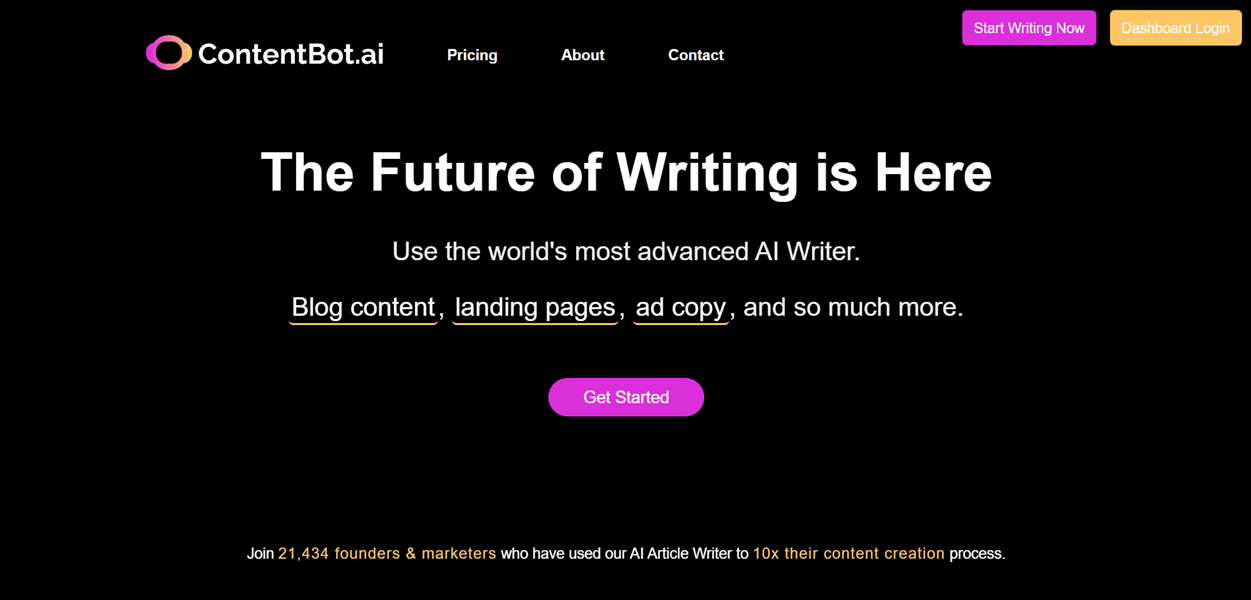
For instance, you’ve probably seen these kinds of promotions for having AI write your next blog post.

What’s really happening there? I don’t claim to have knowledge of any of their algorithms, but I’d bet my last dollar that these are search bots that crawl the web for every piece of content written in the last 10 years about a particular subject. They ingest this huge data set, pick out bits and pieces using sorting criteria that prioritize those with the most clicks, comments and instances, and then rearrange and reconstruct a new version for you.

That’s not creating. That’s recreating at best. And theft at worst.

ChatGPT, the latest and supposedly greatest iteration of AI language prowess, has added a sexy wrinkle into their algorithm. Instead of just swiping content and repurposing it, it adds a level of dialogue formatting to make it sound more conversational, and thus more natural and believable. It claims to “answer follow-up questions” and “admits its mistakes.” And given that it is machine-based learning, it gets “better” the more often it’s used. (It’s driving educators crazy, as students who use it can be deemed to be cheating, not researching.)

What a paradox: a machine learning model that improves the more often it’s used, but also degrades the craft proportionately in the process. [Some disclosures: OpenAI, the company behind ChatGPT is funded in part by Sam Altman, Elon Musk, and just got a billion dollar injection of capital from Microsoft.]

In a recent viral kerfuffle on social media, recording artist Nick Cave (throaty lead singer with The Bad Seeds) reacted to a song that was “written” by ChatGPT “in the style of Nick Cave.” He could not have put it any better:

“Songs arise out of suffering, by which I mean they are predicated upon the complex, internal human struggle of creation and, well, as far as I know, algorithms don’t feel. Data doesn’t suffer. ChatGPT has no inner being, it has been nowhere, it has endured nothing, it has not had the audacity to reach beyond its limitations, and hence it doesn’t have the capacity for a shared transcendent experience, as it has no limitations from which to transcend. ChatGPT’s melancholy role is that it is destined to imitate and can never have an authentic human experience, no matter how devalued and inconsequential the human experience may in time become.”

Okay, back to marketing, and particularly the art of writing good advertising. Part of the craft is developing a sense of counterintuitive thought and embracing lateral thinking. Another big part is the symbiotic relationship of the headline and the image. But so much of modern advertising is about contextualizing the brand into the cultural moment from which it arises.

Think of how many great headlines and taglines would never – could never – be written by AI, by virtue of this necessity for divergence and a sense of the cultural periphery.

“Think Small” from DDB was a radical notion at the dawn of the 1960s. As Americans – less than two decades removed from World War II – were upwardly mobile, one of the most pervasive (and comical) trends in automobile-dom was an oblique obsession with size. Bigger was better, and American cars looked like ocean liners. The nation was also wildly nationalistic at the time, and DDB’s assignment was to sell a small, quirky German car to this audience.

To get to the heart of these cultural undertones and suggest an opposite notion was a radical idea. And paired with the spare art direction (bless you Helmut Krone) and that sea of white space, it became a touchstone for our industry. Could AI ever reach that level of insight? Of rebelliousness? Of sheer chutzpah?

“Think Different.” When this campaign (from TBWA/Chiat/Day) was released in the 1990s, it was paired with images of pioneering artists, thinkers and doers, like Einstein, Picasso and Miles Davis. It also featured zero body copy. What’s so interesting about the head/tagline is that it’s not even good English. But it was a fine encapsulation of the Apple brand in that moment and what it stood for. Would AI dare to break grammar rules to create an emotional response?

I suppose it’s mildly ironic, or at least cheeky, that I chose two classic advertising examples that use the word “think” in the headlines. And perhaps that’s exactly what I’m driving at, and what Nick Cave was fuming at.

Maybe I’m an old fart, but I prefer the consternation. The suffering. The pacing and the waiting and the wondering if this “idea” has legs. Give me time to think about what’s going on in the world. Give me the sudden burst of insight when the neurons start to fire. Give me the end of the sentence that starts with “wouldn’t it be cool if…” Give me a person, thinking about another person, and getting them to actually think different.

There’s nothing artificial about that.