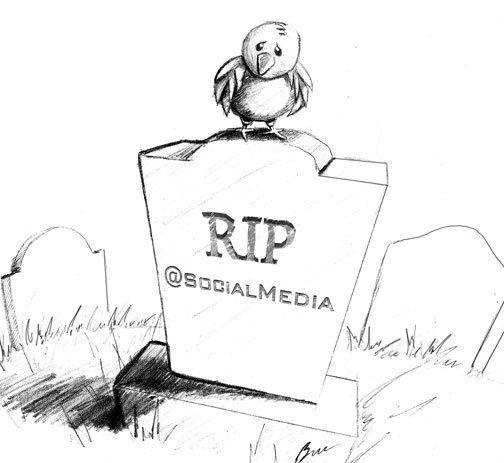
Death and Social Media – version 2.0

Illustration:  Bruce Crilly

The below is a follow-up to a post I wrote back in July 2010. First, the original post, then the follow-up:

Death and Social Media
This is a morbid way to discuss an idea, but let’s talk about death. And while we’re at it, let’s talk about social media. I was (briefly, fleetingly) thinking about what would happen after I die, and the kinds of things people would remember about me. (And more exactly, the kinds of things I hope people will remember about me.)

In my life, (and I’m not quite done yet,) I have created volumes of content in the social media world: blog posts, and blog comments, Facebook statuses and comments and likes and picture uploads and all those Tweets, reTweets and direct messages on Twitter! I’ve yelled about firing the head coach of my beloved Buffalo Bills on the fan forums on buffalobills.com, and helped people solve technical problems on support forums for Apple computers and some software platforms. I’ve written record and book reviews on iTunes and Amazon. I’ve uploaded and even commented on videos posted on YouTube! (Eeek. What a geek.)

So I wondered, will this become part of what people remember about me? Will there be people at my funeral saying, “yeah, nice guy…oh! And did you see his Tweets from the IAB mobile conference back in 2010? So insightful.” Instead of a collage of photos, will there be a screen somewhere with a streaming feed of my life’s digital output?

On one hand, I seriously doubt that these bits and bytes of my recommendations, forwards, hashtag snips and extemporanea will have any bearing on what people think about me. But on the other, there’s no getting around the fact that social media content is now a contributing editor to my legacy. I also submit that I think it would be an interesting, revealing and even fairly intimate way to chronologically peek into the ebbs and flows of my (mostly) professional life. Which makes me think: are we (am I?) Tweeting accordingly? Is the overall tone of my social commentary admirable/useful/honorable? Will my children be proud of what they read? Does it really matter how many check-ins I have, or if I’m the bloody mayor of some local bar? Jeez…maybe we better start looking at all of this in context.

In older days, we might have discovered a diary under a bed, or a journal tucked away in a closet somewhere, long after the departure of a loved one. But now, we have a digitized database of someone’s every thought and comment for years and years. And since most people in the world will never author a book, or write a professional article in a real journal, or be interviewed for television or radio, is the chronicling of social media verbiage a new means to endure? [Uh oh, I think I smell a new business model being hatched.]

Follow-up [September 2011]
So it turns out I was on to something about new business models being hatched, and people starting to talk about this morbid stuff with a more, um, opportunistic tone. A year after my blog post, a journalist named Adam Ostrow gave a TED talk that covered this topic – and outlined some new business models that are indeed being hatched at the intersection of death and social media as “opportunities for technologists.”

The first (and perhaps weirdest) is ifidie.net, a service that lets you create a message or video to be posted to Facebook after you die. Check out their website…kind of a wacky approach to a fairly serious topic.

“My Next Tweet” is a service that uses an algorithm to predict what your next (and perhaps last) bit of social output would be on Twitter by analyzing all your previous tweets and retweets.

Finally, Ostrow points out 1000 Memories, a service that allows you to organize, share and ultimately post a collection of photos, memories, writings and more to Facebook or an area of their site. Not just for the dead, apparently.

On the flipside of all that nonsense, there is a beautiful side-effect to digitizing one’s last days. I recently read a gorgeous narrative by Rebecca Armendariz chronicling a series of Gchats with her lover that is both heartwarming and gut-wrenching, and exquisitely written. Read it and (be prepared to) weep.

I suppose all of this does lend gravitas to the idea of self-monitoring your digital expressionism. Once you’re gone to the great mashup in the sky, you don’t want one of these dopey services misrepresenting your life’s social work. So if today is indeed the beginning of the end of your life, social-ize accordingly.

Point/Counterpoint: Who should set the marketing budget – the client or the agency?

Nader Ashway marketingthingy blog post image - who sets the marketing budget

Okay, so I’m borrowing from Saturday Night Live’s classic sub-skit featuring Jane Curtin and Dan Aykroyd.  But it’s the only way I think we can easily platform this complex topic for debate.  For you legal eagles out there, copyrights appear at the end of this post.

Who should set the marketing budget – the agency or the marketer?  This seems to be the question that plagues marketing relationships – especially between small and midsize marketers and smaller agencies.  On the broader scale, it’s pretty easy…larger marketers (and/or public companies) tend to stipulate their budgets way out front, and use previous years’ spend as a barometer, which can be tracked on resources like Adviews, a subscription-based tool from Nielsen. Generally, most of that spend is earmarked for media anyway.

But with smaller/midsize companies and smaller/midsize agencies, it seems that the budget dance is a tricky little two-step, and no one seems to know who should lead.  Let’s explore both scenarios and see which one makes the most sense for you.  Your opinions are invited!

Jane:  The agency should set the budget.
Buying marketing services is similar to buying any other services from any other vendor.  That being the case, you want to get the most bang for the buck.  So you invite a couple of agencies in, set up the goals for the upcoming year (or the project or initiative) and ask them to come back with a proposal that sets out a budget, a timeline, and what they expect they’ll achieve.

The agencies come back with proposals about what they think the marketer should be doing (building a microsite, running an outdoor campaign, running a sweepstakes, maybe,) and what they want to charge you for that. So the benefit is that you – the marketer –  do get to see a variety of thoughtful approaches to your marketing, as each agency will make different types of suggestions and usually prepare very fancy presentation materials!

As far as costs, an agency will typically include management fees, creative fees and expenses for out-of-pocket costs, like media, some third party add-ons, printing, postage, web development, etc.

This is the best way to do it.  I’m not telling what the agency to spend – they can tell me what they want, and I’ll choose from there. Agencies know what things cost, they know what they need to make to be profitable, and they know what I want.  Why should I tell them I have $100,000 to spend this quarter if they can deliver it at $75,000?  I have to be responsible with my budget.

Dan:  The marketer should set the budget.
Jane, you ignorant slut.  Everyone knows that if you ask an agency to set the budget, they’ll come back with a number you can’t afford, that includes every possible marketing incarnation from social to mobile to telepathic or whatever.

Or worse, they’ll suggest an over-inflated, over-reaching grandiose plan that includes tons of media that they can commission at double digits, and tons of dopey ideas like flash mobs and street teams and who knows what else.  [Not that these are bad ideas, but when there are no boundaries, some agencies like to frolic in the fields on your dime.]

If marketers want to get an equal assessment of how an agency can perform, the best way to do that is to quantify specific parameters:

using X dollars, and in Y time frame, what do you suggest to help us meet objective Z? 

Using this simple formula, or expanding it to a more detailed RFP, you will get presentations from agencies that are focused, that demonstrate their core capabilities and that usually have an ROI component attached.  But without stipulating dollars, you’ll never quite be comparing the presentations on an equal footing.

Marketers, YOU know what your goals are.
Not the agency.
You know what your operational expenses are to sell a product or service.
Not the agency.
You know what your board of directors or shareholders want to accomplish.
Not the agency.
You know what you have to spend to get there.
So why ask the agency to tell you?

So.  What do YOU think?  Should the agency tell you what to spend, or should you ask an agency what they’ll do with your budget? 

“Point/Counterpoint” is intellectual property:  a sub-skit of “Weekend Update.” “Weekend Update” is part of a comedy program called “Saturday Night Live,” created by Lorne Michaels; originally written by Chevy Chase and Herb Sargent. © 1975 Broadway Video/SNL Studios.