I have a complicated relationship with the marketing funnel. On one hand, I love it. It’s elegant. It’s simple. And it’s one of the most useful and illustrative conceptual models our industry has ever produced.
On the other hand, I HATE IT. Not because it’s wrong, but because it’s woefully incomplete. And we’ve been teaching it, illustrating it, and building marketing plans around it for more than a century without bothering to fix one rather glaring omission.
A little history. The marketing funnel has been around for a long time. Its origins date back more than 100 years, when advertising pioneer Elias St. Elmo Lewis introduced the principles that eventually evolved into the four-stage A-I-D-A model we use today: Awareness, Interest, Desire, Action. (Technically, Lewis’ first A stood for Attention, but the underlying idea about moving through these stages was quite similar.)
The concept is beautifully simple, logical, and easy to understand. And when you visualize that progression as a funnel, it gets even better. The wide opening at the top represents the universe of consumers who might become aware of your brand. As they progress through the stages, the funnel narrows, illustrating perhaps the most important reality: not everyone who becomes aware will become interested. Not everyone who’s interested will develop desire. And not everyone who desires your product will take action.
There’s leakage at every stage. And this is why the conceptual model is so useful. [Sidebar: There are a lot of people out there who genuinely think that reaching a million people with an ad campaign means that a million people will suddenly consider buying your product. Your current client is probably one of them.]
The funnel, as a model, helps us understand how marketing impacts consumers and their perceptions over time. It also reminds us that the job of marketing is mostly about progressively creating the appropriate conditions for consumers to make decisions.
The funnel is also one of the best teaching tools in the business. In fact, I use it with my grad students every semester. However, the tragic flaw of the funnel is that it treats the action as the finale. And that’s where the “hate” part of my love/hate relationship with the funnel strolls onto the stage.
Here’s why. The A-I-D-A model simply ends at action. And then, nothing. It’s like “YAY! We did it! We got a consumer to take an action! We’ve reached the bottom of the funnel! Order the pizza and beer and then let’s take the afternoon off!” It has that “Mission Accomplished” ethos written all over it. It’s ridiculous.
First, let’s consider what “action” actually means. It might mean visiting a website. Or downloading a PDF. Or offering up an email address. It doesn’t always mean making a purchase, or an initial appointment. And as we all know, downloading a PDF, while a cute KPI, is not going to get your client renewing your budget for next year. The marketing job is not done when someone reads your e-book, bro.
Now let’s assume that the action is indeed a purchase. The consumer has navigated through all four stages, chosen your brand over the competition, and handed over some hard-earned money. That’s a win.
But what happens next? Do we simply display the thank you page, wave goodbye, and turn our attention to the next batch of unsuspecting prospects? Of course not. That would be marketing malpractice, especially because you’d be abandoning the relationship right at the moment when it’s become most valuable.
In fairness, smart marketers have understood the importance of retention, loyalty, repeat purchase, and advocacy for decades. And many funnel-faithful marketers include some of these things, but they tend to do so outside of the model. That stuff happens on a different floor of the building. So, if we’re willing to admit that there’s usually more to the conceptual story, why do we keep leaving out the last chapter? That’s like having Freebird or Hotel California, but without the guitar solos at the end.
Models matter. Especially the ones that are being taught in both undergrad and grad schools. They influence how we think, what tactics we may prioritize, and ultimately, where we may spend our marketing dollars. The funnel is so ubiquitous that we now have acronyms like TOFU, MOFU and BOFU (which all sound silly to me, by the way) to represent top-of-funnel, middle-of-funnel and bottom-of-funnel activities. So, when something this popular and widely utilized under-represents the whole story, I think we’re doing the industry a disservice by perpetuating it. We have to illustrate what happens next, and include it as an essential element of the model.
So I propose a modest addition to the venerable AIDA framework. Let’s call it AIDAI. Just add another “I” at the end. And it stands for Involvement.
The idea is simple: after a consumer takes action, marketers should be working just as hard to encourage continued involvement with the brand as they worked to generate awareness, interest, desire, and action in the first place. Some of that involvement is practical. Product updates. Warranty information. Service reminders. Helpful content that makes the product easier or more enjoyable to use. And when that initial action is NOT a purchase, involvement can keep the brand top of mind for a consumer who has expressed some level of interest. A well-conceived brand app can be an excellent example of the “I” part of the funnel in action.
Consider Starbucks. Its app (and the embedded rewards program) provides ongoing reasons and avenues for customers to continually interact with the brand, accumulate benefits, explore offers, and return for future purchases. It also does not require a purchase…you can download the Starbucks app even if you’ve never purchased. (And that download, interestingly, is an action that might ultimately lead to a first purchase!)
BMW offers “Performance Driving Schools” across the country, where they offer classroom lessons and driving classes, including for teens. BMW extends the purchase of your vehicle by showing you how to take the “ultimate driving machine” and learn how to drive it as such. But here’s the cool part: You don’t need to be a BMW owner to participate. The “action” here is simply showing interest. (And note how compelling it might be to sit behind the wheel of an M5 and drive it like a race car.)
Other brands go even further and create opportunities for purchasers to not only continue interacting with the brand, but also to interact with other purchasers. Jeep and Harley-Davidson, for example, offer opportunities for owners to participate in events, to organize group rides, and to form communities that reinforce the emotional connection between consumer and brand.
These aren’t merely clever promotional tactics. (I mean, they are.) They’re deliberate efforts to extend the customer relationship beyond an initial action, even if that action is an expression of interest. And they work in different ways, across different categories, for different reasons.
Now, let’s be clear. Not every brand can take advantage of these opportunities. I can’t imagine a meetup of enthusiastic toilet paper purchasers getting together for extreme wiping lessons. But the potential is there in different ways, and every brand should be asking what meaningful ongoing involvement might look like.
And that’s my beef with the current four-stage funnel. It simply ends. And that’s why I not only think that Involvement should be the fifth stage, but I also think it should shift the way the model flows. Once added, it creates a continuous loop stage between Action and Involvement. It looks like this:
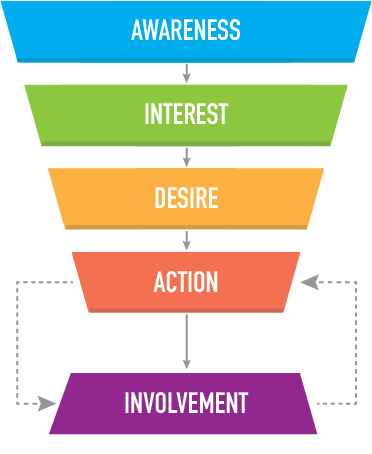
The brand actively encourages involvement. Involvement stimulates additional actions. Those actions create opportunities for deeper involvement. And around we go.
And the additional action does not necessarily have to be a repeat purchase. (Although that’s delicious.) Sometimes it’s participation in an event. Sometimes it’s sharing content, or offering a testimonial, or recommending the brand, or simply choosing to stay connected in various ways. But here’s the quiet part that I’ll say out loud. Continued involvement can reinforce preference, reduce perceived risk and ultimately create deeper trust. Which implies that future actions may not require the same journey through awareness/interest/desire. The relationship itself has changed, and illustrates that nice, neat, linear funnels are not so linear after all.
I’m not suggesting we abandon the traditional funnel. I’m suggesting that we finish it, and avoid ending with a splat. Because the job of marketing isn’t simply to move consumers from awareness to action. It should be to create and sustain valuable relationships that encourage consumers to keep acting, interacting, participating, advocating, and yes, even keep purchasing when that’s appropriate too.

