Super Bowl 60 Grins and Groans

Congratulations to the Seattle Seahawks on their dominating performance over the New England Patriots. And a special shout-out to Charlie Puth for a stunning performance of the national anthem. Wow! If only the advertising could reach such heights.

THEMES
While stuffing your ads full of celebrities is always a Super Bowl theme, this year didn’t deviate from that path. It was a bit much, and in most cases, did not really serve the spots very well.

AI seems to have pushed out automobile advertising. I counted six (seven if you count the Alexa offering with Chris Hemsworth?) spots that featured AI in some way, including ChatGPT’s nod to developers, and some new entrants to help with every day tasks, like creating apps.

Retro also showed up to the party, with Instacart taking the absolute cake with Ben Stiller and Benson Boone and their over-the-top competition for the spotlight. Very funny. Dunkin’ tried their hand at it, too, with less success, and Xfinity inserted themselves into the original Jurassic Park with a well-managed proposition that their services would have “just worked” and avoided some pretty big mishaps. Plus Coinbase rocked a retro-looking karaoke spot for…well, that’s unclear. More on that later.

Speaking of unclear, vagueness unfortunately turned out to be a theme too. A movie promo for Netflix that never mentioned the title. The Coinbase spot, just listing irrelevant lyrics, and poor Poppi soda, talking about “vibes” instead of probiotics.

Also, the Backstreet Boys was kind of a theme this year too (?) I’ll just leave that there. And did I mention that there were talking – make that SINGING – clumps of hair on bathroom floors and in shower drains? Ooof. Makes you miss the good old days of puppy-monkey-babies, doesn’t it?

HONORABLE MENTIONS:
Budweiser returned to form with a coming-of-age story of a Clydesdale foal and a clumsy eagle chick that both grow up to become symbols of Americana. They generally don’t miss the mark with these life-on-a-farm vignettes, and this year was no exception.

Google Gemini let us in on a quiet conversation between mother and child while looking for a new home, and using Gemini to visualize the space in new ways. Their banter is sweet and sensitive. And the platform shines because it’s proven right before your eyes. For years, Google has always managed to humanize their services (even paid search) with a deft and elegant touch. Well done.

HIMS and HERS probably made the most significant statement of the night, starting out by saying “rich people live longer.” And then doubling down with the line “the wealth gap is a health gap.” Then they hit it out of the park when they wrap the idea that personalized science is in reach for everyone, punctuated with the line, “Now that’s rich.” Wow – now THAT’S a statement, and a great way to get 99% of the country to at least pay attention. Gutsy move, and I think it paid off handsomely.

GRINS:
The best ads of the night all have something in common, which is that they take a simple concept (which is usually a basic, un-exciting value proposition) and inject it with drama in some way to make that boring-ish platform an exciting new way to understand the brand. All of these did that very well this year. Here are my top three:

Apartments.com/Homes.com starts with their basic selling proposition: “with millions of listings on our platforms, you’re going to find virtually any place you can live.” Then, they set up the way in to the concept: it would be easier to just find the places you CAN’T live. Then, hilarity ensues when they dramatize those “you can’t live here” locations: a tarmac at a busy international airport, a de-commissioned Soviet space station, the Mariana Trench, and so on. There’s a clear path here to successful advertising, which is to dramatize the benefit, or in this case, dramatize the opposite. Strong work here for sure.

Grubhub
Sometimes, the best ideas are the simplest ones. And no brand demonstrated that better than Grubhub. They took a bland boardroom idea about not passing on delivery fees to consumers and turned it into an elegant, funny, villainize-the-fees sendup. The brand joins us as partners against a common and bothersome enemy. (Smart.) It doesn’t hurt when George Clooney sits at the head of the table and says “we’ll eat the fees.” The reason I love this spot so much is for its SINGULARITY. One idea, clearly articulated, then exceptionally well-executed.  A winner in my book.

State Farm wins the night with their Super Bowl spot, spoofing “halfway there” insurance with Danny McBride and Keegan-Michael Key clearly explaining that you’d be “livin’ on a prayer” with their insurance to Hailee Steinfeld. The spot was great, but so were all the ancillary teasers that they did both online and on sneaky TV buys leading up to the game. Of course, a Jon Bon Jovi cameo at the end doesn’t hurt and Steinfeld seals the deal when she turns to a State Farm billboard and simply utters “I should have gone with State Farm.” Fun, over the top, deliciously comedic performances, (I’d love to see the outtakes for this) and a clear and simple proposition. They drive off into the sunset (that’s the victory) and the State Farm Guy says “stop livin’ on a prayer and get State Farm.” This is big-league-level Super Bowl advertising, well-executed, well-acted and well-delivered.

GROANS
Now, if taking your core value and dramatizing it in some way is a smart path for successful Super Bowl advertising, then the opposite is true when you either a.) don’t state your value proposition very clearly or b.) don’t explain why there’s value in choosing you. A lot of spots fell flat in this regard, including these.

Ritz crackers had the basic punch list of a Super Bowl spot: get a bunch of celebrities. Check. Put them on a beach and have a party. Check. But then…what? We’re “salty” and don’t want to go to the party? Sure, Jon Hamm delivers a couple of brand points when he says “they do have Ritz crackers, though…that salty buttery flavor…” And…that’s it. Oh, and then Scarlett Johansson shows up on a jet ski. Bowen Yang is almost always funny, but the script here just made him an unclear, even unlikable character. The problem here is that Ritz do not come out as the hero, nor do the characters turn out as the heroes once they decide to join the party. It’s like they positioned Ritz for “other people,” which is the exact opposite of a brand directive, don’t you think?

I don’t even know what Squarespace was trying to accomplish with their commercial. The ad seems to focus on the main character not being able to secure a vanity URL, and then being frustrated by that. (Also, why does she live in a castle on a remote island?) But that’s not the Squarespace proposition anyway. I didn’t understand this at all. Someone just got enamored of the idea of having Emma Stone and director Yorgos Lanthimos do their spot and then seemed to forget what people know and understand Squarespace to be. (A template-based website building platform.) Now…if the ad was designed to show that Squarespace now offers domain registrations, (do they do that now?) this was also the exact OPPOSITE way to describe that. (She can’t secure emmastone.com throughout the spot and smashes laptops in frustration.) Basically, Squarespace dropped like $10 million to do a very nice commercial plug for GoDaddy. Head-scratcher for sure. Side note: director Lanthimos also did the Grubhub “Feest” spot.

Coinbase
Sure. Everybody wants to steal some headlines for doing something downscale, and maybe even outrageous. Remember the floating QR code or Crowdstrike’s “western” theme in the  last couple of years? This was just weird. I’m not sure how “rock your body” lyrics relate to a cryptocurrency platform. Are you? Please explain it to me. Note to future Super Bowl advertisers: show this first in your strategy meetings and then explain to everyone, “we’re NOT doing this.”

So…what was your favorite? I’d love to hear.
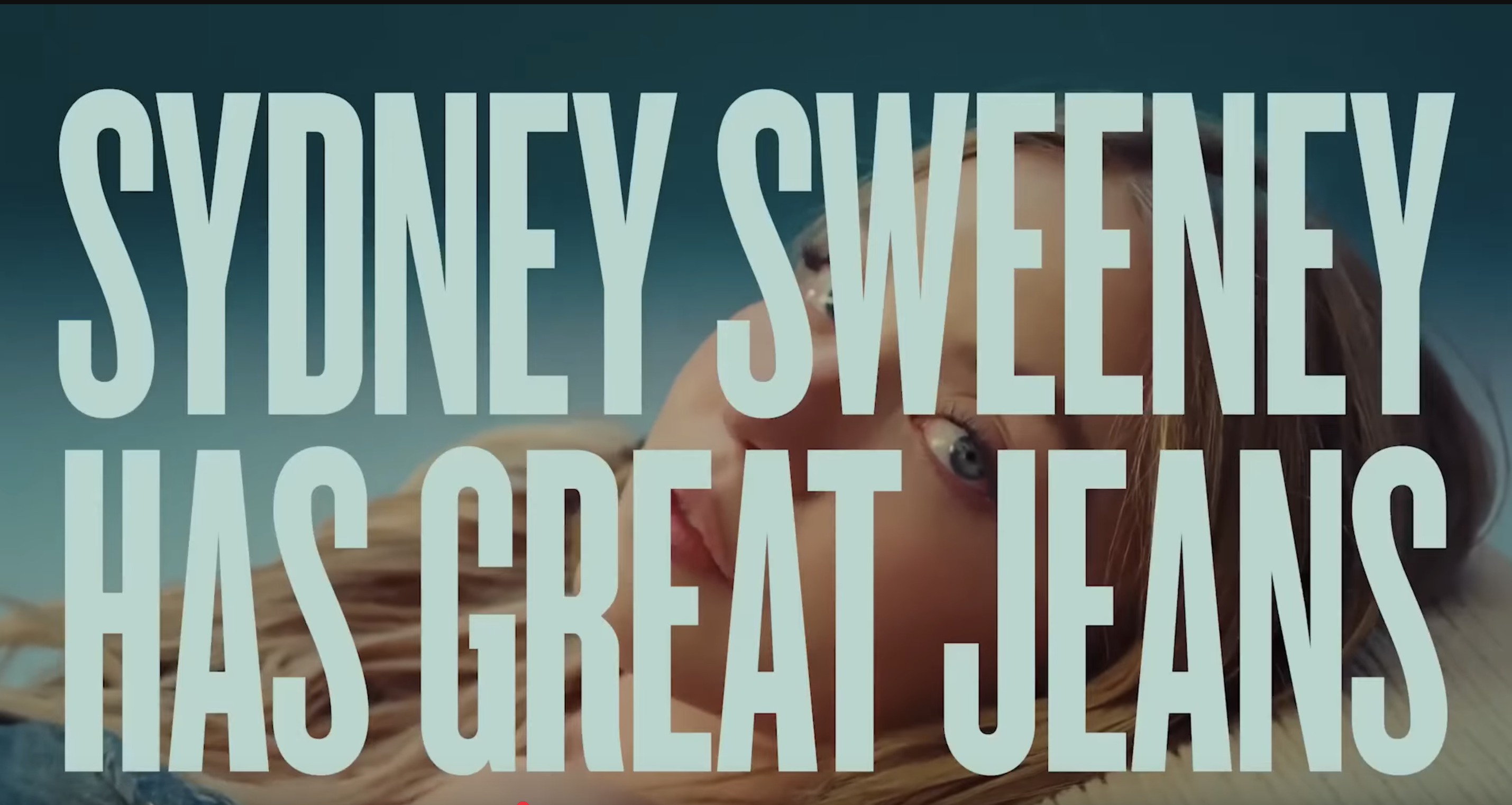
American Eagle and Sydney Sweeney: massive marketing mileage from meh advertising.

American Eagle Sidney Sweeney advertising image

A lot has been made over the recent American Eagle ads, called “great jeans,” featuring the actress Sydney Sweeney. And the question is, of course, why?

The advertising itself is pretty meh. And that’s not a knock on the creative or production teams. I just mean it’s super simple, mostly one-shots, no effects, no music bed, etc. Just stripped down actor-on-screen-reading-lines stuff. And Sweeney demonstrates no range as an actress – it’s almost a staged testimonial. The “big idea” was leveraging a pun on the word “jeans” to overtly imply “genes.” Okay, not earth-shattering, but not altogether a terrible way in.

It also affords American Eagle the opportunity to call their product line “great,” under the auspices of the pun construct. And the spots (there are at least four :30 versions, including one where she is shown auditioning for the part,) are simple showcases for her body shown in double denim. I’m much more surprised that the blowback wasn’t from the fashion police. Eeeeek!

Sweeney’s primary appeal, to put it kindly, is not in her eyes, nor in her hair (which was almost purposefully styled to look un-styled for these shoots,) nor is it her vocal fry let-me-be-sultry half-whispers. But that appeal was hardly leveraged in any of the spots. So it’s not overtly sexualized.

And any comparisons to Brooke Shields’ turn in Calvin Kleins from the early 1980’s are unwarranted. Sure, the American Eagle ads may be derivative, (attractive young woman alone, lying on the floor, talking directly to camera in and about her jeans,) but Shields was an akimbo nearly six feet tall 15-year old uttering lines that she probably didn’t fully understand to be as provocative as they were. “What comes between me and my Calvins” is far more suggestive and dangerous than a nearly-28-year old independently wealthy, 5’3” actress/producer reading a script whose impetus is a pun on the word “jeans.”

But then, there was no global public forum back in 1980 for moral critics—or heads of state—to air their grievances and/or share their hot takes. The wrong voices have taken over the conversation. And much of it is helping American Eagle get far more mileage out of this campaign than they likely would have otherwise.

In fact, were it not for social media, almost nobody would be talking about these ads, except for maybe the VIP tier of the Sydney Sweeney fan club. On one hand, you have some virtuists (not a word, but if Shakespeare can do it, so can I,) calling one of the ads “racist” and “eugenics signaling” (not kidding) because Sweeney refers to her jeans/genes being blue. (And because she’s Caucasian. And has blonde hair.) Nowhere in the script does it say anything about that making her superior or preferable. You want a script gone awry? Try on Dove’s “white is purity” debacle from 2017. Oooof.

Are there legitimate concerns that AE is showing a skinny white girl in their ads, instead of someone of color, or someone who is more representative of the average American woman in terms of size? Perhaps. According to multiple—and conflicting—sources, the average woman’s jean size is somewhere between 12 and 16. AE chose to ignore that, and opted instead to feature a size 2 or 4 Sweeney. They did it not to be exclusive, or dismissive, but to capitalize on her ascendant stardom and her significant influencer status as a social media personality with a hefty following. The ads are neither racy, nor racist. They’re just aimed at the average/likely American Eagle consumer, who happens to be young-ish and caucasian-ish, and probably identifies with or admires Sweeney in some way.

I also like that American Eagle responded to the criticism. An Instagram post from the brand reads:

“ ‘Sydney Sweeney Has Great Jeans’ is and always was about the jeans. Her jeans. Her story. We’ll continue to celebrate how everyone wears their AE jeans with confidence, their way. Great jeans look good on everyone.”

[Sidebar to all social media community and brand managers: note how the focus is more on the category (jeans) than it is on the brand (AE.)]

In many ways, the conversation has become the campaign. The advertising was just the spark that lit the fire. While that’s exciting, it’s also impossible to control…so AE ought to enjoy this, and be sure to not add any additional accelerant.

Is there a moral to this story? Is there a story in this story? I think so. But it’s far less complicated or sinister than most are making it out to be. I think American Eagle shelled out a lot of money to hire Sydney Sweeney, did some OK advertising, and has gotten tons of marketing mileage out of this, in just over a week. In our business, that’s a big win. And no matter what you do when you’re advertising, you will never please all of the people all of the time.

But remember. American Eagle is a for-profit apparel brand. And their target audience is not (and never was) “all of the people.”

Super Bowl 59 Grins and Groans

Super Bowl 59 is in the books, and congratulations to the Philadelphia Eagles on an outstanding performance. If you were in the mood for a dominating defensive performance, you had a very good evening. If you were in the mood for great advertising, well…you certainly got a LOT of ads, but not sure if they were all great. Some high points, some low points, and some decidedly weird points. Let’s break it down.

Themes
Like last year, a lot of advertisers turned to the meta approach for their spots. This is when the ad is about making the ad. Dunkin, Homes.com and UberEats all took this approach, and it can be really funny (like the way Homes.com doubled down on the “it’s the best” meme with Morgan Freeman,) or it can get a little obtuse, like the Dunkin’ ad with actor Jeremy Strong trying to get into character by immersing himself in a barrel of coffee beans. (Right?)

Facial hair was another theme in this year’s ads. (There’s a sentence I never thought I’d write.) Both Pringles and Little Caesars decided that their best angle would be to have men’s facial hair – eyebrows and mustaches – fly off for some odd reason. Some of the gags were humorous (the caterpillars chanting “we’re not worthy” to Eugene Levy’s eyebrows made me chuckle,) and I think Pringles did it with a bit more context. After all, there’s a giant mustache on every package.

A surprising few amount of spots this year from car manufacturers. Polestar showed up in the pregame show, but not as an official Super Bowl commercial. Only Jeep and Ram appeared this year, which is odd, given the history of this game and some of the iconic spots that have run. If you’re counting, we had more spots with Matthew McConaughey than with cars.

HONORABLE MENTIONS:
A few ads played it safe, and still managed to deliver decent brand messages. Orlando Bloom and Drew Barrymore did a cute tete-a-tete on European vs American holiday/vacation expressions, and it painted MSC Cruises in a similarly cute light. Homes.com played at the idea of saying they’re “the best” while their legal counsel advised them that they can’t legally say that. Uber Eats continued their “the NFL is trying to sell you food” conspiracy theory with origin stories, and it gets especially funny when Martha Stewart laughs hysterically that the Super Bowl venue is “named after a salad!”

The last couple of years, Jesus has made an appearance at the Super Bowl, but this year’s was a bit more special because he brought along a better soundtrack. Note to aspiring creative directors: having Johnny Cash sing Depeche Mode in your spot is ALWAYS a good idea. Hat tip to Jesus’ creative team. Hailee Steinfeld and Wanda Sykes teamed up for a smart PSA that made me look, er, notice, er, appreciate their, I mean ITS, value. It’s for Novartis, and it’s aimed at getting more women screened for breast cancer. And Dove scores another hit with a female empowerment spot that was punctuated by the line “let’s change the way we talk to our girls.” Nice.

While we’re mentioning some ads, we have to talk about Seal playing a, well, seal in the Mountain Dew spot. If facial hair flying off faces, and tongues flying out of mouths (more on that in a moment,) wasn’t weird enough, a seal with the face of Seal, singing a jingle to the tune of “Kiss From a Rose” was basically a 12 on the weird-o-meter. Fun? Sure. But about 50 million Americans probably had a terrifying dream about that one last night.

GRINS
First off, golf claps to Weather Tech for finally listening to their agency and doing a concept spot instead of their usual “here’s a view of our factory where we prove they’re made in America” pandering. The grannies-go-wild approach offered lots of good laughs, and then quietly made a nice plug for their spill-proof floor mats. Much more memorable than the last few years.

Google Pixel 9 really tugged at the heartstrings with their dad-and-daughter vignette disguised as a “guy turns to Gemini AI for help preparing for his job interview.” The reason this worked so well is that it contextualized the product benefits while letting us in on the backstory. Really well-conceived, and really well-produced. You almost never want to go soft-sell on Super Bowl, but Google almost always has, and almost always wins.

Liquid Death literally made me LOL with its “drinking on the job” spot. Pilots, surgeons, school bus drivers, even the cops are pounding Liquid Death, and to an awesome theme song. The company has disguised their filtered water to look like small-batch beer cans, and this is exactly why: so they can misdirect and manipulate you right into the big reveal. Good stuff. Spots end with bold type: “Don’t be scared. It’s just water.”

It just isn’t Super Bowl without a Budweiser Clydesdale spot, and this one, “a horse walks into a bar,” is by far one of their best ever. It’s great storytelling, with virtually no dialogue. Our hero is faced with a choice, has to overcome difficult challenges along the way, and somehow, some way, prevails. For decades, Budweiser hasn’t even tried to sell beer with their Super Bowl commercials…they sell this version of Americana on which we can (almost) all agree.

Hellmann’s went retro with their “When Harry Met Sally” sendup. It features Billy Crystal and Meg Ryan back in Katz’s Deli, and wouldn’t you know it? Meg has another orgasmic experience (this time it’s REAL!) thanks to a shmear of Hellmann’s mayonnaise. Targeted at Gen X? You bet. Wrapped in a bow for Gen Z? Sure, and that’s why you have Sydney Sweeney deliver the punchline. So much better than their last several years of Super Bowl spots, which were big groans for me. Oh, and Hellmann’s signs off with the apt line “It hits the spot.”

Doritos proves that when you crowdsource your advertising (through their thankfully resurrected “Crash the Super Bowl” campaign,) really good things can happen. Here, an alien ship comes to Earth and tries to take a guy’s Doritos away. He fights them off – sort of – and then, by chance, the Doritos destroy the alien ship! The alien survives, and he/she/it (?) and the guy enjoy the chips together. What’s great about Doritos is that they ALWAYS put the brand front and center, and the motivation is consistent: get your hands on some Doritos.

I think my favorite of the night (and this is a bit of a critic’s pick, I’ll admit) was the ChatGPT “dots” ad. Again, no voiceover, just graphics, and magnificent ones at that. All of it based off ChatGPT’s “dot” prompt. So it’s a little “hello world,” and a little “IYKYK.” Anyone who has used ChatGPT will recognize the dot. During the spot, the dots sync up to go and create all kinds of interesting images, symbolizing progress through time, from fire to the wheel to the steam ship, to walking on the moon, to dial up modems to now. And then it delivers the line “all progress has a starting point.” I like this most of all. It says “AI is not the be-all and end-all. We’re just getting going, and let’s see where we might go from here.” A bit of a departure for Super Bowl advertising, but a simple and clear way to illustrate the power and potential of this particular AI engine.

GROANS

RED BULL: When I saw this spot come on, I immediately recognized the illustration style, and the classic setup. Boy penguin says to his father “I figured out how to fly!” Dad, suspicious, says “oh…really? And how exactly are we going to do that?” The boy responds that all they have to do is drink Red Bull, and they’ll be able to fly because, after all, Red Bull gives you wiiiiings. Up to this moment, this is a typical Red Bull spot. But then, the boy can’t fly, because the Red Bull he attempts to drink is frozen. (They’re penguins and it’s 40 below zero, according to Dad.) So…the product doesn’t work. The benefit is never realized. And we’re all disappointed. They try to make us think they’re in on the joke, because the voiceover says Red Bull gives you wings, “but only if you drink it.” No. No. No. Don’t do that.

SQUARESPACE: Look, I get that it’s hard to sell tech enablement as a Super Bowl spot. Squarespace is a platform that helps do-it-yourself-ers build and maintain their own websites. Last year, they tried aliens…with Martin Scorsese directing and starring in the spot. The year before that, it was an obtuse take on “the singularity” with Adam Driver. In 2022, they actually made a really GOOD spot with Zendaya, who portrayed Sally, who sold (you guessed it,) seashells by the seashore. That spot followed a simple narrative. Sally was not doing well. Then, she built a website with Squarespace, and things really took off! That’s generally how we like to portray our brands in our advertising: as aids in the hero’s cause.

This year, however, we have actor Barry Keoghan (the guy who went full frontal in Saltburn,) riding a mule through the Irish countryside, whipping laptops at people like a sedated and psychotic newspaper delivery boy. But they’re laptops! And they’re dangerous! And one smashes through the window of a pub. (Also, and even stranger, hardly anyone reacts to any of these near-death assaults.) And how, exactly, does this connect me to any understanding of their basic offering? Most Americans could hardly make out the brogue, let alone the value proposition.  

COFFEE MATE: So, let’s give props to Coffee Mate for shelling out the almost $8 million dollars and producing their first-ever Super Bowl ad! (Applause.) Aaaaand…let’s give it up for Shania Twain writing and producing a new song specifically for the commercial. Yay.

However, that song starts with the lyric “let’s go tongues.” And the young man in the ad, who has just had a taste of cold foam after adding it to his cold brew coffee (I guess?) goes into a trance, where his tongue (yes, you heard me right,) does various dances, makes heart shapes, plays the chimes, high-tongues (I just wrote that) the Coffee Mate logo, and then – are you sitting down? Jumps out of his mouth. And spins around in the air while fireworks go off, and then plunges back into the young man’s mouth as he awakes from this fantasy. Just as a reminder, we’re talking about his TONGUE!

Then the young man and his pal start chugging (question mark) the Coffee Mate foam together, as we cut to the closing shot of the line “a little foam a lotta fun” spelled out in, you guessed it, foam! I could have lived a very full life without having seen that. And hopefully, I never will again.

So…what were your favorites? Let me know in the comments.

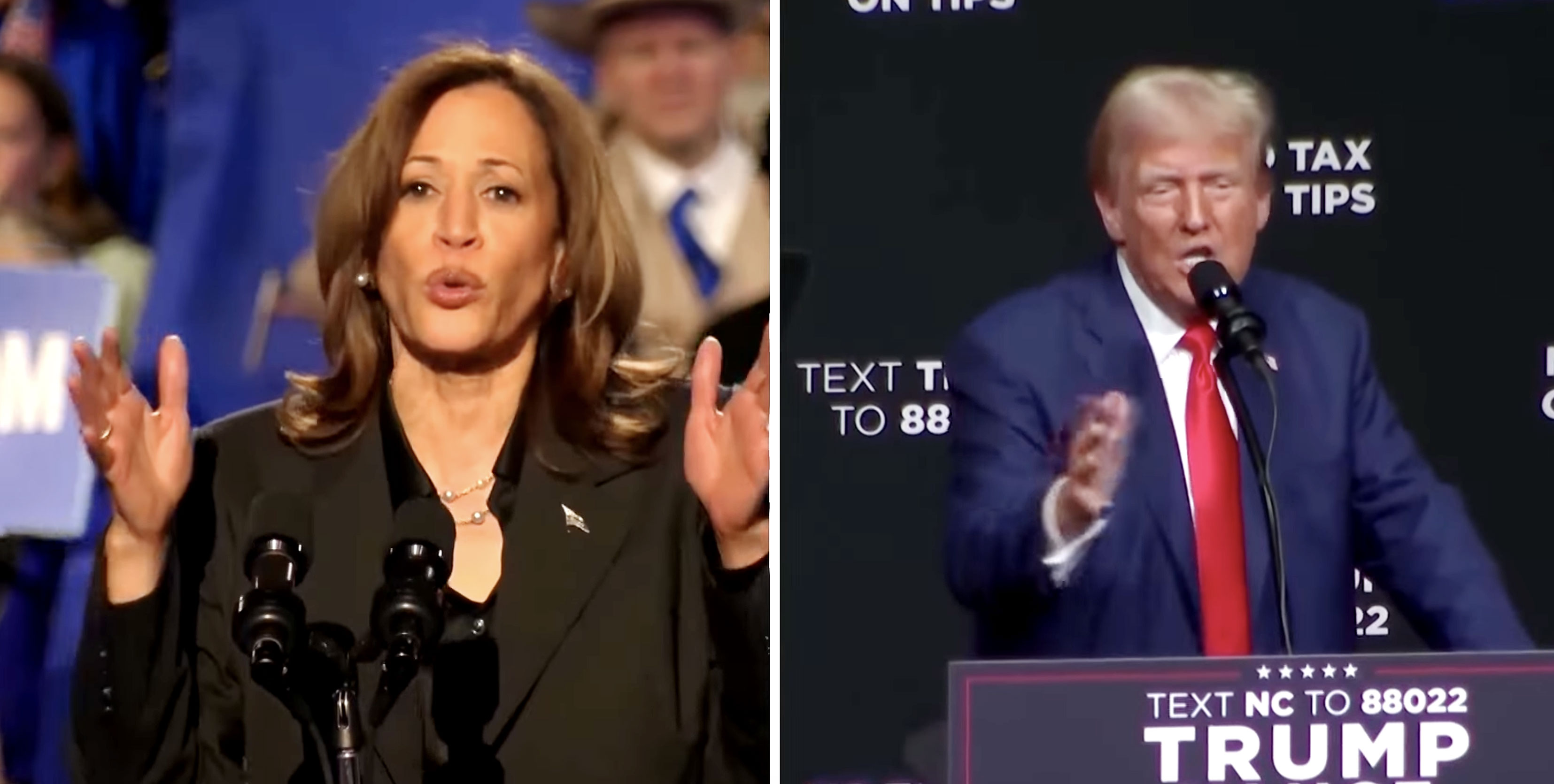
You want good* advertising? You won’t find it in the election media blitz.

Don’t you just love advertising in presidential election years? Aggressive, repetitive, and often un-creative ads in every commercial pod, whether you’re watching football, soap operas, or game shows. ‘Tis the season to be mud-slinging.

In the general election, The New York Times has reported that more than $500 million will be spent by the Harris and Trump campaigns, and that the Super PAC supporting Harris will pour $187 million into television and radio alone in the final 49 days. I’m not great at math, but that’s almost $4 million PER DAY from September 17th through November 5th. That’s not counting digital, social, texting, robo-calls, and whatever else each campaign’s AI-driven algorithms are cooking up.

But what about the ads themselves? Is there any tangible messaging going on beyond the “don’t vote for the other team, because they’re terrible” tropes? Sadly, not much.

The Trump campaign has struck gold with one spot called “They/Them” that’s running ad nauseam across cable networks, which focuses on a (decontextualized) message about Harris supporting gender reassignment in prisons, with the implication that American taxpayers are footing the bill. It ends with the line, “Kamala’s agenda is they/them. Not you.” However you feel about the issue and the message, (and the malevolent editing,) you gotta admit that’s a darn strong line to punctuate the spot. It’s creative and pithy, and rings a potent dog whistle for conservatives who bristle at all things trans.

Harris fires back with a spot focused on Trump and his anti-abortion influence, and his implicit ties to the mercurial Project 2025. The spot is called “Who He Is,” and is (again) focused on her opponent, and his previous (and likely future) inclinations as it relates to national policy.  The compelling aspect of this spot is that none of it is conjecture – Harris is highlighting actual changes that were affected during Trump’s actual presidency. It invites the viewer to draw their own conclusion (and the creative directors are betting on this,) that “if he did it before, he’ll do it again.”

So, what’s wrong with this advertising? Some would argue that the ads are fine, claim “that’s just what they do,” and that politics simply brings out the worst in strategists and creative directors. Hey, it’s a limited run, so attack, attack, attack, and it’s definitely rated R for rubbing just about everyone the wrong way.

But that isn’t the way most brands compete, is it? Most brands want to use the precious time they have with the consumer to connect to something positive, and special, and DIFFERENT about that brand. Most brands want to say good things (about themselves,) and let the consumer draw their preferences from there. Geico, as an almost on-par example, (they spend almost $3 million per day in advertising year-round,) doesn’t spend their time shitting on Allstate or State Farm. They use that time and all that money to drill simple, memorable messages into consumers’ minds: 15 minutes could save you 15% or more; so easy a Caveman could do it; etc.

Some strategists argue that you should NEVER mention your competition in your ads, because you’re essentially using YOUR media budget to promote THEM (to some degree.) Tell that to Coke v. Pepsi, or McDonald’s v. Burger King, or Apple v. PC. There are exceptions to every rule.

But marketing IS a conversation, and a campaign is an extended conversation that happens in short spurts over long periods of time. Brands use 15 or 30 or 60 seconds to get you to think something, believe something, and maybe even to do something over the course of several months or more. If they spend all their time talking about the other brands, what would you think about them? And more importantly, would you think about them at all?

That’s what’s disappointing about this unprecedented time in marketing history. The most money ever spent on presidential campaign advertising, and all we’re doing is rejecting the rules that all of us are taught about advertising, especially about being memorable, and about never misleading your audience.

I think we can do better. And I’m looking forward to November 6th, when we can go back to talking lizards, bunnies banging drums, and people getting their hands stuck inside potato chip containers. Ain’t advertising great?

Super Bowl 58 Grins and Groans

Super Bowl 58 has come and gone, and two things are evident: Post Malone is a pretty darn good singer, and the Chiefs are apparently a very good football team. [Congratulations to them and their fans on being the first team to win back-to-back championships since the New England Patriots nearly 20 years ago.]

Speaking of back-to-back, it appears the advertising bowl was a repeat of last year as well. Nothing risky, nothing wildly interesting, nothing off the wall but really smart. You like to be WOWED with Super Bowl advertising, and – for the second year in a row – I suspect there were not a lot of “wows” being uttered in living rooms across the world.

Some themes that emerged last night:

Religion is apparently making a comeback. A total of five spots were dedicated to some form of religiosity: two spots for Jesus, a spot reminding us to stand up to Jewish hate (sad that we have to be reminded of that,) the annual pitch for Scientology, and Mark Wahlberg hawking Hallow, a new prayer app. (Sad that we need an app for that.)

Repetition was a theme last night as well. And this I like. If you’re trying to get some of the 115 million+ people (in the US) watching the game to REMEMBER you, repetition is a pretty strong tool. And if you can repeat creatively, all the better. A few brands managed to pull this off last night, some with more efficiency than others. Kate McKinnon’s cat meows over and over again, but it sounds like “mayo” for Hellmann’s; and Aubrey Plaza continually reminding us she’s having a “blast” for Mountain Dew; both were fairly effective. But Arnold Schwarzenegger using his own accent as a comic tool when he repeats the word “nay-bah” for State Farm and their “like a good neighbor” tagline was both effective AND funny. And Doordash really hit the repetition ball out of the park with their spot, continually repeating the word “dash” to great effect, while reminding viewers of the actual brand name in the process.

Meta, (the concept, not the company,) was also a theme. We saw a lot of spots using the “let’s make a commercial about making a commercial” theme. It’s a strong device, given that this is the biggest platform on the planet for commercial-making.

HONORABLE MENTIONS:

BetMGM bet on Vince Vaughn doing Vince Vaughn things, and it worked. Throw in Tom Brady and Wayne Gretzky for the typical Super Bowl celebrity-stuffing and you get a pretty good spot.

Ken Jeong is just hilarious, and his turn as a recently-unfrozen-cryogenic-experiment was a laugh. When he’s told it’s Popeye’s, he asks “the sailor man?” Loved it, and sincerely hope that was ad-libbed.

Christopher Walken being hounded by people attempting Christopher Walken impersonations is always welcome. And BMW wrapped it up nicely with the line “the rest are just imitations.”

Reese’s probably gave us the most fun spot of the night with “big change.” Narrator having fun with a roomful of people having outsized reactions – classic fun, and pretty memorable.

Poppi soda made a nice, simple, smart statement about their soda being better than what we all think “soda” is. Less sugar, prebiotics, cool flavors. Nice.

PlutoTV did a nice job of growing couch potatoes in an entertaining spot for their streaming service. They had a good gag, and took it all the way to the farm.

And let’s face it. Chris Pratt kinda does look like the Pringles guy, right?

GRINS:

T-Mobile has been crushing it on Super Bowl ads the last couple of years, and they kept it up with two fun spots. They love singing in their commercials, and this year we got Jason Momoa showing off his pipes and some feats of acrobatics. And their “audition” spot, a Bradley-Cooper-and-his-mom spot, which featured cameos by Laura Dern, Patrick J. Adams and Gabriel Nacht of “Suits” fame, Common, and Jennifer Hudson was entertaining and smart to boot (the idea is no one has to “audition” to get T-Mobile’s Magenta Status VIP treatment.)

Last year, Dunkin’ went all in on the Ben Affleck/Jennifer Lopez thing, and they’ve continued the story this year with Ben trying to break into the pop music business with his group “The Dunkings,” which also features Tom Brady on keyboards. Probably not the best brand-building spot we’ve ever seen, (they’re going all in on the Boston thing,) but it’s cute, and the self-effacing turn from Matt Damon made it really funny.

Disney+ put in a surprisingly good turn this year with their “well said” spot. Just plain typewriter text (not quite Courier, but close,) on a white screen, scrolling through some of the more memorable phrases in Disney history, including “who’s the fairest of them all?” and “the Force will be with you…always” and “To infinity…and beyond.” Some might call this lazy. I saw it as a way to break through the clutter (and a noisy living room hosting a Super Bowl party) and deliver something powerful. Winner of the “sneaky good” category.

NFL made some important statements about bullying and mental health in two semi-PSAs/semi-self-congratulatory spots. But their full length spot, featuring Quesi, a young boy from Ghana with big NFL dreams, made a salient point: “it doesn’t matter where you’re born, as long as you’re born to play.” That line is delivered by Osi Umenyiora, a former NFL player of Nigerian descent. The NFL is committed to growing the game internationally, and this spot shed light on that initiative with warmth and fun and facts. Well done.

One of my favorites of the evening was this spot for CeraVe, another meta take on commercial-making, where quirky actor Michael Cera is pitching the dermatology board at CeraVe skin care to use him as their spokesman. The screen cuts to bold text (love that Din Pro font family,) that says “Developed with Dermatologists. Not Michael Cera.” It manages to deliver silliness, seriousness, a singular brand platform that their products are indeed developed by dermatologists, name recognition and memorability all at once. Exactly what a Super Bowl spot should do.

This spot from Verizon, featuring Beyonce trying to “break the Internet” was a masterclass in over the top advertising. First off, she’s wildly popular. Second, she pretty much HAS broken the Internet over her career. This spot features her going to outrageous lengths to TRY and break the Internet, but Verizon’s incredible coverage never wavers. A great performance by Beyonce, a hint of self-effacing humor shows she doesn’t take herself THAT seriously, and lots of smart and timely pop culture references. And that she’s using it as a platform to tease/drop new music is even cooler.

I think one of the best spots of the night was made by Bud Light. A return to form for this brand, (who has been in the news the last year or two for all the wrong reasons,) which is to be big, brash, unapologetically silly and fun. They take a simple concept, stretch it out as far as it can go, add a couple of big celebrities (Peyton Manning and Post Malone, with a cameo by Tyrannosaurus Rex,) and execute the heck out of it. The perfect recipe for really strong Super Bowl advertising.

MY WINNER:

Dove returns with another smart ad that’s tactfully and intelligently delivered. Using the “It’s a Hard Knock Life” song, we see a montage of girls flubbing it at sports from gymnastics to ice skating, basketball and softball. And even though they do, they smile and press on. The text on the ad reads “the knocks don’t stop girls playing sports…low body confidence does.” Wow. BANG. The ad gets quiet, and we get a peek at a young girl in a bathing suit looking at herself somewhat disapprovingly in a mirror. Text reads “45% of girls quit sports by age 14…together we can keep them in the game.” And we’re encouraged to “Join the Body Confident Sport program.” This brand hardly sells soap anymore – they sell esteem and female empowerment and tolerance and acceptance and…and..and…Great work as usual.

GROANS:

The Google Pixel ad was a good moment. Lovely story of a semi-blind man named Javier who is now able to capture photos on his phone with the help of the phone’s AI assistant. I liked it initially, and the final scene was touching. It’s also technically good advertising because it focuses on a singular feature. I just think that accessibility is about so much more than taking selfies, and I thought this ad undercut the mission a little bit.

The Nerds Gummy Clusters ad was just kind of confusing. It features Addison Rae, a Gen Z singer/influencer, and a blobby Nerd candy (I guess?) recreating the iconic scene from Flashdance. It just felt weirdly mistargeted, as I’m not sure how much of the Super Bowl audience under 40 would even know or remember Flashdance. Compare this with the Skechers ad using Mr.T as a conduit – at least those sneakers are targeted to an aging Gen X audience that would actually know who he is.

All of the Homes.com ads (there were three of them at least,) went too far into the gags without clearly making the points they were hoping to deliver. The ads say some really good things about the brand like “gathering up close and detailed information on neighborhoods, and hiring top experts to get you insider info on local schools…” All good stuff, but the core messaging gets blurred out in the outlandish mayhem designed to be funny. They further confused the point by introducing Jeff Goldblum into one of the ads – he’s the Apartments.com spokesman – for comedic effect. The only effect it had was an unclear value proposition, poorly delivered across several ads. The parent company, CoStar Group, reportedly spent $35 million on all their ad exposure. Yikes.

Oreo delivered a big-budget ad with big scenarios throughout history left to chance, with decision-makers deciding on which way to go by “twisting on it.” Yeah – they twist their Oreo cookies, and if the cream is on the left, homo sapiens split off from the dinosaurs and survive the asteroid hit that kicks off the ice age. If the twist reveals cream on the right, we get boy bands and the Kardashians. Ugh. I always like the let’s-show-the-product-in-action approach, so I’ll submit that as a plus. But “let’s twist on it” sounds forced, and it looked that way too.

I know it’s sacrilege, but is it okay if I didn’t like the Martin Scorsese-directed spot for Squarespace? It just seemed like more of a commentary on people’s obsession with smartphones, and made exactly ZERO mention of any brand benefits. Squarespace is a website that makes it easy to build websites, and it’s never mentioned. Not once. And the only ones who use it are aliens trying to get noticed? Then they end with the tagline “A website makes it real.” Makes WHAT real, exactly? Meh.

And probably my biggest groan of the night was Crowdstrike’s attempt at a “big” commercial for the Super Bowl. It’s set in the Wild West…in the past? Or is it a post-apocalpytic future? Hard to tell. Some people are dressed like it’s 1820. The spokeswoman is standard 2024 every-woman. What the what? And if you’re still watching, she tells the cyborg sheriff (not kidding) that she’s got it covered. Then she proceeds to digitally undress the invading virus-borgs (also not kidding) so they’re embarrassed and run away. I think I’ve got that right. What a confusing mess.

But hey, at least we didn’t have to watch any faux-patriotic spots from Weather Tech, right? What were your favorites? Let’s hear it in the comments.

Until next year!