Creative or Re-creative?

“Imitation is the sincerest form of flattery.” So the saying goes. But when that imitation becomes a direct lift of concept and content, is it flattery or is it something else? This question is begat with a new ad for an organization called GrassIsNotGreener.Com, who recently ran a full page ad in The New York Times to caution against widespread legalization of marijuana, and protest recent supportive editorials.

The ad uses a headline comprised of the two words “Perception” and “Reality.” [If it sounds familiar, you’re probably over 40 years old and in the marketing business. More on that in a moment.]

Cleverly art directed, the “perception” typography sits adjacent to an inset head shot of a semi-cute 20-something long-haired bandana-wearing stoner dude with a 2-day scruff (just long enough to denote slacker, but too short to pass for intended hipster stubble.)

The “reality” typography sits two inches below, and we see that the main image of the ad is that of a power-suit sporting corporate executive at the head of a board room table. The obligatory wristwatch, broad single Windsor, a rocks tumbler filled with spring water, and the latest quarterly earnings report comprise the modest styling of the shot.SAM_ad_full_page_NYT_11.55x21_31Jul14_FINAL-1

The copy is strong, and gets to its points quickly and clearly. Not a word wasted, and they took a firm shot at The New York Times along the way. They’re also borrowing a lot of negative equity from the tobacco industry, which is also hinted at in the copy.

All in all, this is a very good ad. It says, “hey…you think this one thing, but there’s another really important thing going on that you may not be aware of…so we’re here to make you more aware.”

Here’s the problem: it’s using a creative concept that’s been done before. And when I say “using,” I mean, damn-near-exactly DUPLICATING a creative approach that was done some 30 years ago. What further complicates this issue is that it wasn’t some obscure little creative execution that no one saw…this was a campaign (props to Fallon McElligott as they were known at the time,) that appeared in Advertising Age, among other publications, ran for a decade, won every major award known to man and other species, and was wildly successful for its client, Rolling Stone. (To add further props, it was a b-to-b campaign, a category in which people are still arguing “you can’t be super creative.” Right.)

RollingStoneVWbus2-640x427

[In case you’re interested, GrassIsNotGreener.com is supported by a group called ProjectSAM, [which stands for “smart approaches to marijuana,”] founded by former government officials and comprised of several medical, legal and volunteer organizations.]

But wait…there’s more. It’s not just that this ad directly lifts this concept. Boyd Communications, based in Shrieveport, LA, used the same (exact) concept for their client CryoLife to demonstrate that most people’s perceptions about age and cardiac valve transplants are wrong. Does it work to crystallize the point? Yes, extremely well. And while there’s nothing new under the sun in advertising, they could have used that helpful, “hey there’s more to know about this subject” approach without using the same exact words, no?
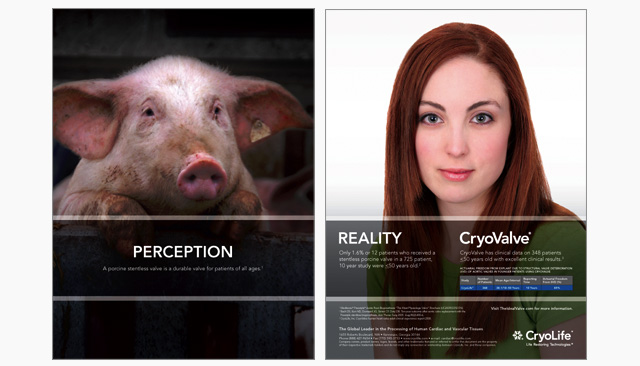
cryolife4

And it’s not like this hasn’t happened before over the last 100 years or so – it has, countless times. Big popular executions and little-known local work gets riffed on and ripped off all the time. Sometimes it’s intentional, and sometimes, strong ideas simply resemble each other.

Advertising – especially creative strategy and execution – is about finding an effective “way in” to consumer perceptions. So when that way in has been paved on the efforts and talents of someone else, is that cool? I’m not sure. But when you use the exact same words, for the exact same ends, that is to say, when your creative is actually re-creative, we may have to start asking the question “what’s the compensation package for credit?”

Super Bowl 2014: Grins and Groans

First off, condolences to the Denver Broncos organization and their fans. That’s what we call a rough day at the office. And for those of you who are fans of Super Bowl advertising, it was kind of a rough night on the couch. Again.

Last year, we had a few “wows” interrupted by a lot of mediocre. Sadly, that trend continued through 2014. And at $133,000 per SECOND, that can mean some rough Mondays for some advertising executives.

SINGLE GRINS:
Radio Shack – good for them for poking fun at themselves as they make their re-rebrand statement. (Remember “The Shack” attempt from a few years back?) Best tweet of the night I read said something like “Radio Shack had to close 10 of their 12 stores to pay for that spot.” At least they’re trying.

Heinz – after sitting on the sidelines (yes, all puns intended,) for 16 years, Heinz returns with a feel-good spot to the tune of “If you’re happy and you know it…” Solid, simple, reminder advertising. The right message for a brand that already owns the category.

Wonderful Pistachios – for a brand that is trying to make hay in a highly commoditized category, Wonderful Pistachios made a strong statement for themselves with two :15s wrapped around the H&M David Beckham spot. They did a great job of getting out of the way, and letting Colbert be Colbert. Especially poking fun at themselves about a “lack of branding.” Really fun, really light, and memorably goofy.

DOUBLE GRINS:
T-Mobile’s Tim Tebow spots were absolutely hilarious, and I thought the most on-target/on-focus advertising of the night. Perfect symmetry between his situation (a national figure without a contract) and their basic brand position (mobile network service with no contract necessary.) He’s a good sport (yep, another pun) for poking fun at himself, the ads had high production and camp value, and I think this was a touchdown. (Ugh, that was shameless.)

Doritos brought high value humor to a crop of commercials that were otherwise meh. Add the fact that the spots were created by contest entrants, and you add a level of intrigue. Congratulations to Ryan Thomas Anderson for the winning entry and the $1 million prize. A second level of kudos to Doritos for matching good advertising with strong social activation, and (you may have missed this) an absolutely cool in-stadium activation: recordSetter got 30 people to don orange ponchos to create “the world’s largest human Dorito.” Pretty effing cool.

BIGGEST GRIN:
Chrysler 200 with Bob Dylan
So this was one of the (very few) spots that was not leaked or teased prior to the game, and it really paid off. Chrysler has embraced Detroit/Americana as a stand-in for the brand, and they have wrapped a powerful message around it. (Remember Clint Eastwood’s “halftime in America” ad? And the Paul Harvey “God made a farmer ad from last year for Dodge?” Yeah, same idea.)

They encapsulate this idea in the statement “Detroit made cars. And cars made America.” Overly patriotic? Sure. A tad pandering? Maybe. But powerful advertising? You bet your ass.

The best part is the finale of the 2:00 triumph, (delivered incredibly by a surprisingly articulate and pointed Bob Dylan,) with this: “Let Germany brew your beer. Let Switzerland make your watches. Let Asia assemble your phones.” Dramatic pause. Cut to Dylan in a pool hall talking directly into camera. “We. Will build. Your car.” Touchdown. Two point conversion. Game over. (Yeah. I went there.)

And now for the GROANS.

WTF GROAN:
Maserati introduces its new Ghibli sedan to America with an overly produced spot about “unleashing monsters” or something. Sure, I get that you can make a “big splash” with a Super Bowl ad…but wasn’t there ANYONE in the room saying “this might not be the best media buy?” And who named “Ghibli?”  If you’re going to introduce a “more approachable” brand extension (the Ghibli starts around $67,000) to an otherwise unattainable line, shouldn’t the spot be more, um, approachable?

SLOW GROANS:
Kia takes a target demographic couple on a spin through the Matrix with Laurence Fishburne in full Morpheus mode. Um, what? Or, rather, why?

Bud Light – Now here’s an instance where the social media leadup was better than the ads themselves. Bud Light’s three and a half minute brand film around the “up for whatever theme” was great. The two spots that got edited out of it…a little disjointed.

Beats Music Service introduces its “we’re better than Pandora” intuitive music service. Sounds like a cool idea. They made a nice spot, riffing on the Goldilocks folktale. Except they chose Ellen DeGeneres. Hmmm…is SHE the target? (Highly doubtful.) Is she RIGHT as being appealing to what we would imagine the target to be? (Still no.) So…why Ellen?

BIGGEST GROAN:
AUDI just completely missed the mark this year with “Doberhuahua.” After such an incredible showing last year with their “prom” spot, they go for the dopey CGI-laden humor trick of a Doberman cross-bred with a Chihuahua. They took their potshots at sappiness with knocks at kennel shows and Sarah McLachlan, and tried to wrap this around the idea that “compromise is scary.” It is. Especially in advertising.

End notes: Other hits and misses…
GoDaddy tried to capitalize on the “real time marketing” concept with a spot where a woman (Gwen) quits her job on live television. Interesting. And better than that gross makeout spot they ran last year. Wheeeew!

H&M’s ad with David Beckham was the first to be truly interactive…for a limited few. Turns out, if you have a Samsung SmartTV, you could have ordered product live through your television. Great strategy for the 327 people who actually own that tv.

Volkswagen’s “Wings” ad starts out as a really smart quality claim. Dad tells daughter that every time a Volkswagen hits 100,000 miles, a Volkswagen engineer gets his wings. Cut to German factory, where white-lab-coat-wearing engineers start sprouting wings. Funny concept, well executed. Major problem with this spot: NO FEMALE ENGINEERS. Not a one. Except that young lady in the elevator who slaps the other engineer. Wrong message to send to the world’s young girls, Volkswagen.

Until next year – keep grinning!

This article first appeared on Technorati.

What were YOUR favorite spots? Post in the comments below.

Bolton, Burgundy and Cheeky Buzz – Auto Marketers Set a New Tone

If you’ve seen the recent round of spots (they ran throughout the fourth quarter of 2013) for Dodge Durango featuring the fictional character Ron Burgundy, you know how good they are.  Crazy good.  (Kudos to Wieden & Kennedy.) They’re stupid funny, with an offbeat wit that perhaps only Will Ferrell could channel in this character composite, a mashup of 70-‘s into 80’s d-list celebrity relics.

Here’s just one of the many spots that were filmed (likely loosely scripted and then ad-the-hell-libbed-out-of by Ferrell) for the campaign:

What’s more intriguing, of course, is that the spots were wildly effective.  According to this article in Autoblog, Durango’s sales were up a staggering 59% in the first month of the campaign. Similarly, after three months of leadup, (the Durango spots were a marketing tie-up to promote the movie inasmuch as they were car ads,) the movie – who some have said didn’t live up to the hype – has raked in more than $108 million dollars at the box office (as of the weekend ending January 5, 2014) against a $50 million production budget.  That’s a profit, yo.  And it might have something to do with the more than 20 million views the spots have received on YouTube.

In a strange coincidence, another auto marketer (Honda) aligned with its own interesting character to help bolster holiday sales.  In the fourth quarter of 2013, Honda ran a campaign of spots under the “Happy Honda Days” theme featuring Michael Bolton, a bit of caricature himself, something of a mashup of 80’s/90’s pop stardom realism.

In the spots, the VO asks, “what does it feel like to get a great deal at Happy Honda Days?  Cue the Bolton.”  (Cheeky, right? Ri-ight?)  And then Bolton appears, singing wintry feel-good lyrics, like “Spread some cheer, the holidays are here…” and “now that the snow is falling down baby, my love is calling your name…” and the more heavy-handed “It’s a winter wonderland, and the snow is gonna blow.”

Take a look:

All these songs were written specifically for the spots…and they’re goofy, but with a deceptively catchy feel that’s very, well, Bolton.  That’s pretty neat.

But what’s really neat (and perhaps where Honda has out-cheeked Dodge in this strategy,) is the social component that’s wrapped into the spots.  Here’s how the program worked.  In late November, there was a 5-day window when people could message their friends via Facebook, Twitter, Instagram or Vine using a hashtag #XOXOBolton.  Here’s “The Bolton” setting the stage himself:

Then a bunch of lucky winners did indeed get personalized songs from Bolton, and THOSE were really funny too: Check one out, delivered to the difficult-to-pronounce Erdle:

So, major props to Rubin Postaer (sorry, now known as RPA) for taking a good idea and going a few really creative steps further.

In comparing these two campaigns, (Dodge and Honda,) how would you crown a winner?  Is it the quality of the idea?  The production value?  Or the reach?  Dodge and Ron Burgundy rode a wave of laughter all the way to the bank, (for both brands, it turns out.) Honda went the whole way, integrated the celebrity endorsement (and really carried the joke through) in a rich and fun social media activation.

Honda wins on extending the activation and driving engagement.

But at the end of the day, we have a job to do.  And in this inter-office smackdown, Burgundy and Durango win hands down for moving the needle way over into the profit redline.

So…who’s next on the cheeky auto endorsements?  How about Alice Cooper and Verne Troyer for Mini Cooper?  Huh?  Whaddayasay?

Just spitballing here.

Top Five Marketing Resolutions for 2014

As this year comes to a close, I’m reading a lot more posts and articles about the “best” this and the “most” that of 2013.  And yet, rather than reflecting on the astounding advances of the past year, I find myself looking forward.  And hoping.

With that in mind, here are my top 5 resolutions that marketers – of all sizes – might consider in the coming year.  If you’re a mom and pop shop that’s embraced marketing on any level, or a mega marketer that has a department full of b-school overachievers, or a business to business service provider that’s retooling…here are some idea-starters for moving your brand forward in the coming year.

The First Resolution:  I Will Get Integrated.
I know, you’ve heard this one before.  But I’m not talking about integrating digital with your current TV and radio campaign.  Or adding a url to your print ads.  I mean really integrating everything – reorienting everything you do – around your brand and the promise it carries.  And remember that can mean way more than advertising.  If your brand is about fun, then make sure your office is set up for FUN!  Or if your brand is all about design superiority, then pull that superiority into EVERY communication piece…even if it’s some mundane necessity, like an inter-office memo, or a fax cover sheet.  (Remember those?)

Integrating your brand means looking at EVERYTHING you do through a different lens…through YOUR lens.  Just having the conversations with your internal teams about what that might mean will be valuable indeed.

The Second Resolution:  I Will Get Visible.
If you’re not advertising, please start.  We are far beyond the era of marketers who will be able to say “it’s amazing…we’ve gotten really far without advertising at all.”  The truth is, the brands that win are typically the brands that advertise (in some way.) Do you ever wonder why ad budgets go up every year for most companies that are advertising?  Usually because it’s WORKING.  Even if you have a modest presence, or you’re outspent by your competitors, being visible still creates opportunities that invisibility simply precludes.

The Third Resolution:  I Will Get More Social.
Just recently, I heard about a midsize company who refused to embrace social media, despite having a membership-based audience, because they were afraid that someone might hijack their feed with some negative commentary.  The category leader was social.  The flankers were social.  But this brand refused to get on board for fear of one potential dickhead who might take to the Twittersphere with some grade-school gripe.  Instead, they’re missing out on having any number of conversations that might lead to deeper brand involvement, or maybe even more sales.  But a fear of what might go wrong is preventing that brand from reaping all that might go right.

The Fourth Resolution:  I Will Get in Bed with Data.
There are so many amazing things evolving in the analytics realm, it’s hard to consider developing a program without talking about the various incarnations of data tracking that may result.  Just think of the audience data.  Just think of the site tracking.  Just think of the…wait, I’m going full geek.  Oh, hell.  I am a geek!  And I love data.

Think about setting marketing objectives.  Then start thinking about setting data objectives that run alongside those:  what do you want to LEARN today?  Build that into your next marketing program, and you’ll be surprised how fun it is to hang with the geeks.  PS – it’s also a great way to build accountability:  from your creative team, to your media buys to your ecommerce providers…a strong set of data objectives is where the feet meet the fire.

The Fifth Resolution:  I Will Get More Creative.
Despite the fact that data is driving the marketing bus these days, there is no better time than 2014 to get full-on creative. Give your agency or your in-house team or that freelancer you’ve been avoiding a little slack and let them run with an idea or two or three.  And the bigger the idea, the better.  Why not a rock tour?  Why not the side of a building?  Why not get a million people to sign up?

Sure, build in some responsibility markers, and don’t let them do anything that might be considered rude or insensitive, but let’s let ideas fly this year.  Write a jingle.  Listen to an idea from an unlikely source.  Just because you’ve been “doing it this way for years,” doesn’t mean you can’t try something new.  You might have an opportunity to become your very best.  And it might be this coming year.

What are YOUR marketing resolutions for 2014?
Leave your comments here, or better yet, Tweet them at #marketingresolutions


I know a good spot when I SMELL one.

No, no, no.  This is not about some crazy new scratch ‘n sniff technology.  It’s about the latest television commercial for Nationwide Insurance, simply called “Baby.”  It comes from the agency McKinney (Durham, NC & NYC.) I like this spot a lot.  And you’ll see why in a minute.

Here’s the spot:

While this spot may not win a Gold Lion, it is perfectly and productively creative.  It also embraces virtually all of the classic conventions of good, solid advertising. I’ve developed a simple acronym/meme called SMELL to outline the five primary points of enumerating the creative approach through this process.  [Not the most elegant thing in the world, but hey, it works.]

This spot is Simple.
It’s a very concise idea.  The man in this spot thinks of his brand new Mustang as his “baby.”  He cleans it, treats it with care, makes sure it doesn’t get hurt.  Then when something does go wrong, he gets it fixed, and both he and baby are happy again.  No fancy tricks (except the enlarged baby effect,) no special lighting, no explosions.  Just a straight metaphor idea, simply executed.

Even the copy (voiced over by Julia Roberts) is simple:

“In the Nation, we know how you feel about your car.
So when coverage really counts, count on Nationwide Insurance.

Because what’s precious to you is precious to us.
Just another way we put members first.  Because we don’t have shareholders.

Join the Nation.”

Note:  I don’t quite get the “because we don’t have shareholders” bit, but it must have been a mandatory in the creative brief.  Oh well.

This spot is Memorable.
It’s hard to get this idea out of your head.  Once you see the car equated with “baby,” you get it, and there’s no need to explain it any further. Plus, because there’s a clear narrative thread (man loves car, man protects car, man hits fire hydrant with car, man gets car fixed and all is right again,) it’s easy to remember the story in context of the baby image.  That happy baby playing with a tire in the auto shop is super cute!  (And super cute is super memorable.)

In addition, the jingled slogan “Nationwide is on your side” is also memorable.  The line, developed by Ogilvy, Benson & Mather (now Ogilvy Worldwide,) in 1964, was sung to the distinctive 7-note jingle in 1973 and hasn’t changed since.  Consistency aids memorability.

This spot is Emotional.
One of the most important aspects of marketing is that it appeals to the emotions.  Brands create bonds on the emotional level, not the intellectual.  We start by desiring them, then come to trust them, and in some cases, we become deeply bonded to them.  That’s not rational – it’s pure feeling.

By humanizing the car (and with a cute little baby, no less,) this spot plays to emotions.  We see it happy, then we see it sad (after the accident,) then we see it happy again.  An emotional up-and-down within 30 seconds.

This spot is Likeable.
One of the key aspects of this spot is that it’s easy to like.  The main character is likeable, (he waves to the neighbor while washing his baby,) the baby (unless you’re an alien) provides likeability, they get Ms. Likeable herself Julia Roberts to do the voiceover, and they use the classic “Love is Strange” song from Mickey and Sylvia (from 1956) to provide the soundtrack:  a wailing wooing and cooing “baaaaaa-by!”  I like that.  It fits.

To lend some fairness to the conversation, the spot is NOT for everyone.  There are a host of dissenting opinions on this spot, (some people find it creepy, or weird, or just plain silly,) and I found a thread that sums it up here: http://www.commercialsihate.com/aahits-a-giant-babynationwide-stop_topic16598.html

This spot is Lasting.
Perhaps the most important thing about this spot is that it has a timeless quality to it.  This spot could have been released 10, or 20 or even 30 years ago.  I suspect that it will be relevant in 10 or 20 or 30 years from now.  That’s because there’s no “inside joke” being used, no “markers” of the current era (except for maybe the model year of the car itself,) and no descriptors in the copy that would be out of place years from now.

Because the ad taps into universal truths (babies are cute, we love our cars, sometimes we get into accidents, etc.) it has a quality about it that allows it to be relevant for a long, long time.

On second thought, maybe it should win a Gold Lion?