Advertising: starring social media

I’m sure you’ve noticed this, but the phenomenon of digital interactivity – and especially via social media – has become a pervasive theme in modern television advertising.  Everywhere you look, brands of all kinds are using dramatic setups in their spots that either include, focus on or ultimately lead to some kind of digital interactivity.

To clarify, this is not just listing all the places you can find the brand on social media with a tag at the end of the spots.  This is regarding the growing number of spots being ABOUT social media, and about our digital lives, and how the brands are woven into our modern lifestyles.

Survey Monkey, typically regarded as a b-to-b entity, has gone out with an appeal to the consumer audience, and claims that their platform can be used “for all kinds of things, including event planning.”  What I love about this spot is the way it’s contextualized (and well-directed, as the story bookends the extended spot) around the “original” survey model.  Molly leaves a note in little Johnny’s locker, handwritten with crayon:  Do you like me?  With two options:  Yes.  No.  Classic.

Now, obviously, it makes sense for any type of online platform to use the digital life as the basis for the creative.  Google has done this marvelously before in their search spots, and more recently in a spot for their Nexus 7 product, where they use the theme of “search” as the basis for interacting with their electronic gadget.  It’s good – and they touch the humanity button perfectly with good casting and a few carefully planned tugs at the heartstrings.

Samsung’s Galaxy S4, (whose advertising still confounds me, since they’re just marketing around features instead of trying to find differentiating benefits, but that’s another post,) has a new spot featuring a traveling baseball team.  A bored infielder is using the video capture on the device to film his sleepyhead travel companion.  As the nod-er-off-er’s head bounces, the video is captured, and the buddy starts to tool on the loop.

And that’s what’s interesting – the ad isn’t about the quality of the video the device provides, the number of megapixels on the device, or even the dopey “tap to share” feature on the device, but rather on the video loop that this kid will create with the device.  (A primary-grade-level feature on any smartphone today.)  Ostensibly, the owner of the Galaxy S4 in this case is merely considering what a great Vine upload this would be, or at the very least how many likes that GIF will get on Tumblr.  THAT’s the unspoken focus of this spot, and it marginalizes the brand in some ways, because you can do that with ANY bloody phone.

In another category altogether, Wendy’s has taken up the social-media-as-the-end-to-the-means with its latest spot for its chicken flatbread sandwich.  In the old days, we would have just created a situation-comedy style setup with the big laugh at the end and then a 6-second panning beauty shot of the sandwich.  Today, the dialogue and setup is totally based on social media:  male character walks in and starts the dialogue with “hey…you saw my post on this great bakery…” and then ends with him posting a pic of redheaded “Wendy” to Twitter. [They also tagged the spot with a hashtag #twEATfor1k.]

And it goes beyond fast food into several other categories.  One new car commercial (for Honda) touts its “the car reads your emails for you” feature, and positions it as a safety benefit.  Smart.  But stop and think about that for a moment:  the brand recognizes the need for us to stay connected to our digital lives, and has built in an e-mail reading feature into their vehicles, and is now running spots promoting that.  That goes way beyond MP3 players and partnering with Pandora for entertainment purposes.

Surveys.  Search.  Social media posts.  All taking a lead role in spots for big brands.  Going even further, many brands now are using crowdsourced images and videos as the visual basis for their ads. It’s an interesting paradox, or at least a healthy turnabout:  for years, brands have hoped to be discussed and passively promoted through social media and across the digital landscape.  Now, social media and the digital life are being actively promoted via brand advertising.

Are you a “wham-bam-thank-you” brand?

So much has been written about social media, it’s hard to find a spot that hasn’t been filled with advice, and best practices, and case studies and epic fails and wow-how’d-she-get-700,000-followers white papers.

And yet it still seems that many brands (even the big, smart ones) think of social mediums like they think of traditional mediums:  each a single-shot source for their single-shot message.  But the key (and obvious) difference between social media and all the others is this:  social is your always-on messaging tool.  Whether you like it or not.

In traditional media, (like print or broadcast, for instance,) you choose to make your presence into THEIR schedule and THEIR available inventory.  So you want to do a big spring push for your b-to-b message? You put it in every book’s March issue, and maybe you do some PR around the big events that month, and maybe you sponsor the March business meeting at the national association’s conference.  Perfect.  Same is true with b-to-c:  get in the books, get on a tv or radio schedule, send out the press release and Wham! Bam!  Thank you, Brand! Your presence magically appears on the consumer perception field at the precise time.  Then you can disappear for three months while you tally your ROI and your other magical KPIs to convince the bean counters to do it again next quarter.

But social is different.  Social certainly cares what message you’re pushing, but definitely not WHEN you want to push it.  Because social is less a medium and more of a monitor.  Social is ALWAYS ON.  Because your customers (whether they’re teenage girls or the C-suite types,) are always on. Listening.  Watching.  Waiting.  Wanting to engage.  Wanting to converse.

That’s why more brands FAIL in the social media sphere than they expect to.  Some marketing professionals treat social media like a one-off insertion instead of a constant scheduled presence.  When brands start pulling consumer comments off their Facebook pages, or have to yank tweets from their agencies, it’s not because those content nuggets are not part of the conversation (although they may wish they weren’t.)  It’s because “conversation” was never a chapter in “how to write a marketing plan” before about the last three years or so.  This stuff is still pretty new.  It was easier when marketing was a one-way proposition.  Now it’s decidedly a multi-voiced interaction, and brands have to listen.  Even if what’s coming back is very negative.

It’s not that brands will ever STOP doing timed marketing, or running themed promotions, or launching stuff in a huff.  [Jeez, without those deadlines, how would any of us know we have a pulse?] But in the new media age, timed marketing activity has to start fitting in with your ongoing social conversations.  NOT the other way around.

The Butterfly Effect of Marketing

Illustration:  Bruce Crilly

Have you heard of the Butterfly Effect?  It’s a chaos theory-based rubric attributed to Edward Lorenz for explaining the sensitivity of the dependence on initial conditions relative to widely dispersed outcomes.  The theory is expressed in the saying “the flap of a butterfly’s wings in Thailand can set off a tornado in Texas.”

Okay, so what does that have to do with marketing, especially for small to midsized companies? If you drill down into the Butterfly Effect statement, you learn that small, seemingly insignificant actions can, in time and to a great degree, affect or evolve into great, often extraordinary results not easily conceived in context of the original event.  And conversely, you see that the auspices of great outcomes can be found to have relatively benign provenance.

In marketing, we’re often overcome trying to “think big” and “make it rain” and “blow it out,” and a zillion other clichés of bigness.  The truth, however, is that we can sometimes reach these astonishing aims by applying the Butterfly Effect and initiating small actions and – this is the key – setting them on the right course.

Here’s a simple viral marketing example:  you put a status up on Facebook, for instance, and tell 10 of your friends to pass it to ten of their friends, and so on.  Perhaps you’re promoting a secret concert of a popular band.  How many times does this have to be passed on for your initial (small) action to have a great effect?  In just four repeats of your original action (tell ten friends,) you have 100,000 screaming fans show up at the concert.  Uh oh – only 20,000 seats! So, sure, there’s very little chaos there.  But you can see how quickly simple actions can scale outward to a great degree.

Social media is really the Butterfly Effect in action in today’s marketing world.  Brands are seeding conversations, and then setting them off into the ether.  And in an extremely democratic (and sometimes terrifying) manner, the brand is weaved into conversations by people, and expanded, and turned into recipes or planking videos or mashups or hashtags.  Who knows? It’s chaos, but it’s usually good for the brand.  Sometimes (see AdFreak’s recent post on ChapStick’s social debacle,) it’s not so much.

One last point.  It doesn’t have to be social media.  You can start generating big marketing effects through small actions in lots of ways.  It could be a new merchandising program, a refresh of your menu, seeking new talent, or adopting a cause, or a new partnership, or a next blog post.  It could be anything.  But it has to be something and it has to be started.

A few keys to applying the Butterfly Effect:

Chaos. An important aspect of all of this is that it’s painfully hard for mere mortals to calculate chaos.  [An easy task for a math-head.  Not for me.] So it’s easy to imagine outcomes that are too likely.  The Butterfly Effect is constantly evolving, ever shifting and morphing into outcomes that, while predicated on the action before it, often do not travel a predictive pathway.  Get with that.

Direction. Don’t think about the outcome, because you often have little or no control over it.  Just ensure that the initiating action is set off in the right direction, is well-intentioned and is aligned with your brand values.  The rest is the market’s work, with all its environmental and evolutionary vagaries. Indeed, the chaos is part of the fun of watching this theory in action.

Distance (whether it’s measured in time or space) is a necessary factor.  You can’t expect these great things to happen in sixteen minutes.  Be patient, and integrate the Butterfly Effect along with your other, more urgent, plans.  If you launch a rocket in the air, and then measure its effectiveness in six seconds, you’ve failed to reach the stars.  Measure again in four hours, and you’re dancing among them.

How does this apply to your brand?  What can you START today?  What ten things can you start today?  Even if it’s a small but pertinent action that can evolve, it’s probably worth it. So start flapping.

The Law of Failure

Illustration:  Bruce Crilly

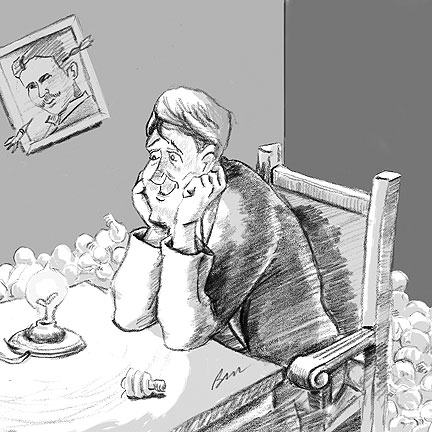
It’s been noted in many places that Thomas Edison [caricatured above] may have failed as many as 1,000 times at inventing an electric-powered light bulb, and when asked about his string of failures, he turned the tables by saying (and I’m paraphrasing,) “I didn’t fail 1,000 times. I succeeded at inventing a light bulb, and it took 1,000 steps to arrive at it.”

A recent New York Times article asked the question “What if the Secret to Success is Failure?” when discussing education and character among school-age children. Do a search on “failure,” and you’ll find inspiring stories of heroes of history who have failed mightily on the way to great successes: Churchill, Einstein, Darwin, Pasteur, Ford and on and on.

And at the recent DMA International Conference in Boston, Biz Stone, co-founder of Twitter, turned failure on its head relative to social media, stating “if someone posts a negative comment about your product, it demonstrates a level of investment and passion about your brand.”

Okay, that’s a lot of fluffy and warm and puppies. But in business – and particularly in marketing – we’re trained otherwise. For most of us, “failure is not an option” for our next product rollout, or our next advertising plan, or our next event. However, if we embrace The Law of Failure, we might find that failing helps to reveal what success really looks like.

In almost every business, professionals fail their way into success, typically in a process of elimination continuum: try › fail › tweak › repeat until try ultimately leads to success. At which point, you test the snot out of that success to ensure repeatability and reliability. This is true in engineering; in medicine; in sports; in fashion; in entertainment; in technology; in a zillion other categories.

In marketing and advertising, (direct, media, creative,) we call it “testing.” But testing is simply an accepted euphemism for “financing failure to yield better strategies.” Why else would almost every big campaign be run through focus groups first?  Why test your spots on samples of your target demographic? It’s not so much that you can see what WORKS, but rather that you can reveal what DOESN’T.

My theory on why it is so vehemently avoided in the marketing/advertising arena is simply because of the money flow. When doing medical testing, for instance, the medical company has an R&D budget to cobble away in a lab for sometimes years at a time. In engineering or technology, all the sunk costs are stacked upfront – sometimes financed by venture capitalists – and millions or tens or hundreds of millions of dollars might be spent to arrive at a new design/product/solution that then gets recouped upon selling/distributing/launching.

But in advertising, the money flow is different. The typical relationship is an outsourcing model (company x hires agency y to develop the marketing program) that puts the pressure on the marketer to justify that spend and that agency choice. It’s our money, so you better spend it wisely. No marketer I’ve ever met wants to hear in the pitch “yeah, we’re gonna spend a percentage of the budget on failing.”

But that’s essentially what’s happening. Sure we do research, we do cluster analyses, we create predictive models. My colleague David Adelman at OCD Media is a media planner who creates predictive models in order to yield what he calls the most “testable propositions.”

The only problem (in advertising and marketing) is that those propositions are tested out in the marketplace, and failure is seen as a scarlet letter on the breast of the marketer (and in many high-profile cases, the agency, too.)

But I propose that failure is not a sad end to high hopes, but rather an intelligent investment in future successes.

When you fail at strategy X, you now have saved an innumerable amount of money because you KNOW that strategy X won’t work (under the current conditions.) You can instead pursue strategies Y and Z. And if they fail, you save proportional amounts, and so on. KNOWING is powerful.  Failure leads to knowing, whereas success is sometimes an intoxicating mix of planned well, guessed right, timed it right, chose a good director, etc.

This might not fly at your company if you’re a slave to the quarterly conference call with the board and have to explain that you’re failing. But if you’re a small to midsize marketer – you’ll never spend money any more wisely than by failing and KNOWING what to avoid in the future.

Death and Social Media – version 2.0

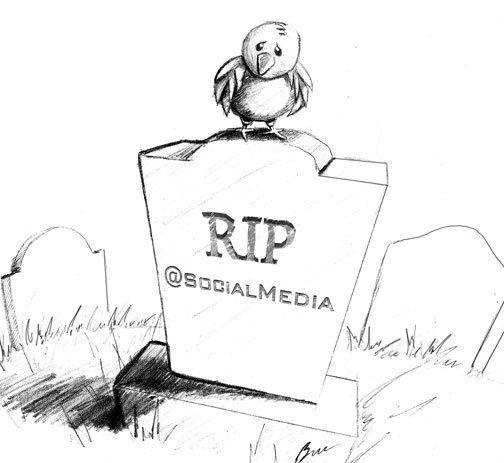
Illustration:  Bruce Crilly

The below is a follow-up to a post I wrote back in July 2010. First, the original post, then the follow-up:

Death and Social Media
This is a morbid way to discuss an idea, but let’s talk about death. And while we’re at it, let’s talk about social media. I was (briefly, fleetingly) thinking about what would happen after I die, and the kinds of things people would remember about me. (And more exactly, the kinds of things I hope people will remember about me.)

In my life, (and I’m not quite done yet,) I have created volumes of content in the social media world: blog posts, and blog comments, Facebook statuses and comments and likes and picture uploads and all those Tweets, reTweets and direct messages on Twitter! I’ve yelled about firing the head coach of my beloved Buffalo Bills on the fan forums on buffalobills.com, and helped people solve technical problems on support forums for Apple computers and some software platforms. I’ve written record and book reviews on iTunes and Amazon. I’ve uploaded and even commented on videos posted on YouTube! (Eeek. What a geek.)

So I wondered, will this become part of what people remember about me? Will there be people at my funeral saying, “yeah, nice guy…oh! And did you see his Tweets from the IAB mobile conference back in 2010? So insightful.” Instead of a collage of photos, will there be a screen somewhere with a streaming feed of my life’s digital output?

On one hand, I seriously doubt that these bits and bytes of my recommendations, forwards, hashtag snips and extemporanea will have any bearing on what people think about me. But on the other, there’s no getting around the fact that social media content is now a contributing editor to my legacy. I also submit that I think it would be an interesting, revealing and even fairly intimate way to chronologically peek into the ebbs and flows of my (mostly) professional life. Which makes me think: are we (am I?) Tweeting accordingly? Is the overall tone of my social commentary admirable/useful/honorable? Will my children be proud of what they read? Does it really matter how many check-ins I have, or if I’m the bloody mayor of some local bar? Jeez…maybe we better start looking at all of this in context.

In older days, we might have discovered a diary under a bed, or a journal tucked away in a closet somewhere, long after the departure of a loved one. But now, we have a digitized database of someone’s every thought and comment for years and years. And since most people in the world will never author a book, or write a professional article in a real journal, or be interviewed for television or radio, is the chronicling of social media verbiage a new means to endure? [Uh oh, I think I smell a new business model being hatched.]

Follow-up [September 2011]
So it turns out I was on to something about new business models being hatched, and people starting to talk about this morbid stuff with a more, um, opportunistic tone. A year after my blog post, a journalist named Adam Ostrow gave a TED talk that covered this topic – and outlined some new business models that are indeed being hatched at the intersection of death and social media as “opportunities for technologists.”

The first (and perhaps weirdest) is ifidie.net, a service that lets you create a message or video to be posted to Facebook after you die. Check out their website…kind of a wacky approach to a fairly serious topic.

“My Next Tweet” is a service that uses an algorithm to predict what your next (and perhaps last) bit of social output would be on Twitter by analyzing all your previous tweets and retweets.

Finally, Ostrow points out 1000 Memories, a service that allows you to organize, share and ultimately post a collection of photos, memories, writings and more to Facebook or an area of their site. Not just for the dead, apparently.

On the flipside of all that nonsense, there is a beautiful side-effect to digitizing one’s last days. I recently read a gorgeous narrative by Rebecca Armendariz chronicling a series of Gchats with her lover that is both heartwarming and gut-wrenching, and exquisitely written. Read it and (be prepared to) weep.

I suppose all of this does lend gravitas to the idea of self-monitoring your digital expressionism. Once you’re gone to the great mashup in the sky, you don’t want one of these dopey services misrepresenting your life’s social work. So if today is indeed the beginning of the end of your life, social-ize accordingly.