Apple’s iPad2 launch: sold out or sellout?

Sure, I know.  It’s pretty rare you hear the words “Apple” and “fail” even mentioned in the same neighborhood (unless it’s a snicker aimed at 1993’s Newton launch,) so let me clarify.

You can call me something of an Apple freak: since my first Mac Classic II in 1990, I’ve upgraded through the IIci, the LCIII, the Quadra line to the Power Mac, Peforma into the Bondi iMac G3. I’m also one of the six people who still owns two G4 Cubes.  I then fell in love with the G5 flatscreen iMacs, and bought a bunch – first the white ones, then the aluminum babes.  My latest supplications:  the latest Powerbook and the 27″ iMac G5. You can call me sentimental:  I still listen to rock tunes on my white (huge) first-generation iPod. You can call me ridiculous:  I was on line in June 2007 for the first iPhone, and have upgraded obediently through iPhone 4.  (And I’ll get my iPhone 5 this June, if they’re in stock!)

But now, you can call me peeved.  This iPad2 release has left me – and a lot of other folks just itching to be separated from hundreds of hard-earned dollars – a bit flat.  iPad2 was launched in stores on March 11, at 5:00 pm. I’m not down on the early evening release:  it helps the retail stores to get their inventory squared away, and get the systems upgraded to handle massive checkouts.  But unless I’m mistaken, it also makes for great localized PR – virtually every local newscast carries stories of the ridonkulous lines around the block at every Apple store in the country. Every day, I visit my local Apple store to hear the sad news from the dude in the blue shirt:  “we had ‘em.  But we sold out. In, like, 10 minutes.”

What’s going on here?  Is this an epic fail of distribution planning?  A gross underestimation of demand?  A glitch in the system?  A return to what Chris Anderson calls “scarcity economics” in The Long Tail?  All not likely from the historically over-prepared Apple Inc.  What’s more likely is that they’re enjoying kicking their competitors in the gut with yet another huge hit of performance computing.  So why not milk every last drop of extra PR coverage out of this sucker?

[In fairness, there are logistical problems facing many parts manufacturers in Japan, impacting their delivery schedules.  (The tsunami and the iPad release on the same day.  Weird.) But Apple has said nothing of the matter – instead, they’re enjoying the long lines and long waits. Call me cynical.]

Here’s the worst part.  I, and many others in my situation, am starting to come to the horrendous realization that maybe, perhaps, just a bit…I could live without an iPad2.  After all, I’ve waited nearly three weeks.  What’s another year?

If your company is considering any kind of PR stunt in the near future, make sure your consumers get the BENEFIT of the stunt, not the brunt of it.
This offer expires soon.

I’ve just read Jay Goltz’ blog post on NYTimes.com entitled “Is Groupon Ruining Retailing?”  A good read, and lots of good points that got me thinking about couponing as a marketing tool.

A classic sales promotion method, couponing has grown steadily over the past several decades.  According to a recent report issued by NCH Marketing (a Valassis company,) shoppers saved $3.7 billion with coupons in 2010.

Sort of a perfect time for Groupon to be coming out of its shell, eh?

However, there are some important rules of the channel that the Groupons of the world might be missing.  Couponing is not for everyone, is more of an awareness-building tool, less of a customer acquisition tool, and it has a limit.  There are also many factors at play besides redemption rates that have to be taken into consideration.

So why do marketers coupon?  A solid coupon program will create:

  • Incremental sales (for either new products or labels past maturity)
  • Brand Awareness
  • Program ROI
  • And maybe some additional opportunities for sell-in at the store level.

A colleague of mine, David Adelman of OCD Media, also reminded me that couponing has to be looked at in context of what the running sales trend has been for the particular brand, and then re-evaluated months after the program.  Sure, there can always be a spike in sales in the short term, but some coupon programs can hurt, since, on some level, you’re discounting future sales for that spike this week.

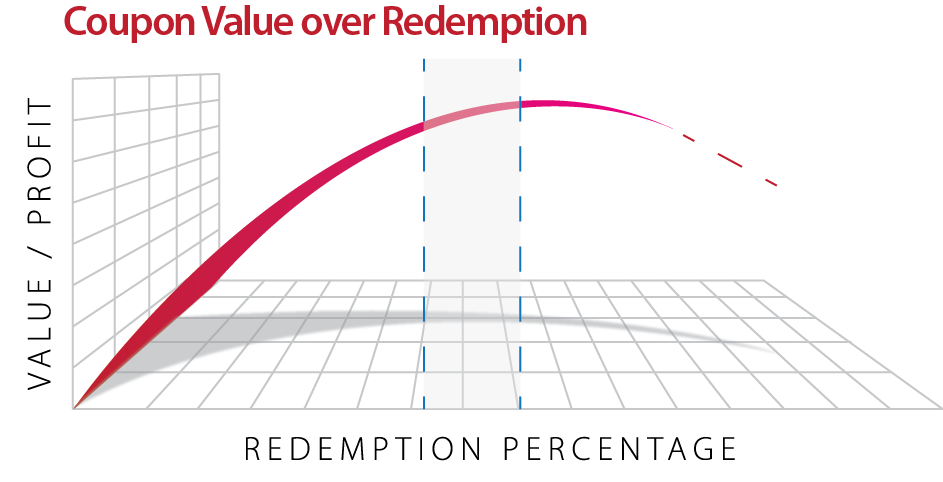
The real balancing act with couponing is about redemption:  too little redemption and the program won’t deliver the requisite ROI.  Too much redemption, and the value of the program ALSO goes down…how is this?

Coupon Redemption Scale


Turns out that too many redemptions can erode the brand in several ways:  super-redemption can cut into overall margins, so while moving more volume, the marketer can be incrementally losing share on every purchase.  Look for a redemption range [in the blue dotted lines] that helps move sufficient volume without over-saturating the market. Better to under-estimate, since you can always pump more coupons into the market, or hand-distribute in stores.  Also, if the coupon is on a 1+ offer, (most are) you can erode repeat purchase by an even longer period…further delaying the product sales rebound…a deadly combination with over-redemption.

So coupon carefully.

The Next Flag for the Next Egypt?

The next flag of Egypt?

With the events of 2-11 still echoing in hearts and minds (and streets and protests in other Arab countries,) the nation is turning to the business of rebuilding.  And the world is taking notice of Egypt:  citizens bound by ideology stage a massive and (mostly) peaceful demonstration of hundreds of thousands, then achieve their regime-change objectives, and then come back the next day to help clean the square and the streets where they demonstrated.  That’s an example of singular aims and national pride, eh?

But the next Egypt will also need rebranding.  We’re all well aware of the nation-building tasks ahead:  new government, new constitution, new systems and infrastructures, all leading to new elections this September.  That’s plenty to chew on.  But one thing I’m thinking of is the identity system:  the Egyptian flag.  What will IT become?  And should it change?

After all, the current flag of Egypt is said to be symbolic of past revolutions.  (There are slightly differing opinions on this:  some say the red/white/black is simply an adoption of the pan-Arab colors; others argue that the symbolism has slightly different provenances.)  The going intelligence is this:

The red stripe symbolizes the time before the 1952 revolution, when the Free Officers stormed the palace and peacefully ousted King Farouk.  Although British occupation of Egypt had officially ended in 1936, the King was still a reminder of the old British oppression, as the monarchy was installed and monitored by Britain for nearly three decades. (Notice a theme?)

The white stripe symbolizes the peaceful nature of the revolution, when the monarchy was effectively abolished without bloodshed.

The black stripe is a combined reminder:  the end of oppression by Britain and by a Monarchy acting under same.

There have been numerous incarnations of the middle symbol – it was once an eagle with a crescent and three stars, then a hawk, then back to an eagle, and so on.  There has also been a version with two stars in the white field to represent the short-lived union of Egypt and Syria as the “United Arab Republic.”

But what about now?

If the Red, White and Black are symbols and reminders of revolution against oppression, surely the 2-11-11 liberation of Egypt by peaceful demonstration deserves lasting representation. It will be quite interesting to watch not only what develops on the flag of Egypt, but how it becomes adopted.  My guess is it will be a refreshingly democratic process at work.

In the rendering above, I’ve shown a corner of the red stripe being pulled away and revealing a vibrant green.  It could be that Egypt simply adopts a pan-Arab color, or perhaps it means something more:  a verdant period ahead for a nation that is dutifully evolving by choice, and quietly leading by example.

Egypt 2.0 Beta: Strategy outlines for the NEXT Egypt.


11 February will go down in history as a day to mark the beginning of the next Egypt.  As I wrote in my previous post, this is the beta period for Egypt 2.0. With former President Mubarak (that sounds strange, doesn’t it?) en route to Sharm el Sheikh, the bonds of “emergency rule” have been broken after 30 years, and the Army is in control of the country’s affairs while a transition takes place.

Today’s demonstration has been won with hugs and kisses, not stones and rockets.  That much is encouraging.  An absolutely jubilant and electrifying scene in Tahrir Square is wonderful to see and inspiring for the world to share.  I can hardly catch my breath for the splendour of it all.

However, there’s an important period to come.  And this could be the most important six or seven months in recent human history.  Will Egypt usher in a new era of peace and representative democracy, or will there be a subversive shift to non-secular leadership, in the form of the Muslim Brotherhood?  Either route will have seismic effects on the world – economically, politically and culturally.

Continuing our de facto marketing plan for Egypt, the next phase will demand strategies.  And today’s events clearly demonstrate how quickly circumstances can change the needs and parameters of formulating strategies.

3 Viable Marketing Strategies for Egypt:

Build the market approach:
Egypt has the opportunity to become the first modern Middle Eastern country to espouse a true democracy.  In a “build the market” strategy, Egypt can lay out the blueprints for creating new channels of peace and prosperity, new methods for promotion and new areas of citizenry exploration.

Pleasant side-effect #1: this astonishing moment could lead to other countries whose people are oppressed (either overtly or tacitly) doing the same and using the Egypt (read: peaceful) blueprint for regime transition.

Pleasant side-effect #2: The entire process took roughly 18 days through mostly peaceful revolution – this itself is a model to be admired.

Competitive Approach:
Target a position on the world stage as a major player in global affairs. This means contributing to global causes as much as it means benefitting from them.  Egypt is a logical and strategically desirable bridge between the West and East.  This is a position no other country (Middle Eastern or otherwise) could feasibly occupy.  For the citizens of the country, this competitive advantage could mean major benefits, particularly economic reforms and human rights reforms.  Today, the Egyptian people have earned the right to benefit from everything life has to offer, no longer through a filter of heavy-handed government rule.

Pleasant side-effect: competition is good.  It could lead other countries to strive for equal representation, it could lead other countries to begin offering their core competencies for the benefit of global advance.  Yummy.

Cause Approach:
Become the modern example for tolerance and non-secular rule as a model for the rest of the middle East, and the world.  We have seen all too often how unfair rule and ill-conceived revolution can gain airtime on the global stage.  Think Rwanda, Darfur, the former Yugoslavia and so many others.  This is an opportunity to take up a central cause, (collective emancipation?) commit to a central mission, rally support and effect real change for real people.  Not the stuff the talking heads are spouting, but ACTUAL human rights, ACTUAL representation, ACTUAL opportunity.  Wow.  Could be the best strategy yet.

Pleasant side-effect:  with a visible cause strategy, Egypt can help change misperceptions around the world about all Arabs being lumped in a “them” category.  Wouldn’t that be something?

Marketing Egypt – Four Sets of Objectives

Egypt2.0

The next phase for Egypt will be a telling one.  And if the country and its people are to actually realize movement in a forward direction, now must be the time to set intelligent objectives.  Marketing Egypt will be a tall task, which is why defining clear objectives is so critical at an early stage.

Let’s be clear:  “regime change” is not an objective in and of itself.  It’s certainly a goal, and the sum of hundreds of thousands of protestors, rocks, hand-written signs and a zillion tweets and Facebook posts.  But a suite of objectives could help the process of democratic transformation take shape, and could provide a road map to the next chapter in Egypt’s storied history.

So what kind of goals should Egypt be setting at this point?

Operational Objectives
Obviously, there are innumerable logistical considerations.  Operational objectives must outline what the desired outcomes will be for electoral systems, governmental systems, infrastructure systems, military stability.  Chief among these, of course, are all the financial systems that must be monitored, maintained and scrubbed for security.  These include tax codes, regulatory systems for Egypt’s stock market, the maintenance and sustenance of Egypt’s chief revenue producers:  the Suez, agricultural exports and tourism.  The culmination of these objectives would likely be outlined in an amended Egyptian Republic constitution.

Political Objectives
Of course, political goals are nearly as important as the operational objectives.  Egypt currently maintains a high profile on the world stage, despite its warts.  The next government will have to lay out a specific agenda for its political objectives.  How it will represent itself at the United Nations.  Where it will stand on the myriad issues that face the Middle East.  How it will contribute to global efforts facing the environment.  Where it will draw a line in the Saharan sand on women’s rights.  And a host of others.

Product Objectives
Most marketing objectives I’ve helped formulate usually involve an element of productizing; helping my clients draw fact-based conclusions on what products will drive revenue, or drive new opportunities for engagement.  For Egypt, the product plan will likely involve two phases: expanding its current line, and developing new products the world desires.  Its current line of agrarian exports can be expanded.  Cotton, rice, wheat and others are a very good start.  But there are tens of millions of people who could be gainfully employed building equipment, or refining sugar, or planting new citrus crops near the Nile.  And for that matter, new contributors to GDP are just waiting to emerge:  there are equal numbers of engineers who could help build assembly plants; refineries, distribution centers, healthcare infrastructures and more.  This may be the most exciting of all the objective-setting plans ahead for Egypt.

Brand/Image Objectives
Naturally, any entity that has been the focus of so much media coverage will have to undertake great effort to repair its image.  The brand objectives will first be a combined effort of artfully bragging about the success of the aforementioned objectives coming to fruition: Yay – a new government!  Yay – new GDP sources!  Yay – equal representation under the law!  But beyond that, Egypt will have to go a long way to lull back tourists to its resorts and attractions.  Egypt will have to enact new programs to prove that it’s a safe and friendly place to visit.  That it’s a worthwhile (and legit) country for investment.  That it can stand up again and take the next step in the evolution of a great nation.

On the horizon:  strategies.
The combination and consideration of these objectives will begin to form the vague shape of an Egypt of the future.  But getting there will require sound strategies.  Those in an upcoming post.