American Eagle and Sydney Sweeney: massive marketing mileage from meh advertising.

American Eagle Sidney Sweeney advertising image

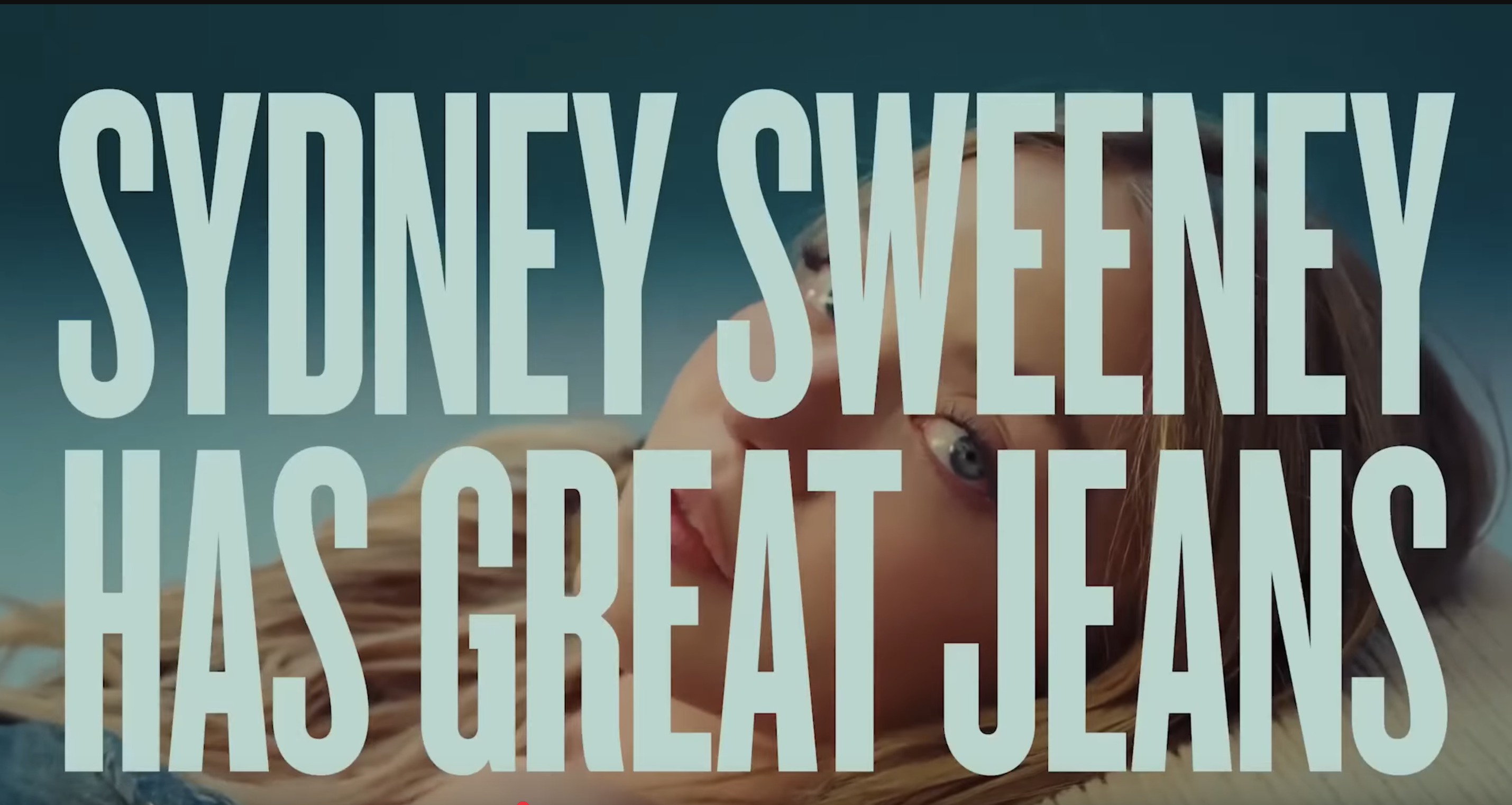
A lot has been made over the recent American Eagle ads, called “great jeans,” featuring the actress Sydney Sweeney. And the question is, of course, why?

The advertising itself is pretty meh. And that’s not a knock on the creative or production teams. I just mean it’s super simple, mostly one-shots, no effects, no music bed, etc. Just stripped down actor-on-screen-reading-lines stuff. And Sweeney demonstrates no range as an actress – it’s almost a staged testimonial. The “big idea” was leveraging a pun on the word “jeans” to overtly imply “genes.” Okay, not earth-shattering, but not altogether a terrible way in.

It also affords American Eagle the opportunity to call their product line “great,” under the auspices of the pun construct. And the spots (there are at least four :30 versions, including one where she is shown auditioning for the part,) are simple showcases for her body shown in double denim. I’m much more surprised that the blowback wasn’t from the fashion police. Eeeeek!

Sweeney’s primary appeal, to put it kindly, is not in her eyes, nor in her hair (which was almost purposefully styled to look un-styled for these shoots,) nor is it her vocal fry let-me-be-sultry half-whispers. But that appeal was hardly leveraged in any of the spots. So it’s not overtly sexualized.

And any comparisons to Brooke Shields’ turn in Calvin Kleins from the early 1980’s are unwarranted. Sure, the American Eagle ads may be derivative, (attractive young woman alone, lying on the floor, talking directly to camera in and about her jeans,) but Shields was an akimbo nearly six feet tall 15-year old uttering lines that she probably didn’t fully understand to be as provocative as they were. “What comes between me and my Calvins” is far more suggestive and dangerous than a nearly-28-year old independently wealthy, 5’3” actress/producer reading a script whose impetus is a pun on the word “jeans.”

But then, there was no global public forum back in 1980 for moral critics—or heads of state—to air their grievances and/or share their hot takes. The wrong voices have taken over the conversation. And much of it is helping American Eagle get far more mileage out of this campaign than they likely would have otherwise.

In fact, were it not for social media, almost nobody would be talking about these ads, except for maybe the VIP tier of the Sydney Sweeney fan club. On one hand, you have some virtuists (not a word, but if Shakespeare can do it, so can I,) calling one of the ads “racist” and “eugenics signaling” (not kidding) because Sweeney refers to her jeans/genes being blue. (And because she’s Caucasian. And has blonde hair.) Nowhere in the script does it say anything about that making her superior or preferable. You want a script gone awry? Try on Dove’s “white is purity” debacle from 2017. Oooof.

Are there legitimate concerns that AE is showing a skinny white girl in their ads, instead of someone of color, or someone who is more representative of the average American woman in terms of size? Perhaps. According to multiple—and conflicting—sources, the average woman’s jean size is somewhere between 12 and 16. AE chose to ignore that, and opted instead to feature a size 2 or 4 Sweeney. They did it not to be exclusive, or dismissive, but to capitalize on her ascendant stardom and her significant influencer status as a social media personality with a hefty following. The ads are neither racy, nor racist. They’re just aimed at the average/likely American Eagle consumer, who happens to be young-ish and caucasian-ish, and probably identifies with or admires Sweeney in some way.

I also like that American Eagle responded to the criticism. An Instagram post from the brand reads:

“ ‘Sydney Sweeney Has Great Jeans’ is and always was about the jeans. Her jeans. Her story. We’ll continue to celebrate how everyone wears their AE jeans with confidence, their way. Great jeans look good on everyone.”

[Sidebar to all social media community and brand managers: note how the focus is more on the category (jeans) than it is on the brand (AE.)]

In many ways, the conversation has become the campaign. The advertising was just the spark that lit the fire. While that’s exciting, it’s also impossible to control…so AE ought to enjoy this, and be sure to not add any additional accelerant.

Is there a moral to this story? Is there a story in this story? I think so. But it’s far less complicated or sinister than most are making it out to be. I think American Eagle shelled out a lot of money to hire Sydney Sweeney, did some OK advertising, and has gotten tons of marketing mileage out of this, in just over a week. In our business, that’s a big win. And no matter what you do when you’re advertising, you will never please all of the people all of the time.

But remember. American Eagle is a for-profit apparel brand. And their target audience is not (and never was) “all of the people.”
You want good* advertising? You won’t find it in the election media blitz.

Don’t you just love advertising in presidential election years? Aggressive, repetitive, and often un-creative ads in every commercial pod, whether you’re watching football, soap operas, or game shows. ‘Tis the season to be mud-slinging.

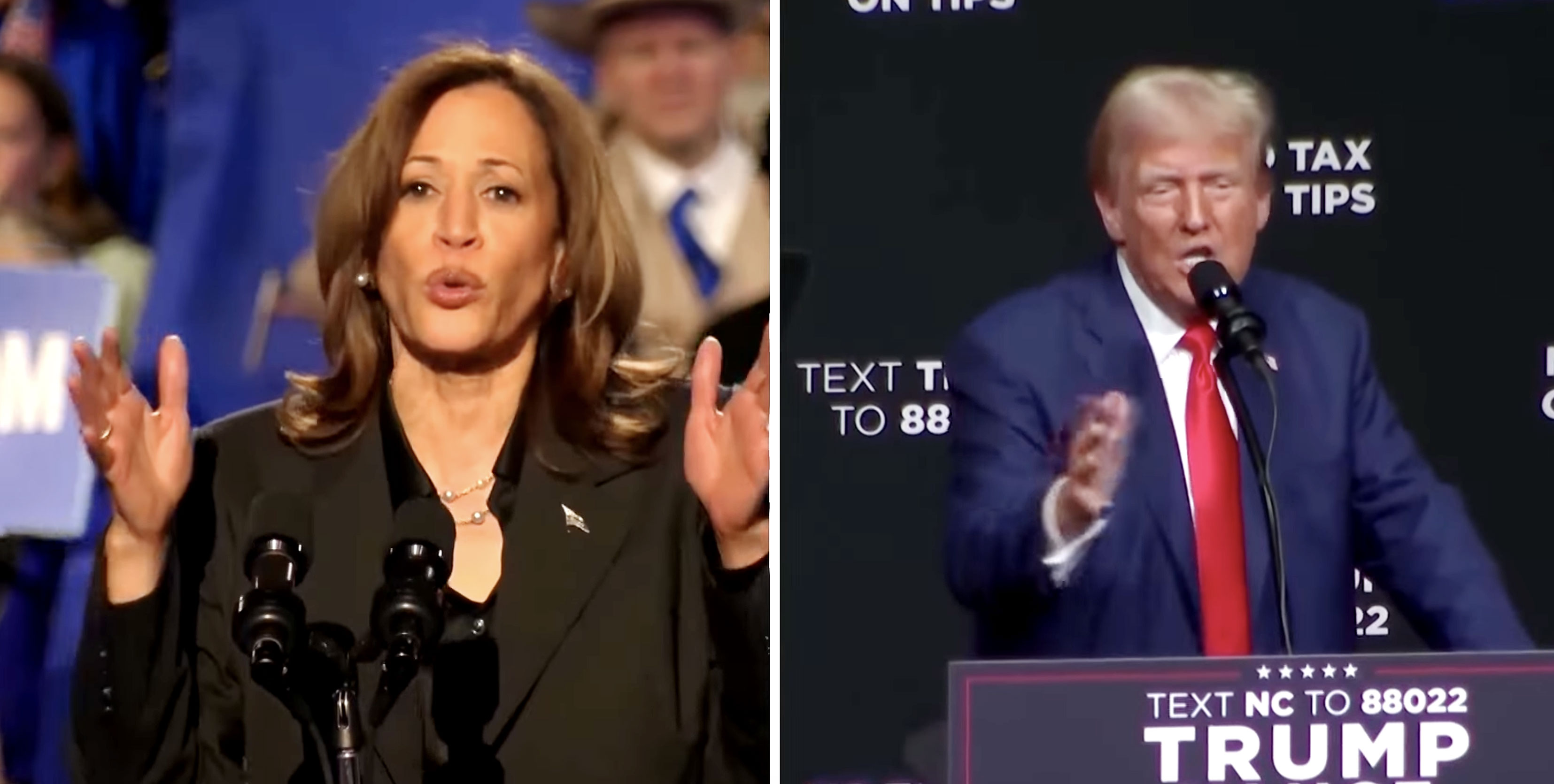
In the general election, The New York Times has reported that more than $500 million will be spent by the Harris and Trump campaigns, and that the Super PAC supporting Harris will pour $187 million into television and radio alone in the final 49 days. I’m not great at math, but that’s almost $4 million PER DAY from September 17th through November 5th. That’s not counting digital, social, texting, robo-calls, and whatever else each campaign’s AI-driven algorithms are cooking up.

But what about the ads themselves? Is there any tangible messaging going on beyond the “don’t vote for the other team, because they’re terrible” tropes? Sadly, not much.

The Trump campaign has struck gold with one spot called “They/Them” that’s running ad nauseam across cable networks, which focuses on a (decontextualized) message about Harris supporting gender reassignment in prisons, with the implication that American taxpayers are footing the bill. It ends with the line, “Kamala’s agenda is they/them. Not you.” However you feel about the issue and the message, (and the malevolent editing,) you gotta admit that’s a darn strong line to punctuate the spot. It’s creative and pithy, and rings a potent dog whistle for conservatives who bristle at all things trans.

Harris fires back with a spot focused on Trump and his anti-abortion influence, and his implicit ties to the mercurial Project 2025. The spot is called “Who He Is,” and is (again) focused on her opponent, and his previous (and likely future) inclinations as it relates to national policy.  The compelling aspect of this spot is that none of it is conjecture – Harris is highlighting actual changes that were affected during Trump’s actual presidency. It invites the viewer to draw their own conclusion (and the creative directors are betting on this,) that “if he did it before, he’ll do it again.”

So, what’s wrong with this advertising? Some would argue that the ads are fine, claim “that’s just what they do,” and that politics simply brings out the worst in strategists and creative directors. Hey, it’s a limited run, so attack, attack, attack, and it’s definitely rated R for rubbing just about everyone the wrong way.

But that isn’t the way most brands compete, is it? Most brands want to use the precious time they have with the consumer to connect to something positive, and special, and DIFFERENT about that brand. Most brands want to say good things (about themselves,) and let the consumer draw their preferences from there. Geico, as an almost on-par example, (they spend almost $3 million per day in advertising year-round,) doesn’t spend their time shitting on Allstate or State Farm. They use that time and all that money to drill simple, memorable messages into consumers’ minds: 15 minutes could save you 15% or more; so easy a Caveman could do it; etc.

Some strategists argue that you should NEVER mention your competition in your ads, because you’re essentially using YOUR media budget to promote THEM (to some degree.) Tell that to Coke v. Pepsi, or McDonald’s v. Burger King, or Apple v. PC. There are exceptions to every rule.

But marketing IS a conversation, and a campaign is an extended conversation that happens in short spurts over long periods of time. Brands use 15 or 30 or 60 seconds to get you to think something, believe something, and maybe even to do something over the course of several months or more. If they spend all their time talking about the other brands, what would you think about them? And more importantly, would you think about them at all?

That’s what’s disappointing about this unprecedented time in marketing history. The most money ever spent on presidential campaign advertising, and all we’re doing is rejecting the rules that all of us are taught about advertising, especially about being memorable, and about never misleading your audience.

I think we can do better. And I’m looking forward to November 6th, when we can go back to talking lizards, bunnies banging drums, and people getting their hands stuck inside potato chip containers. Ain’t advertising great?

Here’s mud in your A.I.

If you’ve been paying attention to the industry news, there’s been a LOT of chatter about AI, (artificial intelligence,) and its various applications. And some of them are really intriguing and useful. With the ability to run predictive diagnostics, artificial intelligence (better described as data-driven machine learning,) is ideal for applications that can benefit from robust and speedy automation.

As is our way, it doesn’t take long for something useful and intriguing to be repurposed into something base and silly. Case in point: AI is also being used now for some fairly sophisticated parlour tricks, like recreating the Mona Lisa.

(Moves soapbox to the foreground.)

But the application of AI in marketing, and most specifically in the creative process, is really (in this sentient blogger’s opinion,) an overreach.

There’s no data set for creativity. In fact, there are no rules. What makes something “creative” is that it is indeed CREATED. By a human being. Part of why we buy paintings, and music and novels and sculpture is because we know there’s a backstory of someone who sweat it out in a studio or at the typewriter. Someone whose fingers bled. Someone who made mistakes, and tried variations, and threw whole passages in a trash can. We celebrate that humanity and that pain and the entire process when we consume anything creative. Not just the end result.

The same is true in marketing. Writing anything – an ad, a blog post, a commercial script – is hard. It’s taking business rules and mandatories into consideration and asking a creative person to then do intellectual gymnastics, linking sometimes disparate ideas in unexpected ways, without a net. Can you write an algorithm for that? Sure, but the results are likely to be shit – the kind of shit a hack would conjure.

For instance, you’ve probably seen these kinds of promotions for having AI write your next blog post.

What’s really happening there? I don’t claim to have knowledge of any of their algorithms, but I’d bet my last dollar that these are search bots that crawl the web for every piece of content written in the last 10 years about a particular subject. They ingest this huge data set, pick out bits and pieces using sorting criteria that prioritize those with the most clicks, comments and instances, and then rearrange and reconstruct a new version for you.

That’s not creating. That’s recreating at best. And theft at worst.

ChatGPT, the latest and supposedly greatest iteration of AI language prowess, has added a sexy wrinkle into their algorithm. Instead of just swiping content and repurposing it, it adds a level of dialogue formatting to make it sound more conversational, and thus more natural and believable. It claims to “answer follow-up questions” and “admits its mistakes.” And given that it is machine-based learning, it gets “better” the more often it’s used. (It’s driving educators crazy, as students who use it can be deemed to be cheating, not researching.)

What a paradox: a machine learning model that improves the more often it’s used, but also degrades the craft proportionately in the process. [Some disclosures: OpenAI, the company behind ChatGPT is funded in part by Sam Altman, Elon Musk, and just got a billion dollar injection of capital from Microsoft.]

In a recent viral kerfuffle on social media, recording artist Nick Cave (throaty lead singer with The Bad Seeds) reacted to a song that was “written” by ChatGPT “in the style of Nick Cave.” He could not have put it any better:

“Songs arise out of suffering, by which I mean they are predicated upon the complex, internal human struggle of creation and, well, as far as I know, algorithms don’t feel. Data doesn’t suffer. ChatGPT has no inner being, it has been nowhere, it has endured nothing, it has not had the audacity to reach beyond its limitations, and hence it doesn’t have the capacity for a shared transcendent experience, as it has no limitations from which to transcend. ChatGPT’s melancholy role is that it is destined to imitate and can never have an authentic human experience, no matter how devalued and inconsequential the human experience may in time become.”

Okay, back to marketing, and particularly the art of writing good advertising. Part of the craft is developing a sense of counterintuitive thought and embracing lateral thinking. Another big part is the symbiotic relationship of the headline and the image. But so much of modern advertising is about contextualizing the brand into the cultural moment from which it arises.

Think of how many great headlines and taglines would never – could never – be written by AI, by virtue of this necessity for divergence and a sense of the cultural periphery.

“Think Small” from DDB was a radical notion at the dawn of the 1960s. As Americans – less than two decades removed from World War II – were upwardly mobile, one of the most pervasive (and comical) trends in automobile-dom was an oblique obsession with size. Bigger was better, and American cars looked like ocean liners. The nation was also wildly nationalistic at the time, and DDB’s assignment was to sell a small, quirky German car to this audience.

To get to the heart of these cultural undertones and suggest an opposite notion was a radical idea. And paired with the spare art direction (bless you Helmut Krone) and that sea of white space, it became a touchstone for our industry. Could AI ever reach that level of insight? Of rebelliousness? Of sheer chutzpah?

“Think Different.” When this campaign (from TBWA/Chiat/Day) was released in the 1990s, it was paired with images of pioneering artists, thinkers and doers, like Einstein, Picasso and Miles Davis. It also featured zero body copy. What’s so interesting about the head/tagline is that it’s not even good English. But it was a fine encapsulation of the Apple brand in that moment and what it stood for. Would AI dare to break grammar rules to create an emotional response?

I suppose it’s mildly ironic, or at least cheeky, that I chose two classic advertising examples that use the word “think” in the headlines. And perhaps that’s exactly what I’m driving at, and what Nick Cave was fuming at.

Maybe I’m an old fart, but I prefer the consternation. The suffering. The pacing and the waiting and the wondering if this “idea” has legs. Give me time to think about what’s going on in the world. Give me the sudden burst of insight when the neurons start to fire. Give me the end of the sentence that starts with “wouldn’t it be cool if…” Give me a person, thinking about another person, and getting them to actually think different.

There’s nothing artificial about that.

A clash of cultures: Twitter cancels Burger King.

A lot has been made of Burger King’s recent ad titled “Women Belong in the Kitchen.” If you’ve heard about it, you’ve likely already taken sides and are either itching to rage-tweet me, or are eager to hear someone else who supports your point of view.  Instead of taking sides, let’s be objective and unpack this thing one step at a time.

For anyone who doesn’t know, or didn’t read past the headline, Burger King was announcing the establishment of a new scholarship called H.E.R. (Helping Equalize Restaurants) to aid aspiring female employees who want to pursue careers as Chefs. The timing of its release coincided with International Women’s Day. 

Here’s the ad that ran as a full page in The New York Times:

First, let’s clarify what the ad was meant to do.  And we can do so by remembering what ALL ads are meant to do: get your attention. And this headline, while controversial if it stood alone, does that very well, because it’s dangerous. Because it’s a trope. Advertising leverages drama because it leads the reader to a destination that’s equal parts entertaining and attention-getting. And because a headline that reads “Burger King launches new scholarship to aid female representation in restaurant kitchens” is neither.  That sort of thing is for a press release, not an advert.

From a craft point of view, this is a strong headline, in that it serves to do at least one job that all good headlines should perform: it summarizes the content that follows. If we’re being objective, (and we agreed that we would be,) this is a very good all-copy ad-nouncement.

Now, let’s look at where it went wrong: in a word, Twitter. When the brand (and the agency behind it,) wanted to extend this exciting conversation online, it took to Twitter and Burger King’s 1.9 million followers with the initial tweet. Which, sadly, was just the headline. It then tweeted a summary of the content that follows in the ad. [Important note: the tweets were initially “debated” on @BurgerKingUK.] While Burger King did clarify the headline tweet in subsequent posts, it was apparently the string of ugly comments in the conversation thread that got out of control. The entire thread has since been deleted, and an apology was issued by global CMO Fernando Machado.

Ad culture meets Twitter culture and fails.  Cancel culture meets Burger King and shuts it down. This whole thing has gotten off the rails, and I think it’s mostly because people are not taking anything beyond face value. I would argue that we need a context culture more than anything else these days.  An army of fact checkers and industry experts who could act as docents for a whole generation of people who seem to crave being offended, and who magically find a fix on social media at roughly the rate of every news cycle.

The ad, the subsequent Twitterstorm, and the media kerfuffle that followed it have become new facets in the cultural touchstone that is today’s cancel-happy culture. The sad part is, it’s a pretty good ad. And Burger King, as a restaurant chain, (whether we should call them a “restaurant” or not is a different subject altogether,) is trying in earnest to do a darn good thing in the face of an inequality on which they are wholly qualified to comment. It’s a shame that we’re dealing with this level of bullshit from a minority of wokesters when a brand decides to put its money into something that might actually help in a concrete way what is, in this case, a marginalized segment of the population.

Now let’s look at what’s REALLY wrong with this ad: the typesetting is insulting, and should be cancelled immediately! The face is what it is – Burger King’s going for the retro-hip thing with the old bubble letters logo. Fine. I’ll concede that for the sake of the old-is-new branding mission.

But lord, where is the copyfitting? When the creative director was reviewing this, didn’t he or she think, “hmmm…that’s a weird place for a hyphen?” In the middle of the name of your new scholarship, in the middle of what’s arguably the most important word (Equalize,) you couldn’t break the line differently? And then again, in the last line of the ad, in another important word (kitchen) we couldn’t hard kern a little bit?

After a week of debating the merits of this approach, I haven’t heard any ad geeks talking about this.  Why? If we’re being objective, there’s probably a conspiracy afoot.

The brand cure for coronavirus: advertising.

The weeks and months leading up to and following March 2020 will go down in history as an incredibly important and impactful time period in the history of the United States. Between the COVID-19 pandemic itself, the economic ramifications of a roller coaster stock market, and the drastic measures being taken at the federal, state, and local levels, nothing seems normal. Virtually all major sports shut down. All major gatherings shut down. Schools closed for mandatory periods of time. Bars and restaurants closing. Social distancing. Self-quarantining. And of course, the dreaded toilet paper shortage. (Ugh.)

The citizenry of the United States is in a near-total lockdown. Without engaging in the regular retail experience – one of America’s favorite social and commercial pastimes – except out of pure necessity, what is the appropriate path for brands during this time? What should brands be doing? What should brands be saying?

I_WANT_YOU

At the risk of sounding insensitive, I say advertise. There are a million reasons to be doing it right now, and to be doing it well. Here are my top five.

Advertise. Because American consumers are concerned and confused, and there’s no precedent for anything like this in recent history. (Zika, Ebola and some of the other outbreaks never reached this level of penetration or panic.) There’s never been a time when we’ve been virtually forced back into our homes to sit and wonder what will happen next. Brands have the unique opportunity to reassure consumers (of course that depends on your brand, and the category in which you compete,) or at the very least, entertain them. If your brand can be a voice of reason, or a voice of compassion, or better still, a voice of comfort through generous offers, then that voice will get valuable attention when Americans have more of it to give.

Advertise. Because with Americans huddled at home for weeks (and potentially months) at a time, there will be record HUT/PUT numbers. National brands can leverage near Super Bowl-sized audiences at what would be considered regular airtime rates. Every advertising dollar will go twice, thrice its normal distance, especially during this time in the broadcast programming calendar, which is typically a lull bridge between the large audience events of Jan/Feb and the scripted series finale season to arrive in April/May. Ratings will be unusually high for the foreseeable future, simply because more people are home with more time – and more opportunity – to consume television.

Advertise. Because programming diversity will actually be an ally during this time. Sure, people will be binging on streaming services. But after three or four hours of catching up on the hottest shows, people will turn to both local and national news. My guess is that media buyers are in a feeding frenzy right now with MSOs to snap up relatively low-cost cable buys, and especially around news programming.

Advertise. Because your competitors are sitting on the sidelines right now, and this gives you a greater potential share of mind. Every brand is thinking about the opportunities they currently have, and what to do with them. But while most of them contemplate, they’ve probably held off on filming anything new, or producing any spots with context to the national psychology. And yes, while you can suffer a great deal for a misstep at this time, the potential also exists for exponentially greater gains if you can connect. Take a look at this spot Guinness released online regarding their brand (with high context to both the pandemic and the upcoming St. Patrick’s day,) and a message that is just wonderfully articulated and perfectly timed:

Advertise. Because we will get through this at some point. Although it’s hard to imagine it today, life will return to normal. Concerts will be staged. Stadiums will be filled with 80,000 fans screaming their heads off for their favorite teams. Schools will be open. Bars and restaurants will be flooded with people who no longer want so much social distance. And most notably, shopping malls and supermarkets will be flush with consumers looking for their favorite foods, clothes, drinks, sneakers, cars, electronics, beers, and so much more. And if you were smart enough to advertise to those consumers during this time, and your message was a strategic one, (or at least a kind one,) you just might have made a valuable impression (while making valuable impressions) to new fans for years to come.