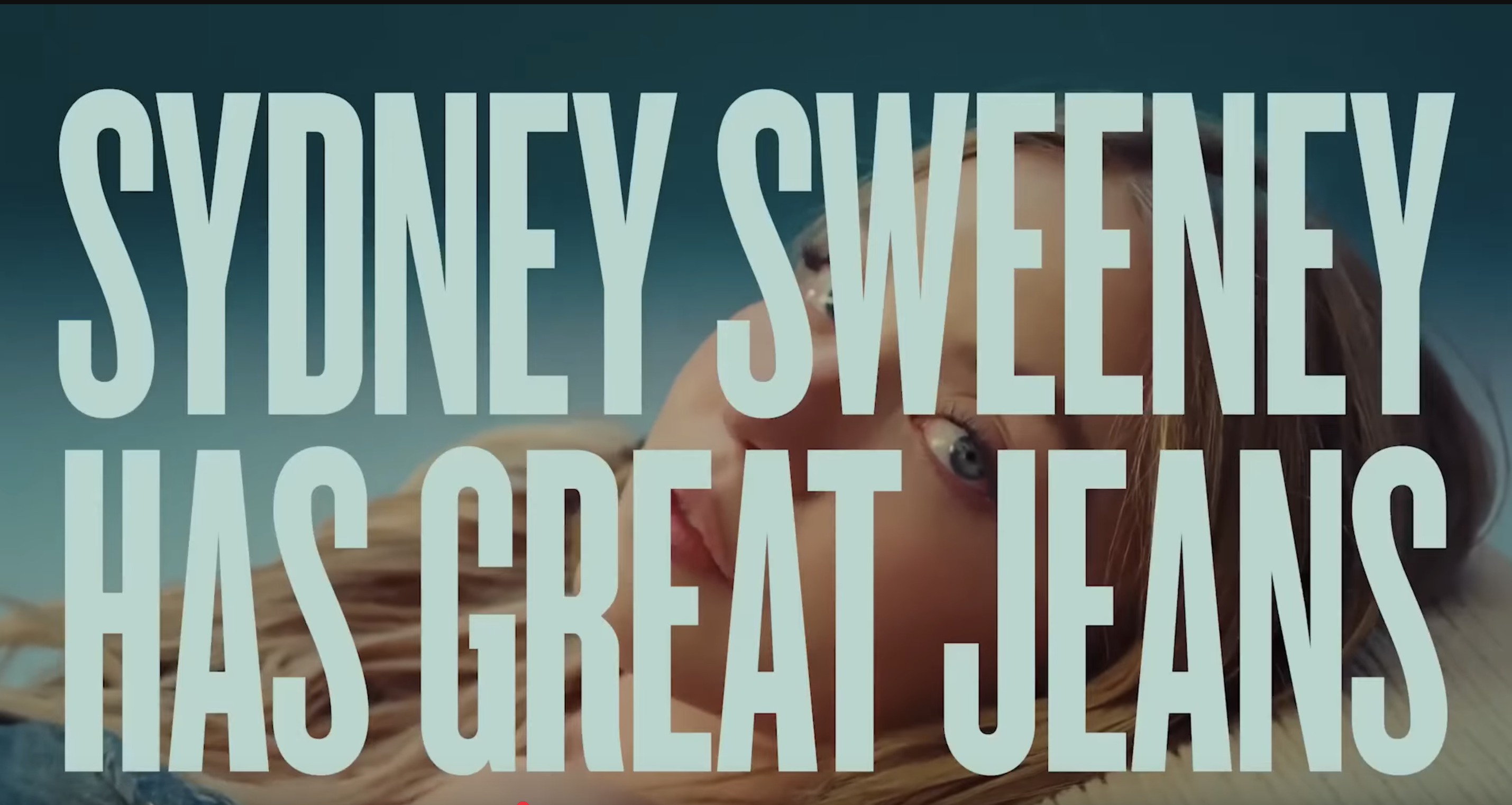
A lot has been made over the recent American Eagle ads, called “great jeans,” featuring the actress Sydney Sweeney. And the question is, of course, why?
The advertising itself is pretty meh. And that’s not a knock on the creative or production teams. I just mean it’s super simple, mostly one-shots, no effects, no music bed, etc. Just stripped down actor-on-screen-reading-lines stuff. And Sweeney demonstrates no range as an actress – it’s almost a staged testimonial. The “big idea” was leveraging a pun on the word “jeans” to overtly imply “genes.” Okay, not earth-shattering, but not altogether a terrible way in.
It also affords American Eagle the opportunity to call their product line “great,” under the auspices of the pun construct. And the spots (there are at least four :30 versions, including one where she is shown auditioning for the part,) are simple showcases for her body shown in double denim. I’m much more surprised that the blowback wasn’t from the fashion police. Eeeeek!
Sweeney’s primary appeal, to put it kindly, is not in her eyes, nor in her hair (which was almost purposefully styled to look un-styled for these shoots,) nor is it her vocal fry let-me-be-sultry half-whispers. But that appeal was hardly leveraged in any of the spots. So it’s not overtly sexualized.
And any comparisons to Brooke Shields’ turn in Calvin Kleins from the early 1980’s are unwarranted. Sure, the American Eagle ads may be derivative, (attractive young woman alone, lying on the floor, talking directly to camera in and about her jeans,) but Shields was an akimbo nearly six feet tall 15-year old uttering lines that she probably didn’t fully understand to be as provocative as they were. “What comes between me and my Calvins” is far more suggestive and dangerous than a nearly-28-year old independently wealthy, 5’3” actress/producer reading a script whose impetus is a pun on the word “jeans.”
But then, there was no global public forum back in 1980 for moral critics—or heads of state—to air their grievances and/or share their hot takes. The wrong voices have taken over the conversation. And much of it is helping American Eagle get far more mileage out of this campaign than they likely would have otherwise.
In fact, were it not for social media, almost nobody would be talking about these ads, except for maybe the VIP tier of the Sydney Sweeney fan club. On one hand, you have some virtuists (not a word, but if Shakespeare can do it, so can I,) calling one of the ads “racist” and “eugenics signaling” (not kidding) because Sweeney refers to her jeans/genes being blue. (And because she’s Caucasian. And has blonde hair.) Nowhere in the script does it say anything about that making her superior or preferable. You want a script gone awry? Try on Dove’s “white is purity” debacle from 2017. Oooof.
Are there legitimate concerns that AE is showing a skinny white girl in their ads, instead of someone of color, or someone who is more representative of the average American woman in terms of size? Perhaps. According to multiple—and conflicting—sources, the average woman’s jean size is somewhere between 12 and 16. AE chose to ignore that, and opted instead to feature a size 2 or 4 Sweeney. They did it not to be exclusive, or dismissive, but to capitalize on her ascendant stardom and her significant influencer status as a social media personality with a hefty following. The ads are neither racy, nor racist. They’re just aimed at the average/likely American Eagle consumer, who happens to be young-ish and caucasian-ish, and probably identifies with or admires Sweeney in some way.
I also like that American Eagle responded to the criticism. An Instagram post from the brand reads:
“ ‘Sydney Sweeney Has Great Jeans’ is and always was about the jeans. Her jeans. Her story. We’ll continue to celebrate how everyone wears their AE jeans with confidence, their way. Great jeans look good on everyone.”
[Sidebar to all social media community and brand managers: note how the focus is more on the category (jeans) than it is on the brand (AE.)]
In many ways, the conversation has become the campaign. The advertising was just the spark that lit the fire. While that’s exciting, it’s also impossible to control…so AE ought to enjoy this, and be sure to not add any additional accelerant.
Is there a moral to this story? Is there a story in this story? I think so. But it’s far less complicated or sinister than most are making it out to be. I think American Eagle shelled out a lot of money to hire Sydney Sweeney, did some OK advertising, and has gotten tons of marketing mileage out of this, in just over a week. In our business, that’s a big win. And no matter what you do when you’re advertising, you will never please all of the people all of the time.
But remember. American Eagle is a for-profit apparel brand. And their target audience is not (and never was) “all of the people.”
Super Bowl 59 is in the books, and congratulations to the Philadelphia Eagles on an outstanding performance. If you were in the mood for a dominating defensive performance, you had a very good evening. If you were in the mood for great advertising, well…you certainly got a LOT of ads, but not sure if they were all great. Some high points, some low points, and some decidedly weird points. Let’s break it down.
Themes Like last year, a lot of advertisers turned to the meta approach for their spots. This is when the ad is about making the ad. Dunkin, Homes.com and UberEats all took this approach, and it can be really funny (like the way Homes.com doubled down on the “it’s the best” meme with Morgan Freeman,) or it can get a little obtuse, like the Dunkin’ ad with actor Jeremy Strong trying to get into character by immersing himself in a barrel of coffee beans. (Right?)
Facial hair was another theme in this year’s ads. (There’s a sentence I never thought I’d write.) Both Pringles and Little Caesars decided that their best angle would be to have men’s facial hair – eyebrows and mustaches – fly off for some odd reason. Some of the gags were humorous (the caterpillars chanting “we’re not worthy” to Eugene Levy’s eyebrows made me chuckle,) and I think Pringles did it with a bit more context. After all, there’s a giant mustache on every package.
A surprising few amount of spots this year from car manufacturers. Polestar showed up in the pregame show, but not as an official Super Bowl commercial. Only Jeep and Ram appeared this year, which is odd, given the history of this game and some of the iconic spots that have run. If you’re counting, we had more spots with Matthew McConaughey than with cars.
HONORABLE MENTIONS: A few ads played it safe, and still managed to deliver decent brand messages. Orlando Bloom and Drew Barrymore did a cute tete-a-tete on European vs American holiday/vacation expressions, and it painted MSC Cruises in a similarly cute light. Homes.com played at the idea of saying they’re “the best” while their legal counsel advised them that they can’t legally say that. Uber Eats continued their “the NFL is trying to sell you food” conspiracy theory with origin stories, and it gets especially funny when Martha Stewart laughs hysterically that the Super Bowl venue is “named after a salad!”
The last couple of years, Jesus has made an appearance at the Super Bowl, but this year’s was a bit more special because he brought along a better soundtrack. Note to aspiring creative directors: having Johnny Cash sing Depeche Mode in your spot is ALWAYS a good idea. Hat tip to Jesus’ creative team. Hailee Steinfeld and Wanda Sykes teamed up for a smart PSA that made me look, er, notice, er, appreciate their, I mean ITS, value. It’s for Novartis, and it’s aimed at getting more women screened for breast cancer. And Dove scores another hit with a female empowerment spot that was punctuated by the line “let’s change the way we talk to our girls.” Nice.
While we’re mentioning some ads, we have to talk about Seal playing a, well, seal in the Mountain Dew spot. If facial hair flying off faces, and tongues flying out of mouths (more on that in a moment,) wasn’t weird enough, a seal with the face of Seal, singing a jingle to the tune of “Kiss From a Rose” was basically a 12 on the weird-o-meter. Fun? Sure. But about 50 million Americans probably had a terrifying dream about that one last night.
GRINS First off, golf claps to Weather Tech for finally listening to their agency and doing a concept spot instead of their usual “here’s a view of our factory where we prove they’re made in America” pandering. The grannies-go-wild approach offered lots of good laughs, and then quietly made a nice plug for their spill-proof floor mats. Much more memorable than the last few years.
Google Pixel 9 really tugged at the heartstrings with their dad-and-daughter vignette disguised as a “guy turns to Gemini AI for help preparing for his job interview.” The reason this worked so well is that it contextualized the product benefits while letting us in on the backstory. Really well-conceived, and really well-produced. You almost never want to go soft-sell on Super Bowl, but Google almost always has, and almost always wins.
Liquid Death literally made me LOL with its “drinking on the job” spot. Pilots, surgeons, school bus drivers, even the cops are pounding Liquid Death, and to an awesome theme song. The company has disguised their filtered water to look like small-batch beer cans, and this is exactly why: so they can misdirect and manipulate you right into the big reveal. Good stuff. Spots end with bold type: “Don’t be scared. It’s just water.”
It just isn’t Super Bowl without a Budweiser Clydesdale spot, and this one, “a horse walks into a bar,” is by far one of their best ever. It’s great storytelling, with virtually no dialogue. Our hero is faced with a choice, has to overcome difficult challenges along the way, and somehow, some way, prevails. For decades, Budweiser hasn’t even tried to sell beer with their Super Bowl commercials…they sell this version of Americana on which we can (almost) all agree.
Hellmann’s went retro with their “When Harry Met Sally” sendup. It features Billy Crystal and Meg Ryan back in Katz’s Deli, and wouldn’t you know it? Meg has another orgasmic experience (this time it’s REAL!) thanks to a shmear of Hellmann’s mayonnaise. Targeted at Gen X? You bet. Wrapped in a bow for Gen Z? Sure, and that’s why you have Sydney Sweeney deliver the punchline. So much better than their last several years of Super Bowl spots, which were big groans for me. Oh, and Hellmann’s signs off with the apt line “It hits the spot.”
Doritos proves that when you crowdsource your advertising (through their thankfully resurrected “Crash the Super Bowl” campaign,) really good things can happen. Here, an alien ship comes to Earth and tries to take a guy’s Doritos away. He fights them off – sort of – and then, by chance, the Doritos destroy the alien ship! The alien survives, and he/she/it (?) and the guy enjoy the chips together. What’s great about Doritos is that they ALWAYS put the brand front and center, and the motivation is consistent: get your hands on some Doritos.
I think my favorite of the night (and this is a bit of a critic’s pick, I’ll admit) was the ChatGPT “dots” ad. Again, no voiceover, just graphics, and magnificent ones at that. All of it based off ChatGPT’s “dot” prompt. So it’s a little “hello world,” and a little “IYKYK.” Anyone who has used ChatGPT will recognize the dot. During the spot, the dots sync up to go and create all kinds of interesting images, symbolizing progress through time, from fire to the wheel to the steam ship, to walking on the moon, to dial up modems to now. And then it delivers the line “all progress has a starting point.” I like this most of all. It says “AI is not the be-all and end-all. We’re just getting going, and let’s see where we might go from here.” A bit of a departure for Super Bowl advertising, but a simple and clear way to illustrate the power and potential of this particular AI engine.
—
GROANS
RED BULL: When I saw this spot come on, I immediately recognized the illustration style, and the classic setup. Boy penguin says to his father “I figured out how to fly!” Dad, suspicious, says “oh…really? And how exactly are we going to do that?” The boy responds that all they have to do is drink Red Bull, and they’ll be able to fly because, after all, Red Bull gives you wiiiiings. Up to this moment, this is a typical Red Bull spot. But then, the boy can’t fly, because the Red Bull he attempts to drink is frozen. (They’re penguins and it’s 40 below zero, according to Dad.) So…the product doesn’t work. The benefit is never realized. And we’re all disappointed. They try to make us think they’re in on the joke, because the voiceover says Red Bull gives you wings, “but only if you drink it.” No. No. No. Don’t do that.
SQUARESPACE: Look, I get that it’s hard to sell tech enablement as a Super Bowl spot. Squarespace is a platform that helps do-it-yourself-ers build and maintain their own websites. Last year, they tried aliens…with Martin Scorsese directing and starring in the spot. The year before that, it was an obtuse take on “the singularity” with Adam Driver. In 2022, they actually made a really GOOD spot with Zendaya, who portrayed Sally, who sold (you guessed it,) seashells by the seashore. That spot followed a simple narrative. Sally was not doing well. Then, she built a website with Squarespace, and things really took off! That’s generally how we like to portray our brands in our advertising: as aids in the hero’s cause.
This year, however, we have actor Barry Keoghan (the guy who went full frontal in Saltburn,) riding a mule through the Irish countryside, whipping laptops at people like a sedated and psychotic newspaper delivery boy. But they’re laptops! And they’re dangerous! And one smashes through the window of a pub. (Also, and even stranger, hardly anyone reacts to any of these near-death assaults.) And how, exactly, does this connect me to any understanding of their basic offering? Most Americans could hardly make out the brogue, let alone the value proposition.
COFFEE MATE: So, let’s give props to Coffee Mate for shelling out the almost $8 million dollars and producing their first-ever Super Bowl ad! (Applause.) Aaaaand…let’s give it up for Shania Twain writing and producing a new song specifically for the commercial. Yay.
However, that song starts with the lyric “let’s go tongues.” And the young man in the ad, who has just had a taste of cold foam after adding it to his cold brew coffee (I guess?) goes into a trance, where his tongue (yes, you heard me right,) does various dances, makes heart shapes, plays the chimes, high-tongues (I just wrote that) the Coffee Mate logo, and then – are you sitting down? Jumps out of his mouth. And spins around in the air while fireworks go off, and then plunges back into the young man’s mouth as he awakes from this fantasy. Just as a reminder, we’re talking about his TONGUE!
Then the young man and his pal start chugging (question mark) the Coffee Mate foam together, as we cut to the closing shot of the line “a little foam a lotta fun” spelled out in, you guessed it, foam! I could have lived a very full life without having seen that. And hopefully, I never will again.
So…what were your favorites? Let me know in the comments.
As we’ve turned the calendar to a new year, and the leadership of the country has turned over to a new administration, we have to consider if there might be a new kind of marketing landscape to be formed in a (hopefully) post-COVID world.
There are two distinct possibilities that could feasibly materialize. One, that we are in for a boom time in advertising as the population wakes from its imposed hibernation. And the other, far more daunting, possibility is that advertising may be met with increased skepticism, or worse, not welcomed in the national commercial dialogue.
Possibility 1 – it could be the best of times. As more and more Americans receive a vaccine, it’s conceivable that life could return to what we would consider “normal,” perhaps even as early as the summer months. It could mean being allowed to gather again with friends, to travel again at will, to eat indoors at restaurants, and (oh please, dear sweet baby Jesus) to sit with 70,000 close friends at the home opener for your favorite football team.
With that, consumerism will likely not just be on the rise, but there’s very good reason to believe that we’ll see an elongated surge in consumer spending across numerous categories, built largely on pent up demand, and the sheer joy of having the “privilege” to once again participate in the analog retail experience.
And once those floodgates open, or it’s even hinted that they might, I would argue that we are likely going to see an equally giddy advertising crop burst out of every conceivable corner and category. Brands will trip all over each other for a share of the voracious consumer appetite, and media companies will feast at the table of “flexible” rates while the demand stays unusually high, and the competition is unusually fierce.
And the best part of this rosy prediction is that the tenor of the advertising itself is likely to be more positive, less serious, and almost joyous in nature. Simple messages like “we’re back!” or “we’re open” will lie at the core of most claims, and brands will be paying big money just to have the “privilege” to beg consumers to come back now that the pandemic has loosed its grip on the nation.
That’s a rosy outlook.
Possibility 2 – (okay, let’s go with the Tale of Two Cities theme,) it’s plausible that it could also be the worst of times.
It’s possible that consumer perceptions have changed significantly over the past 10 months, (and perhaps continue to do so for the next five or six months,) and that large demographic segments may be more guarded against brand messaging delivered across the typical media. This, as a result of first the shock therapy of nightly news with a drone of grim reports, and subsequently the drawn out solitary confinement of houses and apartments, living both professional and private lives in the same spaces.
Consumers may be in a kind of post-pandemic stress disorder, and it might last well beyond the days when it’s deemed safe to come back in the water. This bodes ominous for those sectors hardest hit: restaurants and hospitality, travel and tourism, the arts and entertainment, even healthcare.
And more importantly – and the reason this subject is being taken up on this blog – is that the normal receptivity to advertising messages may be affected in ways that has brands and their agencies re-thinking their strategies, and re-tooling their plans.
It wasn’t long ago (seriously, it was August 2019,) that we all reveled in the great Chicken Sandwich War between Popeye’s and Chik-Fil-A. Or watched like rabid MMA fans as Wendy’s and Burger King dealt death blows to each other via Twitter. It was fun. It was entertaining. And it was good for all the brands involved.
Mostly it was frivolous, and that’s what made it so much fun. Nobody got hurt, and we were just dishing abstract concepts and opinions that no one took THAT seriously. But here we are, perhaps about to come out of the year-plus-long fog that seems to have changed everything. Will American consumers have the patience for frivolous feuds? Will we tolerate the background noise of cola wars? Is it too soon?
Remember that brands (at least the ones with discretionary budgets,) scrambled to change the tonality of their advertising in the first few weeks and months after the pandemic took hold. Starting as early as St. Patrick’s Day 2020, we saw national brands releasing more heartfelt messages, saying things like “we’ll be here when this is over,” and heralding frontline workers. Somber. Serious. Considerate.
A few of the standouts: GUINNESS
UBER
DOVE
While those ads were all very good, (and I say this politely,) it was also almost too easy. When you do ads like that, you know you have about a 97 and a half% success rate, and you’d have to do something egregiously wrong to not curry favor with your target. The real challenge that faces brands and their agencies now is in striking the most appropriate first chord as the stage lights come on and everyone starts watching again.
It’s about to be morning in America once again. (Hat tip to Hal Riney.) And I’m just over here wondering if there will be Twitter feuds this afternoon.
What do you think? I’d love to know your thoughts. Please feel free to leave them in the comments below.
[Important note – We cannot overlook the seriousness of post traumatic stress disorder, including those struggling with the fallout of the pandemic. It’s real, and the people who face it are struggling in untold numbers and in myriad ways. For more information and resources on PTSD, visit www.ptsd.va.gov]
A lot has been made of the new Gillette short film entitled “We Believe: The Best Men Can Be.” The spot, which challenges men to take a look at tired masculine clichés, like “boys will be boys,” and mentions #metoo within the first five seconds, depicts several scenes wherein some certain male behaviors have been tolerated almost hypnotically for quite some time.
A group of teens sit on a couch and flip through scenes of female marginalization in situation comedies and reality shows. An executive inappropriately (because he’s pandering,) puts his hand on a woman’s shoulder and starts a phrase, “What I actually think she’s trying to say is…” And so on.
Then, a new narrative starts to form in the video, where men intervene positively in several oft-tolerated situations, including cat-calling, fighting, and bullying. Underneath it all, the voiceover insists that “some is not enough.” And “Because the boys watching today will be the men of tomorrow.”
On its surface, this is an incredibly powerful social statement. And Gillette should be congratulated for boldly making it.
But as a piece of advertising, it may be overreaching at best, and carelessly ineffective at worst. While I can appreciate what it’s trying to do, the ad loses focus in its earnest to say something share-worthy on social media. (Although, in its defense, it has succeeded in doing at least that.)
The modern American consumer does not always make the loftiest cerebral decisions when trying to discern which brands to buy. Instead, they make simple, often one-word phrase mnemonic connections (that brands typically provide for them,) and choose based on how that singular experience makes them feel.
And for the past 30 years or so, Gillette has “won” consumers on a simple concept: the best a man can get. Strong tagline. A simple and understandable position for consumers. Advertising to support it. Not surprisingly, strong sales followed.
But now, Gillette has waded – rather, they’ve taken a rocket-powered speedboat – into dangerous waters that even their historically strong positioning may not be able to weather.
Here’s why.
It’s too little. And it’s too late. And so it looks like a desperate attempt to re-imagine the “appropriate” response. If there was a Gillette spot genie, these would be my three wishes:
I wish this spot was made a year ago, when #metoo was really a national discussion being had by, for, and with women. That it comes out now seems suspect.
I wish this spot also involved gender and sexuality issues – toxic masculinity is especially reprehensible towards non-heterosexual males and the LGBTQ universe in general.
I wish this spot took on the real issue, which is not just how young boys’ behavior gets formed, but more importantly, how that behavior is reinforced when it gets pardoned at nearly every important juncture of their lives.
In all the reaction I’ve seen, no one has mentioned that other brands, including other P&G brands, have tried this approach before, and to great reception. A zillion accolades (and ad industry awards) were showered on the #likeagirl campaign from Always. And the #realbeauty campaign from Dove was equally lauded.
Why is Gillette getting pounded by the social mediasphere? Probably because it’s disempowering. Probably because it’s by males for males, and about males and male grooming products. And that’s kinda not the point.
Probably because, as a brand, Gillette makes products for men that are purchased as much or more by women on behalf of men, and nowhere in this spot does Gillette equate toxic masculinity to domestic abuse towards women. Swing and a miss.
Now let’s be fair. Gillette attempted to have an important conversation with American consumers, and they handled it awkwardly. But that is STILL better than avoiding that conversation at all. And if you can imagine this, things are about to get harder for Gillette from here.
When a brand takes on a position, embodied by a bold tagline, then you have to own it – and that can come at quite a cost. The real test now for Gillette is where they go from here. If they continue to embody this refreshed perspective, and if all their forthcoming ads are aspirational (where we show men aspiring to be better men, especially with and around their female counterparts,) and they continue to use their brand to inspire action and help shift attitudes, then we can look back and say, “See? This was the moment they became aware of who they were as a brand, and the responsibility they bare as a consequence.”
But if they don’t?
Then the market can have at them – and Gillette will deserve every criticism they will likely suffer, not to mention probably losing market share to a host of upstart razor companies ready to eat their lunch.
No pressure, Gillette. But the world is now watching. And you invited us all to the party.


 Marketing Thingy