Writing Advertising? Shorter is Always Sweeter.


Illustration:  Bruce Crilly

In the history of advertising, some of the most lauded taglines have also been the shortest.  Why is this?  (And while we’re at it, why does the leggy blonde always seem to go out with that short guy?)

Why do we not seem to gravitate to long, multi-syllabic complex thoughtforms?  At first glance, it would seem to be useful if we could pack more bullet points into our advertising signoff, so people would remember lots of stuff about our product or service.  But for American consumers, it just doesn’t work.  Maybe it’s because we’re American.  We like it punchy.  We like it now.  We like Ricky Bobby and light beer, dammit.

Okay, that’s cynical, and not so helpful.  Let’s get serious.  For the most part, shorter taglines work for a number of reasons. Primarily, its because they’re easy to remember.  And if you’re in the business of stimulating demand (that’s what advertising is supposed to do, bee-tee-dubs,) then a short, pithy line is simply more memorable, more recall-able than, say, an advertising haiku. So there’s a form-follows-function overtone there.

Second, there’s an actual meter to consider, a rhythm, a tempo, a little bounce that shorter lines provide over their more verbose counterparts.  With a short line, the consumer can file a meme away into a corner of her mind that only your brand (in the best cases,) can occupy.

Finally, it’s about time.  The modern consumer is busier than ever, and is literally overwhelmed with messages, media, and now devices that carry and deliver information, including advertising messages.  Whether it’s social media applications, or websites, or traditional media, or a sporting event, or the floor at the local grocery store, there simply isn’t time in the consumer’s day to focus on all that content – especially your bloody marketing message.  Now, more than ever, being short and to the point is not just a welcome deviation from the discord in the din, but also a way to stand apart from it.  Brevity is indeed the essence of wit.

Although this might seem confining, remember that you can say an awful lot with a few small words.  Case in point:  ‘Be all you can be.’ for the US Army.  This line lasted more than 20 years and defined perhaps the most successful articulation of any military marketing message. Five words, of two or three letters each.  And yet, the meaning is monumental.  Partly because it’s personalized to the individual reading it via “you,” and “all” is just broad enough to cover virtually every aspect of that individual’s life.  Brilliant.

Some of the most notable short advertising taglines:

Just do it.
Think Small. (This was actually a headline but it rocked so hard, it has to be included.)
We try harder.
Got Milk?
Be all you can be.
A diamond is forever.
Think different.
It’s not TV.  It’s HBO.
Intel Inside.
Priceless.
Because You’re Worth It.
Great taste. Less filling.
I want my MTV!

Putting it into practice:

Let’s not forget, there have been immortal taglines that are not short.  (The Ultimate Driving Machine/When it absolutely, positively has to be there overnight/Melts in your mouth, not in your hands, etc.) So when you set out to craft advertising for your business, keep your audience front and center, and let that dictate what you write.  What are they doing?  What do they need?  How can you help them?

Keep it simple.  Better yet, keep it short.  Pack as much into the idea that you can, without leaving too much to the imagination, (although leaving to interpretation is okay.)  Generally, basic language works best – small words, single syllables if you can help it, and a clear, declarative tone.  And NEVER make your slogan – strapline, tagline, whatever you want to call it – a question, okay?   (A really good one only happened, like, once.)

Now,  get your eraser out and start writing.

The Law of Failure

Illustration:  Bruce Crilly

It’s been noted in many places that Thomas Edison [caricatured above] may have failed as many as 1,000 times at inventing an electric-powered light bulb, and when asked about his string of failures, he turned the tables by saying (and I’m paraphrasing,) “I didn’t fail 1,000 times. I succeeded at inventing a light bulb, and it took 1,000 steps to arrive at it.”

A recent New York Times article asked the question “What if the Secret to Success is Failure?” when discussing education and character among school-age children. Do a search on “failure,” and you’ll find inspiring stories of heroes of history who have failed mightily on the way to great successes: Churchill, Einstein, Darwin, Pasteur, Ford and on and on.

And at the recent DMA International Conference in Boston, Biz Stone, co-founder of Twitter, turned failure on its head relative to social media, stating “if someone posts a negative comment about your product, it demonstrates a level of investment and passion about your brand.”

Okay, that’s a lot of fluffy and warm and puppies. But in business – and particularly in marketing – we’re trained otherwise. For most of us, “failure is not an option” for our next product rollout, or our next advertising plan, or our next event. However, if we embrace The Law of Failure, we might find that failing helps to reveal what success really looks like.

In almost every business, professionals fail their way into success, typically in a process of elimination continuum: try › fail › tweak › repeat until try ultimately leads to success. At which point, you test the snot out of that success to ensure repeatability and reliability. This is true in engineering; in medicine; in sports; in fashion; in entertainment; in technology; in a zillion other categories.

In marketing and advertising, (direct, media, creative,) we call it “testing.” But testing is simply an accepted euphemism for “financing failure to yield better strategies.” Why else would almost every big campaign be run through focus groups first?  Why test your spots on samples of your target demographic? It’s not so much that you can see what WORKS, but rather that you can reveal what DOESN’T.

My theory on why it is so vehemently avoided in the marketing/advertising arena is simply because of the money flow. When doing medical testing, for instance, the medical company has an R&D budget to cobble away in a lab for sometimes years at a time. In engineering or technology, all the sunk costs are stacked upfront – sometimes financed by venture capitalists – and millions or tens or hundreds of millions of dollars might be spent to arrive at a new design/product/solution that then gets recouped upon selling/distributing/launching.

But in advertising, the money flow is different. The typical relationship is an outsourcing model (company x hires agency y to develop the marketing program) that puts the pressure on the marketer to justify that spend and that agency choice. It’s our money, so you better spend it wisely. No marketer I’ve ever met wants to hear in the pitch “yeah, we’re gonna spend a percentage of the budget on failing.”

But that’s essentially what’s happening. Sure we do research, we do cluster analyses, we create predictive models. My colleague David Adelman at OCD Media is a media planner who creates predictive models in order to yield what he calls the most “testable propositions.”

The only problem (in advertising and marketing) is that those propositions are tested out in the marketplace, and failure is seen as a scarlet letter on the breast of the marketer (and in many high-profile cases, the agency, too.)

But I propose that failure is not a sad end to high hopes, but rather an intelligent investment in future successes.

When you fail at strategy X, you now have saved an innumerable amount of money because you KNOW that strategy X won’t work (under the current conditions.) You can instead pursue strategies Y and Z. And if they fail, you save proportional amounts, and so on. KNOWING is powerful.  Failure leads to knowing, whereas success is sometimes an intoxicating mix of planned well, guessed right, timed it right, chose a good director, etc.

This might not fly at your company if you’re a slave to the quarterly conference call with the board and have to explain that you’re failing. But if you’re a small to midsize marketer – you’ll never spend money any more wisely than by failing and KNOWING what to avoid in the future.

Ten Apple Traits Every Small Company Should Emulate


Illustration:  Bruce Crilly

With the recent resignation of Steve Jobs, I began contemplating the company he built more than 30 years ago with a Woz and a dream. Apple Computer, which recently (briefly) overtook Exxon/Mobil as the world’s most valuable company, has had its share of ups and downs. Just a little over a decade ago, they were teetering on the edge of irrelevance, losing ground to new manufacturing and software entrants. Today, however, the company has a total value close to $350 Billion, legions of loyal evangelists and, despite Jobs’ recent announcement, a very bright future under new CEO Tim Cook as the sitting-architect-in-residence of modern computing and electronics.

They didn’t get there by accident. At Apple, Inc., there is a culture of progress, and businesses at the micro level can learn a lot by examining Apple’s behavior. Sure, most of us may never get to their size or influence, but that doesn’t mean small and midsize businesses – in virtually any category – can’t wield the same traits and characteristics and, hopefully, realize similar successes.

Here, the top 10 fundamental traits of Apple that any small and midsize company can emulate:

1. Embrace Innovation. Apple has embraced innovation in virtually every aspect of their business. Not just in the products they develop, but in how they manufacture them, ship them, sell them, update them, service them and finally obviate them with new and improved models. Embrace technology, look for avenues to optimize performance from your team, and adopt a culture of “what can we do next, what can we do better?” at your company to emulate this enviable trait.

2. Anticipate (and even create) Consumer Needs. One thing Apple does very well is think ahead, and think deep into the hearts and minds of their consumers. No one ever thought that they needed a telephone, AND an Internet browser, AND an email client AND an iPod AND an app player, all in one simple device. But when Apple created iPhone, everyone suddenly NEEDED one. Why just give your customer base what it wants, when you can give them more than that, or better yet, something they don’t know they want yet? It’s a great way to bond to consumers and, in strategic terms, to immediately dominate the category in which you operate.

3. Form Smart/Strong partnerships. Apple has done this in many different ways. From manufacturing partners to content partners to the legendary App Store developer partners. Sure, they may dictate the terms of how things will go, but they leverage the talents and abilities of innovative companies that operate well outside of Cupertino. Look around in and outside your category – who can your business partner with to emulate this trait that helps you to grow or helps you improve in some way?

4. Never Forget Your Entrepreneurial Spirit. It’s a classic story: Jobs and Woz in a Silicon Valley garage, building machines from scratch, selling on credit, scrounging for parts and never wavering on their dream to build something new, something special. And that spirit is still evident in every new product launch with Jobs smiling, bragging and still trying to out-geek every geek out there. Sometimes, in our businesses, we tend to forget why we started, how much we love what we do, how good we have it and more. Maybe it’s time to re-kindle that passionate spark?

5. Push Into New Categories. At one point, Apple only offered two core products: a slick operating system and the machines it ran on. Then, about a decade ago, they had an idea to use their skills and optimize their DNA to create a different kind of device that played music. The iPod pushed Apple into a new category (music/entertainment,) that then exploded into the iTunes revolution, that gave way to even more categories (movies, telephones, tablets, etc.) The key here is that even with iPhone and iPad, they have never strayed too terribly far from their core capabilities: intuitive operating systems, running on elegantly designed devices. Think about it. What’s driving your business? And how can you use your skills/your team/your assembly line/your supply chain to push into a new category…or two…or four?

6. Embrace New Channels for Your Business. It’s hard to believe, but for a while, you could only get Apple products (and they were basically only computers) from “authorized resellers” who were few and far between. But Apple realized that retail was a viable channel, especially since their product offering was now appealing to a more mass audience. By embracing retail, they also created new opportunities to expose more people to Apple’s core line of devices and software. Think about your business: can you sell through an intermediary? Can you create a direct dialogue with your core audience? Can you segment or discover a new audience altogether? It might be a viable opportunity to create new revenues without much more overhead.

7. Have a “Cool Factor.” One of the most defining characteristics of Apple is that their products are simply cool. The devices are cool-looking, they play or display cool content (like music and movies and apps and games,) and through a combination of factors (like smart partners – see #3 above – and elegant design; see #8 below,) the company has managed to basically de-position all or most competitors as stodgy, or clunky, or un-hip, or simply, (despite a strategic partnership) as “Windows.”

8. Commitment to Design. One of the key players at Apple is Jonathan Ive, Senior VP of Industrial Design. His influence on clean, elegant, sometimes teeny-weeny product design at Apple has given the entire company a new complexion. While other computing companies are still trying to figure out the “liquid” look for their laptops, Apple presses forward on countless innovations, including the all-in-one desktop computer, the “flywheel” on iPods, the “anti-flip” telephone device, the “it feels so easy in my hand” iPad, the famous “earbuds,” and on and on. A recent article in The New York Times outlined several of the 313 patents Apple has filed for, and one of them is for the iPhone packaging. (Seriously, the packaging is patented.) Even if your company isn’t in the devices business, have a designer look at your business from top to bottom and see if you can’t match your company DNA to an aesthetic and interactive sensibility that elevates the experience of doing business with you.

9. Simple, Effective, and Consistent Advertising. Throughout Apple’s history, advertising has played a central role to how the company promotes its products and disseminates product feature information. And with its (almost unheard of) longstanding relationship with TBWA/Chiat Day, there has been a driving force of simple, features-based, single-concept advertising. From the moment Apple introduced itself to the world with the Ridley Scott-directed
“1984,”
through the “Think Different” campaign of the mid 1990’s to the “Hello, I’m a Mac” spots of recent years, Apple and their agency have always kept it simple and pithy. Any company can learn a lot about how to promote just on the basis of Apple’s advertising track record. Not just what they do, but that they do so much in so many channels (print, radio, tv, outdoor, direct, institutional, one-to-one, etc.) with such consistency.

10. Make Brand Matter. Of all the items listed above, or perhaps as the sum of all items listed above, the most important of all is that Apple has had a very strong commitment to their brand. The products stand for something that is tied to the ethos of the company and its founders. The collective perception of most people around the world is that Apple IS cool, and that’s not by accident. “Designed by Apple in California” is more than just a copyright line, it’s nearly a profession of faith. NONE of this is happenstance or coincidence. It’s been a carefully scripted, scrupulously architected vision of what the company wants to MEAN to its consumers, its competitors and its out-of-category passersby. Of all things, use this as a compass for your company, and work to create a relationship with your consumers that transcends what you do and what you sell. It will carry your business across virtually any obstacle, any economic condition, any CEO resignation. Think Different.

Article first published on Technorati.

Seven Guidelines to Setting Marketing Objectives

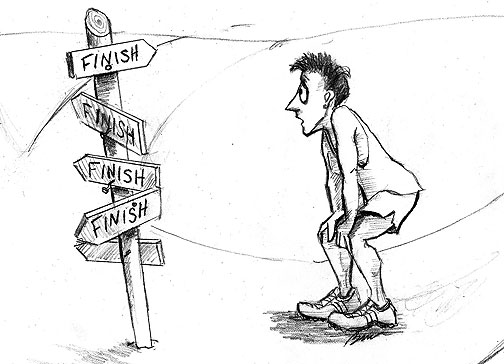
Seven Simple Guidelines for Setting Marketing Objectives Illustration by Bruce Crilly

Illustration:  Bruce Crilly

As you set out to accomplish any long-term marketing initiative in virtually any business, you’ll be faced almost immediately with the task of setting objectives.  Unfortunately, many companies large and small don’t spend adequate time setting – no less understanding the importance of – objectives. If you don’t know where the finish line is, how can you pass your competitors in the home stretch?  Below, seven simple guidelines to understanding and setting marketing objectives.

1. Embrace Multiple Objectives and Objective Types
Depending on the size of your organization, there may be many objectives, and they should be categorized according to who will be accountable and how they will be measured. Loosely, you can have hard and soft objectives, where hard objectives are directly quantifiable (sell 20 million widgets through the direct channel in the next three quarters,) and where soft objectives are crafted to serve larger goals, like growing the company, or opening new offices, or improving the brand awareness levels. Types of hard and soft objectives include marketing objectives, corporate objectives, operational objectives, distribution objectives, promotional objectives, pricing objectives and more.

2. Be Specific
We’ve all heard about the “SMART” objective acronym, where S stands for “specific.” Since objectives provide a baseline so that performance can be measured, specificity is the most important aspect – what you want, when you want it, what you’re willing to do to get there, etc. “Improve accessibility for our customers” is too vague to align your organization. “Create and deploy a customer support system in the next 18 months that allows our customers to connect directly with technicians and with each other in a format that’s conducive to their trade” is more specific and more useful.

3.  More Importantly, Be Decisive
Sure, you want to accomplish a hundred things, but in the next few months, you should be focused. It doesn’t mean that all your issues are not important, but some will have to wait as you set objectives in a clear order. Even if you are embracing multiple objectives or objective types (see guideline #1 above,) this is not the time to waffle. So decide what you want to accomplish, set an order if you have a lot to tackle, then focus on the first item and get your team(s) (internal and external) moving in a unified direction.

4. Set Up an Accountability Structure
Whether it’s an individual or a team, there must be accountability, and that structure must also have contingencies. If you hire a CMO to turn the reputation of a company around, then that person is accountable to align the teams, manage the processes and meet the objectives. However, if the board of directors holds back the budget, or something unforeseen pops up on the radar, the structure of accountability must be refashioned in accord.

5. Tie Strategy to Objectives
The fulcrum of every marketing initiative is the strategy with which it will be executed. But the center of every strategy should be tied to objectives. It’s pointless to set a strategy without this critical connection. A strategy can be conceived of as a road map, and its efficacy should be judged in terms of the extent to which it meets the destination outlined by the objective set.

6. Don’t Confuse Tactics with Objectives.
I’ve been in many meetings where someone says they have an “objective” of creating a Facebook page. While that may be a desire, it’s not an objective. It’s one tactic (of many possible tactics) that’s really only a means to an end. The objective, (if it included details like timing and other specifics,) in this case, is to create a structure and a location to enable a social conversation around the brand. A Facebook page, as an example, provides a fine tactical solution to meet that objective.

7. Be Flexible/Embrace Creativity
As you can see, there are many reasons to stay focused and stay on course, but there is also an important caveat. With so many factors outside of your sphere of influence (competitors, geopolitical developments, economic fluctuations, emerging technologies, etc.) you must also develop the skill to be flexible, adaptive and even quick to embrace new models as opportunities and threats alike may be poised at the gate. This is also a time to let creativity run its course and let ideas evolve and embrace the magic of improvisation and performance. Once the cameras are rolling, or the mic is live, or the program has rolled out, anything can happen, and often what happens is simply a different “version” of what you expected… that doesn’t make it better or worse. But as long as it’s still on objective, the entire enterprise is elevated by and in the moment. It’s craft at its highest level. Enjoy it when you get there.

Article first published on Technorati

Point/Counterpoint: Who should set the marketing budget – the client or the agency?

Nader Ashway marketingthingy blog post image - who sets the marketing budget

Okay, so I’m borrowing from Saturday Night Live’s classic sub-skit featuring Jane Curtin and Dan Aykroyd.  But it’s the only way I think we can easily platform this complex topic for debate.  For you legal eagles out there, copyrights appear at the end of this post.

Who should set the marketing budget – the agency or the marketer?  This seems to be the question that plagues marketing relationships – especially between small and midsize marketers and smaller agencies.  On the broader scale, it’s pretty easy…larger marketers (and/or public companies) tend to stipulate their budgets way out front, and use previous years’ spend as a barometer, which can be tracked on resources like Adviews, a subscription-based tool from Nielsen. Generally, most of that spend is earmarked for media anyway.

But with smaller/midsize companies and smaller/midsize agencies, it seems that the budget dance is a tricky little two-step, and no one seems to know who should lead.  Let’s explore both scenarios and see which one makes the most sense for you.  Your opinions are invited!

Jane:  The agency should set the budget.
Buying marketing services is similar to buying any other services from any other vendor.  That being the case, you want to get the most bang for the buck.  So you invite a couple of agencies in, set up the goals for the upcoming year (or the project or initiative) and ask them to come back with a proposal that sets out a budget, a timeline, and what they expect they’ll achieve.

The agencies come back with proposals about what they think the marketer should be doing (building a microsite, running an outdoor campaign, running a sweepstakes, maybe,) and what they want to charge you for that. So the benefit is that you – the marketer –  do get to see a variety of thoughtful approaches to your marketing, as each agency will make different types of suggestions and usually prepare very fancy presentation materials!

As far as costs, an agency will typically include management fees, creative fees and expenses for out-of-pocket costs, like media, some third party add-ons, printing, postage, web development, etc.

This is the best way to do it.  I’m not telling what the agency to spend – they can tell me what they want, and I’ll choose from there. Agencies know what things cost, they know what they need to make to be profitable, and they know what I want.  Why should I tell them I have $100,000 to spend this quarter if they can deliver it at $75,000?  I have to be responsible with my budget.

Dan:  The marketer should set the budget.
Jane, you ignorant slut.  Everyone knows that if you ask an agency to set the budget, they’ll come back with a number you can’t afford, that includes every possible marketing incarnation from social to mobile to telepathic or whatever.

Or worse, they’ll suggest an over-inflated, over-reaching grandiose plan that includes tons of media that they can commission at double digits, and tons of dopey ideas like flash mobs and street teams and who knows what else.  [Not that these are bad ideas, but when there are no boundaries, some agencies like to frolic in the fields on your dime.]

If marketers want to get an equal assessment of how an agency can perform, the best way to do that is to quantify specific parameters:

using X dollars, and in Y time frame, what do you suggest to help us meet objective Z? 

Using this simple formula, or expanding it to a more detailed RFP, you will get presentations from agencies that are focused, that demonstrate their core capabilities and that usually have an ROI component attached.  But without stipulating dollars, you’ll never quite be comparing the presentations on an equal footing.

Marketers, YOU know what your goals are.
Not the agency.
You know what your operational expenses are to sell a product or service.
Not the agency.
You know what your board of directors or shareholders want to accomplish.
Not the agency.
You know what you have to spend to get there.
So why ask the agency to tell you?

So.  What do YOU think?  Should the agency tell you what to spend, or should you ask an agency what they’ll do with your budget? 

“Point/Counterpoint” is intellectual property:  a sub-skit of “Weekend Update.” “Weekend Update” is part of a comedy program called “Saturday Night Live,” created by Lorne Michaels; originally written by Chevy Chase and Herb Sargent. © 1975 Broadway Video/SNL Studios.