Taco Bell’s Cool (but weird) World Series Breakfast Promotion

taco-bell-logo

If you’re following baseball, you know the New York Mets are in the world series (yay!) to face the Kansas City Royals, who are returning to the Big Show for the 2nd straight year. The games will air on Fox, who will be selling advertising at the average cost of $450,000 per 30-second spot. A far cry from the $3.5 million that the Super Bowl generates for the same airtime, but remember that the World Series has the potential to stretch out over 7 games. So advertisers are lining up in droves to get their brands in front of sports fans, and also to tie in promotions with the game.

One such marketer is Taco Bell, who is running a promotion called “Steal a Base, Steal a Breakfast.” The promotion parameters are as follows: if a base is stolen during games one or two, anyone can walk into a Taco Bell on Thursday, November 5th between 7:00 am and 11:00 am (in your local time zone) and receive a FREE A.M. Crunchwrap. If no player steals a base during those games, but a base is stolen in games three through seven, then the free offer will stand and be available on Tuesday, November 10th.

This is not the first time Taco Bell has run this promotion – it first ran in 2007, returned in 2008 and then once again in 2012.

But…why?

What does a Tex-Mex fast food chain, and in particular, their breakfast service, have to do with baseball and stolen bases? According to the press release issued by Taco Bell, Marisa Thalberg, the Chief Brand Engagement Officer, “we are encouraging the whole country to root for a stolen base in the Series – from either team – because the player who steals that first base will have thereby “stolen” a free breakfast, our A.M. Crunchwrap breakfast sandwich, for all of America.”

Okay. From a marketing standpoint, it’s always a good idea to piggyback off the momentum of a highly attended/highly viewed sporting event. No argument there. But why is Taco Bell doing THIS?

Well, for one, it’s a pure exposure/awareness play. They’ll run television ads throughout the world series promoting the promotion (that sounds funny,) and through a lot of reach and frequency, they’ll get viewers excited to watch for a stolen base. [To be clear, it’s highly unlikely that they’ll convince non-baseball-fans to tune in with any significance to “root” for a stolen base.] There will also be social media marketing run around the promotion (the hashtag is #StealABreakfast,) that will likely garner a bump in new fans/followers on their various social feeds.

Of course, this is a sales promotion, so they will likely also see a significant lift in their morning traffic on the day when the promotion runs – and most of that lift will be coming from visitors who are not typical Taco Bell customers. So it’s a sampling/trial play. The thinking is “if we can get a million new people walking in to a Taco Bell this one morning, we might be able to convert some percentage of them into return business.” Good solid marketing thinking.

I like this promotion on principle, but the details of it strike me as, well, weird. The “steal” theme is a bit of a stretch, and doesn’t really align the brand conceptually or contextually with the game for the long run. The “steal” is very much a “one-time” or at least relatively rare phenomenon. (Major League Baseball statistics show that the median number of stolen base ATTEMPTS per game, per team is .70.  That’s not a lot.  (Also note that Taco Bell has not run this promotion year in and year out…it hasn’t run for three years, so as far as the average consumer is concerned, it’s NEW.) I’d much rather align my brand for the long term with a concept that has lasting power, and maybe some appreciable repetition involved that continues to remind consumers of the brand.

As a rule, we don’t associate baseball with breakfast. (It’s an afternoon or evening game, in terms of general perception.) Generally, we don’t associate baseball with “southwestern” or “tex-Mex” food styles. (The National Hot Dog and Sausage Council (NHDSC) estimates that more than 30,000,000 hot dogs and sausages will have been sold in baseball stadiums alone this year.) And generally, we associate the word “stealing” with something bad or wrong, (in fairness, unless you contextualize it around the offensive game in baseball.)

So this promotion is offered by a Tex-Mex fast food restaurant that sells tacos and burritos, centered around a game that makes a good living selling tens of millions of hamburgers and hot dogs, is promoting breakfast during what will be all night games, is built around a phenomenon that happens rarely, and is associated with a word that we all perceptually agree is something wrong.  That’s why I find it a bit weird. Oh, and if no bases are stolen during the World Series, then, well, no hay desayuno gratis para usted, mis amigos.

Taco Bell has been on a downward slide in the recent period, (according to MarketWatch, its parent company Yum! Brands’ shares are down 18.6% over the past three months,) so it makes sense to do SOMETHING to draw attention to the brand.

And I think the brand will likely see some good numbers coming out of this promotion. But, based on the transiency, I’m not sure it will have the lasting effect they’re hoping for. The cost/benefit analysis will likely allow the marketing executives to keep their jobs for the next quarter, but then you’ll probably see the next “one-off” event/promotion thingy happening.

If you’re going to call attention to your brand with any kind of promotion, remember to do so in a fashion that bonds consumers to it for more than just a “quick hit” and that makes sense with your brand values and your category positioning. Think about alignments that have perennial value, and you’ll roll up fans and maybe even loyal customers for years to come.

Marketers: Get in the game!

Whether you’re a mega-global-brand-giant or a small regional player trying to get noticed, marketing can be a complex enterprise, indeed. So many factors to consider. So many competitors. Choosing the right channels. The nuances in the target segments. What are the right objectives? Which daypart? Oooh! And our social feeds need to be updated, too. Yikes!

All of these complexities pre-suppose that marketers of all shapes and sizes are active in the consumer (or b-to-b) arena, each taking their shots at the proverbial goal – often missing, and occasionally scoring a heart-stopping buzzer beater. But the unspoken truth is that very often, and in some cases with alarming number, marketers are simply sitting on the sidelines, waiting for the right time to “get in” in the hopes of maximizing their scoring opportunities. (Alright, I’ll quit it with the sports lexicon, but you get the idea.)

Why in the world would a marketer choose to NOT market?  What we see in many cases is the symptom of “analysis paralysis.” You’re bunched up with budgets, message, partners, coordinating schedules with holidays or industry-important trade shows. You’re waiting for approvals or certifications. In the meantime, other marketers in the category are gaining ground simply by being visible.

One familiar refrain: “we can’t afford to do marketing right now, so we’re waiting it out.” The simple truth is this: you cannot afford to NOT be marketing. It’s become more critical now than ever before, since we live in an “always-on” socially connected world. In your absence, your competitors are making impressions, driving conversations, making conversions and building engagement. Sure, sometimes it’s on a small scale, and sometimes they may misstep. But the consumer segment you’re all after is being “trained” that your competitor is a brand that’s ready to be engaged with. Your brand, even if it’s empirically “better” in some respects, is invisible in the meantime, and therefore not considered at all as a player in the category. Now that’s costly.

Another recurring pattern is that marketers are tentative, afraid to go out with a “less-than-perfect” iteration of their materials: the website isn’t quite there, or the first cut of the spot was a little rough and could use some cleaning up.

While we all strive to get it as right as possible every time, you’re perfectly allowed to make a misstep here and there in terms of presentation. Not every performer has his or her best night every night of the tour, and not every marketer is going to nail it on every impression. As long as your misstep is not of the “off-brand” or “off-message” variety, you’ll be fine. Every major brand started modestly, and built off their small successes to improve their messaging and put a more shiny coat on their advertising.

So get off the bench, lace up your briefcase, and get out there with your marketing! Who knows? You might even score a few points with your audience.

Here’s a quick checklist:

  1. Do you have a product or service that can be sold to a consumer [or intermediary] right now?
  2. Do you have a brand promise associated with that product or service that can be turned into a compelling marketing message?
  3. Is that brand differentiated from competitors in your category?

Then YAY! You’re ready to go! You can basically start marketing immediately. How much, or how aggressively, is up to you.

Nice Legs, DirecTV – but a little hairy.

(Part 2 in a 2-part series examining a current campaign.)

In my post from last week, I wrote about DirecTV’s most recent campaign featuring Rob Lowe in a series of very entertaining commercials. And while I lauded the campaign for having “great legs,” I also alluded to some parts of it that might not be so appealing.

Each spot starts out with the line “Hi, I’m Rob Lowe. And I have DirecTV.” It’s then followed by another “version” of Mr. Lowe – we’ve seen “overly paranoid” Rob Lowe, “meathead” Rob Lowe, “super creepy” Rob Lowe, “scrawny arms” Rob Lowe and others, all of whom complete their introduction with the sadmission “and I have cable.”

So the joke, of course, is that this is Rob Lowe playing other characters to highlight the DIFFERENCES between DirecTV as a television delivery service and cable carriers (sort of all lumped together.) In some spots, the focus is on sports programming. In others, its uptime. So features and differentiation points abound.

And as I mentioned, these spots are FUNNY. They’re well-written, with a rhythm and a meter that you don’t often see in many spots today. Kudos to the writers over at Grey for developing this campaign (word on the street is that five new executions will appear this year,) with a wit and a style that’s very clean.

So what could possibly be WRONG with these spots?

DirecTV is using these spots to say that they’re decidedly a better brand, based on features and the benefits they deliver. Which is fine. Brands in the same category have been beating the snot out of each other for the better part of a century. No big woop.

But the underlying tonality of these spots is a mocking one. These spots imply that if you have cable, then YOU are some sort of creepy/scrawny/awkward goon. So, for one, that’s just not nice. Two, it’s not really funny when you mock someone for who they are. (But they get away with this – deftly, I might add – by making it a “version” of Rob Lowe…so there’s always that reminder that you’re suspending your disbelief for 30 seconds.)   Three – and this is the doozy – who in the world does DirecTV think are their best targets? Yeah. It’s cable customers. The very people they hope to acquire as DirecTV subscribers.

So, basically, DirecTV is making this statement to cable customers: “Hi, I’m going to make fun of you, and lump you into a loser category of some sort, and make you look foolish, and then I hope that you’re super enthused to buy my product.” See how the logic there is a little goofy?

An interesting side point here: unlike most tete-a-tetes between brands (think Coke v. Pepsi, McDonald’s v Burger King, etc.) this campaign isn’t against a key competitor. It’s against a whole category. Single brand (DirecTV) takes a broad swipe at an entire category (cable companies.) It’s brilliant, strategically…because it’s hard for cable companies to organize a counter-strike.  [Sidebar: it’s a lot like the Mac vs PC spots (TBWA/Chiat Day) that launched (yikes!) nine years ago. In that campaign, it was a single product against a whole category, too.]

Overall, I’m splitting hairs here. These ARE funny, well-thought, well-executed television commercials that have all the important ingredients: a good strategy, strong production, great performances, and a simple and strong call to action (every spot ends with the decisive “get rid of cable.”)

There’s a very fine line between caricaturing and name-calling. And that line gets even thinner in advertising. I think the coming executions will be even more outlandish and more comical than the ones we’ve seen. But I’d LOVE to see the results data on this one, and see if any of the name-calling backfires. After all, a lot of meatheads DO subscribe to cable.


The “other” – and really important – part of your ads

Advertising creative has a lot of moving parts.  There’s the brand’s voice and its implicit promise.  There’s the creative idea that’s holding the ad together.  There are the visuals.  The copy.  In many cases, the VO and the supers and the animation and the call to action.  And the magic pixie dust that we’re all after to sprinkle it with some kind of lasting power and persuasiveness.

But there’s this “other” part that no one really talks about.  The critical part (or parts) that the consumer BRINGS to every ad.  I realized recently that not many of us are including this in our craft.  And it’s time to change that.

Even though advertising seems like a one-way conversation (the brand just shouting out “look at me!” or “sale ends tomorrow!” or in some cases whispering “get over here, sexy,”) it’s not.  The consumer brings a lot of stuff into the mix, and in that magic moment when she reviews your work, it’s deeply influencing how she perceives the brand you’re working for.  I see advertising much more as a careful dance between brand and consumer, and there are a lot of attitudes, feelings and suspicions providing the background music.

There are probably a million little attitudinal elements that consumers bring to ads, but I’ve narrowed it down to what I think are the six most important:

DESIRE.
We all know the pure fact that none of us would have a job if consumers didn’t have wants and needs that they’re trying to fulfill every day.  And in the modern American experience, brands are fulfilling all kinds of desires for consumers every day.  It’s important to distinguish needs and wants here…It may be very true that consumer X needs motorized transportation to take him to and from work.  But he WANTS a BMW, based on the experiences he’s had, and likely, the advertising he’s seen.

You can do a whole semester just on consumer desire, but understand this:  we’re all clawing and scratching for the same things deep down.  We want people to like and affirm us.  And (some might see it as sadly,) we strive for that by what we do, what we wear, where we eat and the labels on everything we consume.
The consumer brings desire to every ad.  Fulfill it.

KNOWLEDGE:
Consumers are smart, and getting smarter about the things they want and the products they buy.  But they’re also smart about advertising.  They know (mostly) that they’re being retargeted in digital.  They know why they’re receiving certain offers in their inbox.  And they know that slick copywriters are weilding language in a way that shrouds the selling messages.  So they’re looking through that.  And by the way, they’ll know when you’re wrong.  Here’s an example:

citi_lo

Cute ad, right?  Makes the point about the convenience of the Citi Mobile App, and ties it right into the language of the subway commuter.  (As you can see, this ad appeared on a subway station in Manhattan.)

One small problem:  THE B TRAIN DOES NOT STOP AT 14th STREET.  And since the target consumer also brings knowledge of the NYC Subway System to the reading of this ad, the wheels kind of fall off abruptly.  The consumer starts reading and says, “wait…the B doesn’t stop at 14th street…it goes express to West 4th.”  The imaginary part of the conversation might then continue, “well, if Citi doesn’t even know the basics of the subway system like I do, how can I trust them to know more than me about mobile banking?”  See?  It’s some dangerous shit.
The consumer brings knowledge to every ad.  So get your facts straight.

PROBLEMS.
One of the cornerstones of marketing [and why advertising exists] is the premise that consumers are trying to solve problems in their daily lives.  They ask internal (and sometimes out loud, if you ride the subway long enough,) questions like “how can I lower my blood pressure?” or “how do I get my ass to look good in these jeans?” and “what steps should I take to prepare for retirement?”  And similar to the desire stuff we discussed above, in many cases, they look to brands to help them solve those problems.  Not every ad can do that.  But in the ones that are explanatory, and for products that might aid consumers, give ’em a little help, eh?
The consumer brings problems to every ad.  Help him solve at least one of them.

CURIOSITY.
Consumers are inherently curious.  Heck, you might say we’ve trained them to be.  Every day, new products come out, new services, new concepts to help them solve problems.  And they don’t just want to know what you’ve got, they want to know what’s behind the curtain, too.  You don’t have to give away the farm, but you can certainly meet this need with a few well-placed words, images and ideas.
The consumer brings curiosity to every ad.  So satisfy it.

BIAS.
As nice as consumers are, they can be pretty picky, too.  Or grumpy.  Let’s face it, they’ve seen like 5,000 ads already today, so the last thing they’re interested in is your opinionated, slanted, over-promising, under-delivering puffery.  No, you have to understand that the person you’re talking to is smart, experienced and has opinions of her own.  So tread carefully, make your case convincingly and you just might change a mind or two along the way.

exxon_lo

Here’s another ad I saw while riding the subway this morning.  Attention-getting?  You betcha.  But when you think of the bias the consumer brings to the reading of this ad, it’s either an immediate “yes” or a decisive “no.”  I don’t love those odds, and would rather have a “definite maybe” from every eyeball.
The consumer brings bias to every ad.  So overcome it.

If you’re involved in either the strategy or the craft of advertising, make this the last item on your review of the work:  what’s the consumer bringing to the reading of this ad, and are we addressing that intelligently and in alignment with the brand who has entrusted us?  It’s quite a dance when you get a hang of the steps.

Affiliate Retargeting: the next, next thing?

In marketing, there’s almost nothing new under the sun. Even new developments in mobile and RTB are just platform-leveraging automations and algorithmically-enhanced functions of previous procedures. But what would happen if we took two sort-of-new concepts and smashed them together?

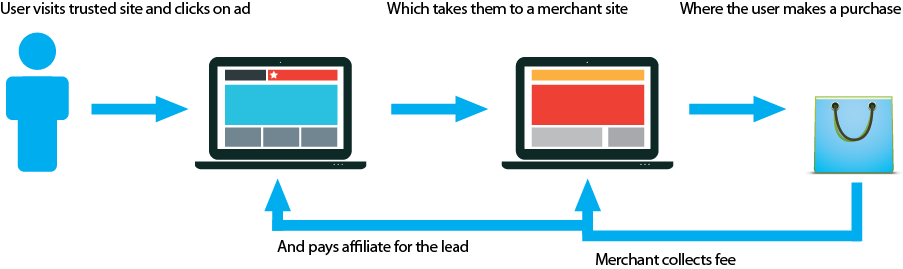
Here’s what I’m talking about: we all have a pretty good idea of what affiliate marketing is. In this arrangement, a marketer pays an affiliate on a performance basis for referral clicks from prospects. Clicks are more likely to occur when the prospect has trust in the content provider and understands that there’s an implied endorsement of the marketer’s product or service. The financial model is typically a revenue share.


affiliate_model


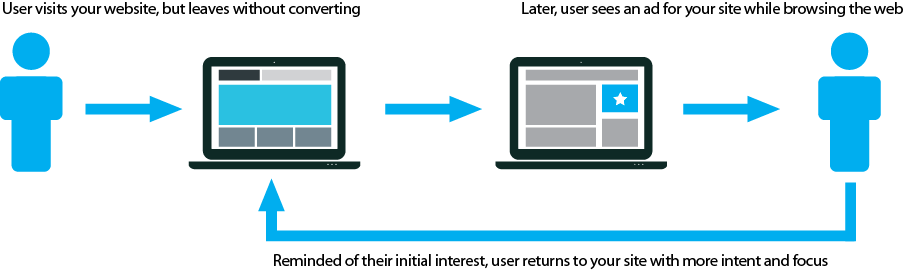
We also have a clear understanding of what retargeting is. In this arrangement, a cookie is dropped on a potential customer’s computer after they’ve visited a particular site. For a period of time, that prospect is served display ads for that site/product/service, creating context and recall. The financial model is typically on a CPM basis.


retargeting_model

Both of these are used in many ways, with varying degrees of frequency, and usually as a component in an integrated digital marketing plan. But what if we took these two models and smashed them together?

I’d call it affiliate retargeting.

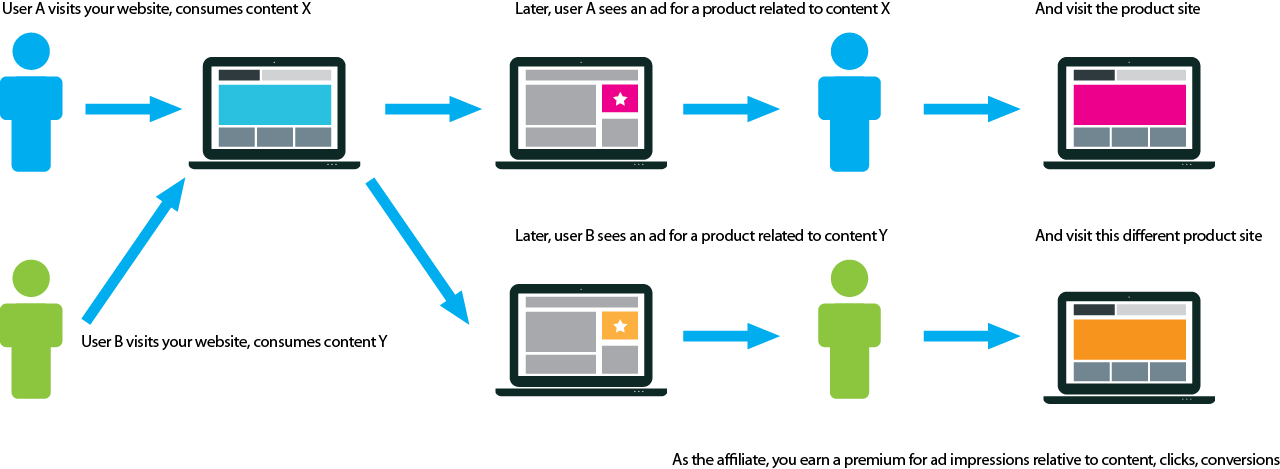
In this arrangement, a prospect visits a site and consumes or browses content. A cookie is dropped on that prospect’s computer, and then contextual and relevant ads would follow that prospect around the web for a period of time. However, the ads would not be simply from the site the prospect visited, but rather from affiliated, relevant marketers that have made an arrangement with the content provider around certain keywords and targeting variables. (I smell an algorithm cooking!)


affiliate_retargeting_model

For vertical marketers, in either consumer or business marketing, this could create much deeper context and help prospects connect the dots. Here’s a simple example:

Let’s say you have a prominent blog in the popular music category. Let’s call the blog “MusicToday.com.” The site gets serious traffic, and discusses all the latest news, releases, tour information and more for various artists, categorized by genre. A prospect visits the site, reads an article about a country artist like Carrie Underwood, then exits the site. For the next several weeks, any number of marketers may be interested in serving ads to that prospect, especially if we could ascertain some basic targeting parameters:

  • A television network may be about to broadcast a special featuring the artist and is looking to increase tune-in. They may be one of the retargeters affiliated with MusicToday.com.
  • The record company may be trying to push a Carrie Underwood greatest hits album, or tour dates. They may be one of the retargeters affiliated with MusicToday.com.
  • A fashion brand may have a co-marketing deal with the artist, and wants to drive traffic to stores to check out her new line of signature jeans. They may be one of the retargeters affiliated with MusicToday.com.

In this arrangement, the affiliate would purchase the display ads (through an automated partner of course,) and pay a CPM for the impressions. The retargeters would pay the affiliate on the same model, but likely with a premium added for a more “qualified” or “targeted” impression. They may also set up an arrangement where conversions pay out on a revenue share model.

With all this talk about “brands as publishers,” this would really create a model where any blogger, content provider, gossip site, even corporate marketer could become a publisher in the truest sense of the word.

Is affiliate retargeting being done currently in b-to-b or b-to-c? If it is, I’d love to know how partners are arranging these deals, how they’re measuring/tracking performance and what kind of automation is being leveraged.

If it’s not being done, what the heck are we waiting for?