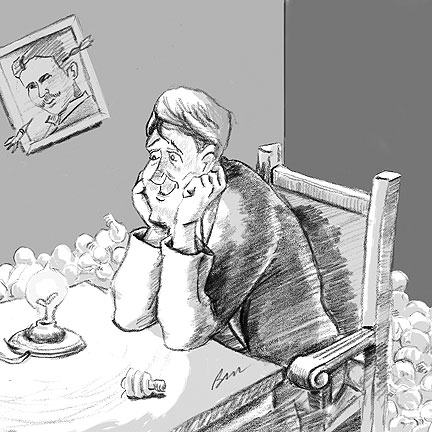
The Law of Failure

Illustration:  Bruce Crilly

It’s been noted in many places that Thomas Edison [caricatured above] may have failed as many as 1,000 times at inventing an electric-powered light bulb, and when asked about his string of failures, he turned the tables by saying (and I’m paraphrasing,) “I didn’t fail 1,000 times. I succeeded at inventing a light bulb, and it took 1,000 steps to arrive at it.”

A recent New York Times article asked the question “What if the Secret to Success is Failure?” when discussing education and character among school-age children. Do a search on “failure,” and you’ll find inspiring stories of heroes of history who have failed mightily on the way to great successes: Churchill, Einstein, Darwin, Pasteur, Ford and on and on.

And at the recent DMA International Conference in Boston, Biz Stone, co-founder of Twitter, turned failure on its head relative to social media, stating “if someone posts a negative comment about your product, it demonstrates a level of investment and passion about your brand.”

Okay, that’s a lot of fluffy and warm and puppies. But in business – and particularly in marketing – we’re trained otherwise. For most of us, “failure is not an option” for our next product rollout, or our next advertising plan, or our next event. However, if we embrace The Law of Failure, we might find that failing helps to reveal what success really looks like.

In almost every business, professionals fail their way into success, typically in a process of elimination continuum: try › fail › tweak › repeat until try ultimately leads to success. At which point, you test the snot out of that success to ensure repeatability and reliability. This is true in engineering; in medicine; in sports; in fashion; in entertainment; in technology; in a zillion other categories.

In marketing and advertising, (direct, media, creative,) we call it “testing.” But testing is simply an accepted euphemism for “financing failure to yield better strategies.” Why else would almost every big campaign be run through focus groups first?  Why test your spots on samples of your target demographic? It’s not so much that you can see what WORKS, but rather that you can reveal what DOESN’T.

My theory on why it is so vehemently avoided in the marketing/advertising arena is simply because of the money flow. When doing medical testing, for instance, the medical company has an R&D budget to cobble away in a lab for sometimes years at a time. In engineering or technology, all the sunk costs are stacked upfront – sometimes financed by venture capitalists – and millions or tens or hundreds of millions of dollars might be spent to arrive at a new design/product/solution that then gets recouped upon selling/distributing/launching.

But in advertising, the money flow is different. The typical relationship is an outsourcing model (company x hires agency y to develop the marketing program) that puts the pressure on the marketer to justify that spend and that agency choice. It’s our money, so you better spend it wisely. No marketer I’ve ever met wants to hear in the pitch “yeah, we’re gonna spend a percentage of the budget on failing.”

But that’s essentially what’s happening. Sure we do research, we do cluster analyses, we create predictive models. My colleague David Adelman at OCD Media is a media planner who creates predictive models in order to yield what he calls the most “testable propositions.”

The only problem (in advertising and marketing) is that those propositions are tested out in the marketplace, and failure is seen as a scarlet letter on the breast of the marketer (and in many high-profile cases, the agency, too.)

But I propose that failure is not a sad end to high hopes, but rather an intelligent investment in future successes.

When you fail at strategy X, you now have saved an innumerable amount of money because you KNOW that strategy X won’t work (under the current conditions.) You can instead pursue strategies Y and Z. And if they fail, you save proportional amounts, and so on. KNOWING is powerful.  Failure leads to knowing, whereas success is sometimes an intoxicating mix of planned well, guessed right, timed it right, chose a good director, etc.

This might not fly at your company if you’re a slave to the quarterly conference call with the board and have to explain that you’re failing. But if you’re a small to midsize marketer – you’ll never spend money any more wisely than by failing and KNOWING what to avoid in the future.
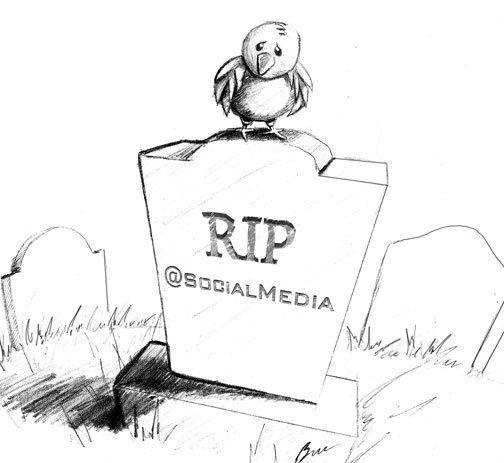
Death and Social Media – version 2.0

Illustration:  Bruce Crilly

The below is a follow-up to a post I wrote back in July 2010. First, the original post, then the follow-up:

Death and Social Media
This is a morbid way to discuss an idea, but let’s talk about death. And while we’re at it, let’s talk about social media. I was (briefly, fleetingly) thinking about what would happen after I die, and the kinds of things people would remember about me. (And more exactly, the kinds of things I hope people will remember about me.)

In my life, (and I’m not quite done yet,) I have created volumes of content in the social media world: blog posts, and blog comments, Facebook statuses and comments and likes and picture uploads and all those Tweets, reTweets and direct messages on Twitter! I’ve yelled about firing the head coach of my beloved Buffalo Bills on the fan forums on buffalobills.com, and helped people solve technical problems on support forums for Apple computers and some software platforms. I’ve written record and book reviews on iTunes and Amazon. I’ve uploaded and even commented on videos posted on YouTube! (Eeek. What a geek.)

So I wondered, will this become part of what people remember about me? Will there be people at my funeral saying, “yeah, nice guy…oh! And did you see his Tweets from the IAB mobile conference back in 2010? So insightful.” Instead of a collage of photos, will there be a screen somewhere with a streaming feed of my life’s digital output?

On one hand, I seriously doubt that these bits and bytes of my recommendations, forwards, hashtag snips and extemporanea will have any bearing on what people think about me. But on the other, there’s no getting around the fact that social media content is now a contributing editor to my legacy. I also submit that I think it would be an interesting, revealing and even fairly intimate way to chronologically peek into the ebbs and flows of my (mostly) professional life. Which makes me think: are we (am I?) Tweeting accordingly? Is the overall tone of my social commentary admirable/useful/honorable? Will my children be proud of what they read? Does it really matter how many check-ins I have, or if I’m the bloody mayor of some local bar? Jeez…maybe we better start looking at all of this in context.

In older days, we might have discovered a diary under a bed, or a journal tucked away in a closet somewhere, long after the departure of a loved one. But now, we have a digitized database of someone’s every thought and comment for years and years. And since most people in the world will never author a book, or write a professional article in a real journal, or be interviewed for television or radio, is the chronicling of social media verbiage a new means to endure? [Uh oh, I think I smell a new business model being hatched.]

Follow-up [September 2011]
So it turns out I was on to something about new business models being hatched, and people starting to talk about this morbid stuff with a more, um, opportunistic tone. A year after my blog post, a journalist named Adam Ostrow gave a TED talk that covered this topic – and outlined some new business models that are indeed being hatched at the intersection of death and social media as “opportunities for technologists.”

The first (and perhaps weirdest) is ifidie.net, a service that lets you create a message or video to be posted to Facebook after you die. Check out their website…kind of a wacky approach to a fairly serious topic.

“My Next Tweet” is a service that uses an algorithm to predict what your next (and perhaps last) bit of social output would be on Twitter by analyzing all your previous tweets and retweets.

Finally, Ostrow points out 1000 Memories, a service that allows you to organize, share and ultimately post a collection of photos, memories, writings and more to Facebook or an area of their site. Not just for the dead, apparently.

On the flipside of all that nonsense, there is a beautiful side-effect to digitizing one’s last days. I recently read a gorgeous narrative by Rebecca Armendariz chronicling a series of Gchats with her lover that is both heartwarming and gut-wrenching, and exquisitely written. Read it and (be prepared to) weep.

I suppose all of this does lend gravitas to the idea of self-monitoring your digital expressionism. Once you’re gone to the great mashup in the sky, you don’t want one of these dopey services misrepresenting your life’s social work. So if today is indeed the beginning of the end of your life, social-ize accordingly.

Ten Apple Traits Every Small Company Should Emulate


Illustration:  Bruce Crilly

With the recent resignation of Steve Jobs, I began contemplating the company he built more than 30 years ago with a Woz and a dream. Apple Computer, which recently (briefly) overtook Exxon/Mobil as the world’s most valuable company, has had its share of ups and downs. Just a little over a decade ago, they were teetering on the edge of irrelevance, losing ground to new manufacturing and software entrants. Today, however, the company has a total value close to $350 Billion, legions of loyal evangelists and, despite Jobs’ recent announcement, a very bright future under new CEO Tim Cook as the sitting-architect-in-residence of modern computing and electronics.

They didn’t get there by accident. At Apple, Inc., there is a culture of progress, and businesses at the micro level can learn a lot by examining Apple’s behavior. Sure, most of us may never get to their size or influence, but that doesn’t mean small and midsize businesses – in virtually any category – can’t wield the same traits and characteristics and, hopefully, realize similar successes.

Here, the top 10 fundamental traits of Apple that any small and midsize company can emulate:

1. Embrace Innovation. Apple has embraced innovation in virtually every aspect of their business. Not just in the products they develop, but in how they manufacture them, ship them, sell them, update them, service them and finally obviate them with new and improved models. Embrace technology, look for avenues to optimize performance from your team, and adopt a culture of “what can we do next, what can we do better?” at your company to emulate this enviable trait.

2. Anticipate (and even create) Consumer Needs. One thing Apple does very well is think ahead, and think deep into the hearts and minds of their consumers. No one ever thought that they needed a telephone, AND an Internet browser, AND an email client AND an iPod AND an app player, all in one simple device. But when Apple created iPhone, everyone suddenly NEEDED one. Why just give your customer base what it wants, when you can give them more than that, or better yet, something they don’t know they want yet? It’s a great way to bond to consumers and, in strategic terms, to immediately dominate the category in which you operate.

3. Form Smart/Strong partnerships. Apple has done this in many different ways. From manufacturing partners to content partners to the legendary App Store developer partners. Sure, they may dictate the terms of how things will go, but they leverage the talents and abilities of innovative companies that operate well outside of Cupertino. Look around in and outside your category – who can your business partner with to emulate this trait that helps you to grow or helps you improve in some way?

4. Never Forget Your Entrepreneurial Spirit. It’s a classic story: Jobs and Woz in a Silicon Valley garage, building machines from scratch, selling on credit, scrounging for parts and never wavering on their dream to build something new, something special. And that spirit is still evident in every new product launch with Jobs smiling, bragging and still trying to out-geek every geek out there. Sometimes, in our businesses, we tend to forget why we started, how much we love what we do, how good we have it and more. Maybe it’s time to re-kindle that passionate spark?

5. Push Into New Categories. At one point, Apple only offered two core products: a slick operating system and the machines it ran on. Then, about a decade ago, they had an idea to use their skills and optimize their DNA to create a different kind of device that played music. The iPod pushed Apple into a new category (music/entertainment,) that then exploded into the iTunes revolution, that gave way to even more categories (movies, telephones, tablets, etc.) The key here is that even with iPhone and iPad, they have never strayed too terribly far from their core capabilities: intuitive operating systems, running on elegantly designed devices. Think about it. What’s driving your business? And how can you use your skills/your team/your assembly line/your supply chain to push into a new category…or two…or four?

6. Embrace New Channels for Your Business. It’s hard to believe, but for a while, you could only get Apple products (and they were basically only computers) from “authorized resellers” who were few and far between. But Apple realized that retail was a viable channel, especially since their product offering was now appealing to a more mass audience. By embracing retail, they also created new opportunities to expose more people to Apple’s core line of devices and software. Think about your business: can you sell through an intermediary? Can you create a direct dialogue with your core audience? Can you segment or discover a new audience altogether? It might be a viable opportunity to create new revenues without much more overhead.

7. Have a “Cool Factor.” One of the most defining characteristics of Apple is that their products are simply cool. The devices are cool-looking, they play or display cool content (like music and movies and apps and games,) and through a combination of factors (like smart partners – see #3 above – and elegant design; see #8 below,) the company has managed to basically de-position all or most competitors as stodgy, or clunky, or un-hip, or simply, (despite a strategic partnership) as “Windows.”

8. Commitment to Design. One of the key players at Apple is Jonathan Ive, Senior VP of Industrial Design. His influence on clean, elegant, sometimes teeny-weeny product design at Apple has given the entire company a new complexion. While other computing companies are still trying to figure out the “liquid” look for their laptops, Apple presses forward on countless innovations, including the all-in-one desktop computer, the “flywheel” on iPods, the “anti-flip” telephone device, the “it feels so easy in my hand” iPad, the famous “earbuds,” and on and on. A recent article in The New York Times outlined several of the 313 patents Apple has filed for, and one of them is for the iPhone packaging. (Seriously, the packaging is patented.) Even if your company isn’t in the devices business, have a designer look at your business from top to bottom and see if you can’t match your company DNA to an aesthetic and interactive sensibility that elevates the experience of doing business with you.

9. Simple, Effective, and Consistent Advertising. Throughout Apple’s history, advertising has played a central role to how the company promotes its products and disseminates product feature information. And with its (almost unheard of) longstanding relationship with TBWA/Chiat Day, there has been a driving force of simple, features-based, single-concept advertising. From the moment Apple introduced itself to the world with the Ridley Scott-directed
“1984,”
through the “Think Different” campaign of the mid 1990’s to the “Hello, I’m a Mac” spots of recent years, Apple and their agency have always kept it simple and pithy. Any company can learn a lot about how to promote just on the basis of Apple’s advertising track record. Not just what they do, but that they do so much in so many channels (print, radio, tv, outdoor, direct, institutional, one-to-one, etc.) with such consistency.

10. Make Brand Matter. Of all the items listed above, or perhaps as the sum of all items listed above, the most important of all is that Apple has had a very strong commitment to their brand. The products stand for something that is tied to the ethos of the company and its founders. The collective perception of most people around the world is that Apple IS cool, and that’s not by accident. “Designed by Apple in California” is more than just a copyright line, it’s nearly a profession of faith. NONE of this is happenstance or coincidence. It’s been a carefully scripted, scrupulously architected vision of what the company wants to MEAN to its consumers, its competitors and its out-of-category passersby. Of all things, use this as a compass for your company, and work to create a relationship with your consumers that transcends what you do and what you sell. It will carry your business across virtually any obstacle, any economic condition, any CEO resignation. Think Different.

Article first published on Technorati.

The Four Cornerstones of Driving Traffic

I recently held a garage sale (how suburban of me, eh?) and, while it was a success, it could have been much better. Definition:  I didn’t sell everything I would have liked to sell.

The issue, I have surmised, was not a question of our inventory or our location or our quality level – it was simply a matter of driving the appropriate traffic. [Note:  a follow-up report from the garage sale indicated that we converted sales at approximately a 25% ratio:  for every four people that came by, one made a purchase.  Not bad.]

While I covered all the requisite bases, there was a lot more I could have done.  It reminded me that small and midsize brands face the same traffic issues every day.  Whether you’re a website, a local retail shop, a restaurant or even a midsize b-to-b service provider, driving and sustaining traffic is central to your survival.

Irrespective of the media you choose, or the vertical you’re in, or the market(s) in which you operate, here are four critical cornerstones to understanding and driving traffic that I’ve branded as the “TMX2” approach.  These are in no certain order, and in many respects, have to be considered simultaneously.

The first cornerstone:  Targeting
Driving traffic begins with a clear understanding of the prospects you WANT.  If you’re working with a media company who’s doing planning for you, you can probably get to a very decisive target.  But if you’re not (maybe you’re small, maybe you’re not sure,) you can ask yourself important questions:  who is the “ideal” customer?  What is the ideal “deal” for that customer?  How can I provide that structure?

Two important targeting sub-themes here:  think virally and think in segments.
First, in the age of social media, ask yourself another targeting question:  Who will be likely to “spread” my message post-purchase?  Second, don’t be afraid to segment.  You can’t be all things to all people, but you can be one valuable thing to one segment, another valuable thing to another segment and so on.  For more information on segmentation, check out the VALS Framework, pioneered by SRI.

The second cornerstone:  Timing
Two facets of timing are essential.  First, give your offer or your brand or your new product launch ample time to sink in and make the requisite impressions.  So often, marketers have great ideas and fantastic solutions to offer, but we bail when we don’t think it’s happening quite quickly enough.  We already know that the American consumer (or business owner) is inundated with zillions of marketing messages every day.  Sure, you have to cut through the clutter with good messaging and solid creative, but you also have to allow for the message to seep in…there’s a reason “frequency” is a cornerstone of every media plan.

The second facet of timing is more delicate – you have to offer your consumer what they’re looking for, at a price he or she is willing to pay, at the right moment.  Not quarter.  Not month.  MOMENT.  This is why the term “real-time” is being bandied about so often in marketing seminars and business conferences around the world.  See articles on real-time marketing on Mashable.

The third cornerstone:  Message
While it’s impossible to cover everything about messaging in an overview, be clear about this:  you can target the right customer, deliver your communications over the right medium, time it perfectly and still not influence or stimulate demand if your message doesn’t resonate with your customer.  So how do you make that happen?

It’s not simple, but make sure you cover at least the following:  Claim the highest possible emotional benefits that speak to your audience (or segment.) Add rational support for choosing your product or service.  Be absolutely relevant.  And don’t be afraid to be a little unexpected – a little cooky.  As long as those other aspects are covered, cooky can work and usually does because it’s more memorable and more entertaining and more differentiating.

The fourth cornerstone:  Mission
Here’s a cornerstone of driving traffic that can easily get overlooked.  Very often, we achieve results when we undertake a marketing effort.  But sometimes, the early returns can influence our perceptions about what we’re trying to achieve.  If things are going great in the first month of a new campaign, everybody starts to project HUGE numbers for the program, and forgets that you had an objective to only move the needle by 10%.  If things start out slow, we may assume that “this is never going to work,” and we forget that we only want to move the needle by 10%, so we crush the program before it has time to sink in.

The best way to avoid abandoning the mission is to document it.  Write it down where EVERYONE involved can see it.   That’s right.  Everyone.  The client.  The agency.  The vendors.  The investors.  Everyone.  “WE WANT TO SELL 22 MILLION WIDGETS AT 19¢ IN THE NEXT YEAR.”  Or “WE WANT TO INCREASE WEB TRAFFIC TO 100,000 UNIQUES PER MONTH IN THE NEXT TWO QUARTERS.”  Whatever it is, keep it sacred and don’t abandon it.  You’ll find that it absolutely aligns every stakeholder and, if you build on the other cornerstones, you’re likely to be pleasantly surprised at the traffic jam just up ahead.

Article first published as The Four Cornerstones of Driving Traffic on Technorati.

Apple’s iPad2 launch: sold out or sellout?

Sure, I know.  It’s pretty rare you hear the words “Apple” and “fail” even mentioned in the same neighborhood (unless it’s a snicker aimed at 1993’s Newton launch,) so let me clarify.

You can call me something of an Apple freak: since my first Mac Classic II in 1990, I’ve upgraded through the IIci, the LCIII, the Quadra line to the Power Mac, Peforma into the Bondi iMac G3. I’m also one of the six people who still owns two G4 Cubes.  I then fell in love with the G5 flatscreen iMacs, and bought a bunch – first the white ones, then the aluminum babes.  My latest supplications:  the latest Powerbook and the 27″ iMac G5. You can call me sentimental:  I still listen to rock tunes on my white (huge) first-generation iPod. You can call me ridiculous:  I was on line in June 2007 for the first iPhone, and have upgraded obediently through iPhone 4.  (And I’ll get my iPhone 5 this June, if they’re in stock!)

But now, you can call me peeved.  This iPad2 release has left me – and a lot of other folks just itching to be separated from hundreds of hard-earned dollars – a bit flat.  iPad2 was launched in stores on March 11, at 5:00 pm. I’m not down on the early evening release:  it helps the retail stores to get their inventory squared away, and get the systems upgraded to handle massive checkouts.  But unless I’m mistaken, it also makes for great localized PR – virtually every local newscast carries stories of the ridonkulous lines around the block at every Apple store in the country. Every day, I visit my local Apple store to hear the sad news from the dude in the blue shirt:  “we had ‘em.  But we sold out. In, like, 10 minutes.”

What’s going on here?  Is this an epic fail of distribution planning?  A gross underestimation of demand?  A glitch in the system?  A return to what Chris Anderson calls “scarcity economics” in The Long Tail?  All not likely from the historically over-prepared Apple Inc.  What’s more likely is that they’re enjoying kicking their competitors in the gut with yet another huge hit of performance computing.  So why not milk every last drop of extra PR coverage out of this sucker?

[In fairness, there are logistical problems facing many parts manufacturers in Japan, impacting their delivery schedules.  (The tsunami and the iPad release on the same day.  Weird.) But Apple has said nothing of the matter – instead, they’re enjoying the long lines and long waits. Call me cynical.]

Here’s the worst part.  I, and many others in my situation, am starting to come to the horrendous realization that maybe, perhaps, just a bit…I could live without an iPad2.  After all, I’ve waited nearly three weeks.  What’s another year?

If your company is considering any kind of PR stunt in the near future, make sure your consumers get the BENEFIT of the stunt, not the brunt of it.