
Wherefore art thou, Facebook?

belgium_hands

By now, you’ve heard of the terrorist bombing attack that took place at multiple locations in Brussels. Awful news. And awfully reminiscent of the news that came out of Paris back in November of 2015.

And when major news events like this happen, people around the world are saddened, or maddened, confused or conflicted. Or all of those things. We can’t quite comprehend these monstrosities, and we yield, typically, to our softer human nature to offer support.

In the modern world, social media provides a forum for us to do this and tell our friends and our networks how we feel. We can demonstrate, protest, or mourn in many digital forms.

Back in November, after the Paris attack, Facebook quickly offered an opportunity to all its billion plus users to show solidarity and support for the French by offering a profile picture overlay of the French flag. This was offered at the top of your news feed.  Your usual mug shot was now overlaid with the red, white and blue stripes of the French flag colors. And millions upon millions of people rushed to switch their pics. Of course, it doesn’t change the horror, but it certainly helps people to know that others around the world are standing with them – whether in prayer, or in purpose.

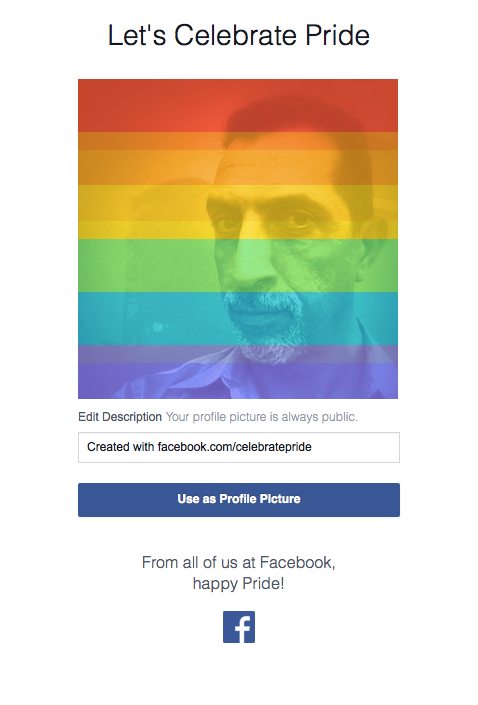
This was not the first time Facebook enabled such a broad-based community alignment. Several months earlier – in June 2015 – Facebook offered a “pride overlay” where you could have your profile picture draped in rainbow colors, following the Supreme Court’s decision to allow same-sex marriage in all 50 states. Here, it was a more exuberant mood, and Facebook enabled its community of users (especially here in the United States,) to show support for the landmark decision. (See below.)

fb_pride_pic_maker

But, interestingly, Facebook has been conspicuously quiet following the Belgium attacks. There is no Facebook-offered profile pic overlay of the black, yellow and red bands of the Belgium flag. Why is this? Does Facebook hate Belgium? Does Facebook favor France over Belgium? Do Belgians matter less than Parisians or gay couples?

This seems odd, and ill-timed for Facebook to be so…selective. Surely, it’s not a DIFFICULT piece of code to offer the profile overlay. And surely, there’s no denying that the deaths of 31 innocent civilians and hundreds more injured don’t merit global support, especially since a terror group has already claimed responsibility.

It wouldn’t be an oddity if Facebook hadn’t done it – nearly immediately, I might add – for the two events I mentioned in June and November of 2015. Indeed, they have set a precedent for this kind of offering. And when they did those others, it was within the Facebook platform – you did NOT have to go to a third party to have it done. [An unofficial user-created page sprung up yesterday on Facebook called “Belgium Flag Overlay Tool.” ]

Why now, then – after something this important and impressive on a global scale – is Facebook so…absent? (And some may also argue, where was the overlay tool for Turkey, or for Mali?)

In my opinion, it’s sending a blurry signal. And blurry signals from a brand so ubiquitous and so central to so many people around the world are dangerous, if not deleterious, to the future of that brand.

Does Facebook hate Belgium?  Of course not.  But it kinda looks that way.  And in terms of brand image and management, that’s about all that matters.

[As a note of fact, if you do prefer to have your profile pic draped in the Belgian flag colors, you can visit the Rainbow Filter website, and choose from the preset “Belgium Filter.”]
Rainbow-colored Research

fb_pride_pic_maker

So, were you one of the millions who “rainbowed” your profile pic on Facebook to show your support following the SCOTUS ruling on same-sex marriage? I was, and quite happily. Then the Atlantic ran this story,  speculating that perhaps Facebook was conducting some far-reaching “experiment” on its users. It also speculates (in the subtext, of course,) that Facebook has likely done this before, and leads readers to surmise that the company may even be actively doing it for pay.

Facebook has never made any claims that it is NOT collecting your data, even on a random Wednesday. In their data policy, which you can find at  https://www.facebook.com/policy.php,  they clearly state – in a jillion different ways:

“we collect the content and other information you provide when you use our Services”

and

“we collect information about how you use our Services”

and

“we collect content and information that other people provide…about you”

and

“we collect information about the people and groups your are connected to”

and

“if you use our Services for purchases of financial transactions…we collect information about the purchase or transaction.”

Now, it’s likely that out of the billion or so users on Facebook, approximately 23 of us have probably read the privacy policy in its entirety. (Busted!) In a previous post on this blog,  I’ve asked about why consumers are so busted up about online tracking, when it makes our lives so much better, and more streamlined. As I said then, tailoring makes our lives better. Cookies make our lives (and our online experiences) better.

If we boil this down to its essence, we’d likely see that the average or typical social media participant is more than okay with the idea that their information and online activity are being tracked in an effort to achieve various ends, like a cooler/faster/more contextual social media experience, or more targeted advertising, or even for social studies. And although we don’t typically read the privacy policy, we’re probably pretty much okay with it, as long as you don’t snag my credit card and go buy $800 worth of frozen pizzas at Wal-Mart.

And so what if Facebook WAS conducting some big-data test with the pride-your-profile-pic exercise? Big woop.  It’s astounding that, in an age where we share more personal information than ever, that we’ve become so hyper-sensitized to that information maybe kinda sorta being “used” for some purposes other than my Grandma Susie seeing my latest motocross bike race. (It was kind of badass, by the way.)

Whether we like it or not, we’re slowly but surely crossing the threshold from web 2.0 to (the social web) to web 3.0 (the predictive web) as a result of all this data tracking that’s going on. It, too, will ultimately make our lives better in ways we probably can’t even imagine right now.

So let’s do a snap poll – provide a simple YES or NO answer in the comments section below (and of course, any comments you care to share are more than welcome):

Are you okay with social media corporations like Facebook and Twitter monitoring your online activity to make assumptions or test hypotheses, whether they be theoretical or commercial in nature?

I’ll start. YES!

Bolton, Burgundy and Cheeky Buzz – Auto Marketers Set a New Tone

If you’ve seen the recent round of spots (they ran throughout the fourth quarter of 2013) for Dodge Durango featuring the fictional character Ron Burgundy, you know how good they are.  Crazy good.  (Kudos to Wieden & Kennedy.) They’re stupid funny, with an offbeat wit that perhaps only Will Ferrell could channel in this character composite, a mashup of 70-‘s into 80’s d-list celebrity relics.

Here’s just one of the many spots that were filmed (likely loosely scripted and then ad-the-hell-libbed-out-of by Ferrell) for the campaign:

What’s more intriguing, of course, is that the spots were wildly effective.  According to this article in Autoblog, Durango’s sales were up a staggering 59% in the first month of the campaign. Similarly, after three months of leadup, (the Durango spots were a marketing tie-up to promote the movie inasmuch as they were car ads,) the movie – who some have said didn’t live up to the hype – has raked in more than $108 million dollars at the box office (as of the weekend ending January 5, 2014) against a $50 million production budget.  That’s a profit, yo.  And it might have something to do with the more than 20 million views the spots have received on YouTube.

In a strange coincidence, another auto marketer (Honda) aligned with its own interesting character to help bolster holiday sales.  In the fourth quarter of 2013, Honda ran a campaign of spots under the “Happy Honda Days” theme featuring Michael Bolton, a bit of caricature himself, something of a mashup of 80’s/90’s pop stardom realism.

In the spots, the VO asks, “what does it feel like to get a great deal at Happy Honda Days?  Cue the Bolton.”  (Cheeky, right? Ri-ight?)  And then Bolton appears, singing wintry feel-good lyrics, like “Spread some cheer, the holidays are here…” and “now that the snow is falling down baby, my love is calling your name…” and the more heavy-handed “It’s a winter wonderland, and the snow is gonna blow.”

Take a look:

All these songs were written specifically for the spots…and they’re goofy, but with a deceptively catchy feel that’s very, well, Bolton.  That’s pretty neat.

But what’s really neat (and perhaps where Honda has out-cheeked Dodge in this strategy,) is the social component that’s wrapped into the spots.  Here’s how the program worked.  In late November, there was a 5-day window when people could message their friends via Facebook, Twitter, Instagram or Vine using a hashtag #XOXOBolton.  Here’s “The Bolton” setting the stage himself:

Then a bunch of lucky winners did indeed get personalized songs from Bolton, and THOSE were really funny too: Check one out, delivered to the difficult-to-pronounce Erdle:

So, major props to Rubin Postaer (sorry, now known as RPA) for taking a good idea and going a few really creative steps further.

In comparing these two campaigns, (Dodge and Honda,) how would you crown a winner?  Is it the quality of the idea?  The production value?  Or the reach?  Dodge and Ron Burgundy rode a wave of laughter all the way to the bank, (for both brands, it turns out.) Honda went the whole way, integrated the celebrity endorsement (and really carried the joke through) in a rich and fun social media activation.

Honda wins on extending the activation and driving engagement.

But at the end of the day, we have a job to do.  And in this inter-office smackdown, Burgundy and Durango win hands down for moving the needle way over into the profit redline.

So…who’s next on the cheeky auto endorsements?  How about Alice Cooper and Verne Troyer for Mini Cooper?  Huh?  Whaddayasay?

Just spitballing here.

Top Five Marketing Resolutions for 2014

As this year comes to a close, I’m reading a lot more posts and articles about the “best” this and the “most” that of 2013.  And yet, rather than reflecting on the astounding advances of the past year, I find myself looking forward.  And hoping.

With that in mind, here are my top 5 resolutions that marketers – of all sizes – might consider in the coming year.  If you’re a mom and pop shop that’s embraced marketing on any level, or a mega marketer that has a department full of b-school overachievers, or a business to business service provider that’s retooling…here are some idea-starters for moving your brand forward in the coming year.

The First Resolution:  I Will Get Integrated.
I know, you’ve heard this one before.  But I’m not talking about integrating digital with your current TV and radio campaign.  Or adding a url to your print ads.  I mean really integrating everything – reorienting everything you do – around your brand and the promise it carries.  And remember that can mean way more than advertising.  If your brand is about fun, then make sure your office is set up for FUN!  Or if your brand is all about design superiority, then pull that superiority into EVERY communication piece…even if it’s some mundane necessity, like an inter-office memo, or a fax cover sheet.  (Remember those?)

Integrating your brand means looking at EVERYTHING you do through a different lens…through YOUR lens.  Just having the conversations with your internal teams about what that might mean will be valuable indeed.

The Second Resolution:  I Will Get Visible.
If you’re not advertising, please start.  We are far beyond the era of marketers who will be able to say “it’s amazing…we’ve gotten really far without advertising at all.”  The truth is, the brands that win are typically the brands that advertise (in some way.) Do you ever wonder why ad budgets go up every year for most companies that are advertising?  Usually because it’s WORKING.  Even if you have a modest presence, or you’re outspent by your competitors, being visible still creates opportunities that invisibility simply precludes.

The Third Resolution:  I Will Get More Social.
Just recently, I heard about a midsize company who refused to embrace social media, despite having a membership-based audience, because they were afraid that someone might hijack their feed with some negative commentary.  The category leader was social.  The flankers were social.  But this brand refused to get on board for fear of one potential dickhead who might take to the Twittersphere with some grade-school gripe.  Instead, they’re missing out on having any number of conversations that might lead to deeper brand involvement, or maybe even more sales.  But a fear of what might go wrong is preventing that brand from reaping all that might go right.

The Fourth Resolution:  I Will Get in Bed with Data.
There are so many amazing things evolving in the analytics realm, it’s hard to consider developing a program without talking about the various incarnations of data tracking that may result.  Just think of the audience data.  Just think of the site tracking.  Just think of the…wait, I’m going full geek.  Oh, hell.  I am a geek!  And I love data.

Think about setting marketing objectives.  Then start thinking about setting data objectives that run alongside those:  what do you want to LEARN today?  Build that into your next marketing program, and you’ll be surprised how fun it is to hang with the geeks.  PS – it’s also a great way to build accountability:  from your creative team, to your media buys to your ecommerce providers…a strong set of data objectives is where the feet meet the fire.

The Fifth Resolution:  I Will Get More Creative.
Despite the fact that data is driving the marketing bus these days, there is no better time than 2014 to get full-on creative. Give your agency or your in-house team or that freelancer you’ve been avoiding a little slack and let them run with an idea or two or three.  And the bigger the idea, the better.  Why not a rock tour?  Why not the side of a building?  Why not get a million people to sign up?

Sure, build in some responsibility markers, and don’t let them do anything that might be considered rude or insensitive, but let’s let ideas fly this year.  Write a jingle.  Listen to an idea from an unlikely source.  Just because you’ve been “doing it this way for years,” doesn’t mean you can’t try something new.  You might have an opportunity to become your very best.  And it might be this coming year.

What are YOUR marketing resolutions for 2014?
Leave your comments here, or better yet, Tweet them at #marketingresolutions


Breaking (Bad) news: Marketers LIE!

I know it sounds like heresy, but I’m here to break bad news: marketers lie. Most specifically, they lie in their advertising. They’ll do or say virtually anything to GET YOU TO LOOK OVER HERE! It’s nothing new. They’ve been doing it for decades, from omitting “unnecessary” items on their package labeling, or touting offers that get negated in 30 lines of 5 pt heavily kerned knockout legal copy.

And it’s hard to avoid. Because in many instances, the competitors are lying too. So some awfully nice marketers are often forced to join in the lying spree to make sure YOU LOOK OVER HERE TOO!

Case in point: Century 21, the national real estate broker, recently perpetrated an outright lie to draw attention to their brand. Wanting to capitalize on the enormous popularity of the AMC TV Series Breaking Bad and tie in to the September 29, 2013 series finale, and seeking a solution around the enormous costs associated with advertising on the show, they opted for a more, um, unorthodox solution.

Century 21, and their agency Mullen, ran the below ad in Craigslist, listing fictional character Walter White’s Negra Arroyo lane ranch.

cent21_cl_ad

See the full listing at http://albuquerque.craigslist.org/reb/4098553645.html

Pretty neat, huh? It’s a funny and quirky idea that leverages the popularity of the show. And they make no bones about it: the ad is a farce. It’s laced with Breaking Bad references, and inside jokes about how there’s nearby “RV spots” and a “motivated seller” who must be out by 9/29. Let’s face it. It’s pretty funny stuff.

But it’s also an out and out lie. And here’s the thing – they may have misled some people in the process. I commented on the AdAge article about the stunt and surmised that there may have been 117 people who actually clicked on the ad interested in this home. (Seriously, a 3BR ranch in a nice neighborhood for $150K listed by a reputable broker would MAKE ME LOOK.) And let’s say that 20 or so of those people immediately understand that it’s a Breaking Bad riff, and get a good chuckle out of it. That’s 97 misled people who MAY now have a bad taste in their mouth about the brand.

When you call the telephone number associated with the ad, you’re told “this house isn’t really for sale. But if you’re interested in buying a home, call Century 21.”

It seems odd to me that THAT’S the way you’d like to call attention to your brand. Sure, I get the bulleted list of reasons to do this:

– capitalize on Breaking Bad popularity
– show people in the target 25-44 demographic that Century 21 is a little hipper than you might remember
– get some ink around the #breakingbad and #waltshouseforsale hashtags

But still, if Mullen didn’t issue a press release around this concept, who would know about it? Maybe the extended social networks of those 20 potential buyers who are also Breaking Bad fans. But heck, you may have 97 people crowing to THEIR extended social networks about how they were DUPED by Century 21 in the name of a marketing “stunt.”

Brands have a hard enough time trying to maintain their personalities among competition, economic trends, and other market forces. So it’s ill-advised to pull out the rope-a-dope in the hopes of creating fans.

But as I said earlier, lying is nothing new for marketers. I recently received a promising email from JetBlue touting a two-day sale with “fares starting at $69.” And it happened to be somewhat true, there WAS a fare starting at $69. Just one. From New York to Buffalo. EVERY other flight leaving out of New York was more than $69, with some as high as $249. The promised fare carried restrictions like:

• “travel on Tuesday and Wednesday only” and
• “travel between October 8th and December 18th” and
• “blackout dates of November 22nd through December 2nd” and
• “may not be available on all flights” and
• “does not include fees for optional services” and
• “additional restrictions apply.”

While this is all important legalese, it ultimately dilutes the power and appeal of the original promise. So as a consumer, I’m left holding the bag on a flight I don’t even want to take, on days I don’t want to fly, just to try and save a few bucks? No thanks.

I’ve written many times that brands are very delicate entities that are built over time. Most importantly, one of the primary aspects of a brand is that it is a cumulative phenomenon – the perceptions and overall impressions are built over time into what you ultimately believe about the brand and its promise. And when brands start lying to me about virtually everything, (even as a goof,) those perceptions start to erode. And as a consumer, there are so many “shiny new things” out there, that I’m likely looking for another promising offer within 2 minutes.

Take note Century 21 and JetBlue and any other brand that’s still using snake oil salesman tricks from 100 years ago.

It’s a new age.

It’s a new consumer overloaded with choices.

You can’t just break bad and expect it to keep working.