Rainbow-colored Research

fb_pride_pic_maker

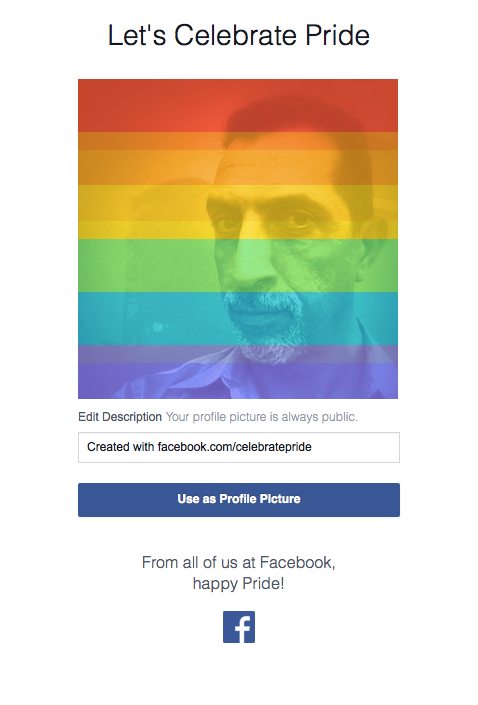
So, were you one of the millions who “rainbowed” your profile pic on Facebook to show your support following the SCOTUS ruling on same-sex marriage? I was, and quite happily. Then the Atlantic ran this story,  speculating that perhaps Facebook was conducting some far-reaching “experiment” on its users. It also speculates (in the subtext, of course,) that Facebook has likely done this before, and leads readers to surmise that the company may even be actively doing it for pay.

Facebook has never made any claims that it is NOT collecting your data, even on a random Wednesday. In their data policy, which you can find at  https://www.facebook.com/policy.php,  they clearly state – in a jillion different ways:

“we collect the content and other information you provide when you use our Services”

and

“we collect information about how you use our Services”

and

“we collect content and information that other people provide…about you”

and

“we collect information about the people and groups your are connected to”

and

“if you use our Services for purchases of financial transactions…we collect information about the purchase or transaction.”

Now, it’s likely that out of the billion or so users on Facebook, approximately 23 of us have probably read the privacy policy in its entirety. (Busted!) In a previous post on this blog,  I’ve asked about why consumers are so busted up about online tracking, when it makes our lives so much better, and more streamlined. As I said then, tailoring makes our lives better. Cookies make our lives (and our online experiences) better.

If we boil this down to its essence, we’d likely see that the average or typical social media participant is more than okay with the idea that their information and online activity are being tracked in an effort to achieve various ends, like a cooler/faster/more contextual social media experience, or more targeted advertising, or even for social studies. And although we don’t typically read the privacy policy, we’re probably pretty much okay with it, as long as you don’t snag my credit card and go buy $800 worth of frozen pizzas at Wal-Mart.

And so what if Facebook WAS conducting some big-data test with the pride-your-profile-pic exercise? Big woop.  It’s astounding that, in an age where we share more personal information than ever, that we’ve become so hyper-sensitized to that information maybe kinda sorta being “used” for some purposes other than my Grandma Susie seeing my latest motocross bike race. (It was kind of badass, by the way.)

Whether we like it or not, we’re slowly but surely crossing the threshold from web 2.0 to (the social web) to web 3.0 (the predictive web) as a result of all this data tracking that’s going on. It, too, will ultimately make our lives better in ways we probably can’t even imagine right now.

So let’s do a snap poll – provide a simple YES or NO answer in the comments section below (and of course, any comments you care to share are more than welcome):

Are you okay with social media corporations like Facebook and Twitter monitoring your online activity to make assumptions or test hypotheses, whether they be theoretical or commercial in nature?

I’ll start. YES!

Facebook’s Mobile Phone: Three Reasons to “Unlike”

facebook-phone
Concept art courtesy of Gizmodo

Facebook is set to announce this Thursday the release of the Facebook Phone in partnership with HTC. According to the latest mobile report from The New York Times, the plans are to manufacture the first smartphone designed around the total social/sharing experience that Facebook enables. Maybe it’ll be called PhoneBook? Ugh.

On paper, it’s a really good idea. More than a billion people use Facebook on a regular basis to connect with friends, weigh in on political ideas, and just generally brag. And as it turns out, MOST of them are posting, liking and commenting from a mobile device.

However, this announcement is NOT on paper. It’s real. And on most levels, it’s kind of silly. Facebook has become one of the most visible, one of the most recognized, and one of the most important brands on the planet, (although, according to the stock price relative to the IPO, NOT one of the most valuable.)

And yet, with all the Stanford MBAs on staff in their marketing and operations departments, is there anyone there voicing an opinion that this is a thinly veiled brand extension that’s simply designed to appease shareholders with a strategy to create more revenue streams? Because, let’s face it folks, that’s what it is.

The subtext of the “exciting” and “new” direction for Facebook is to have another screen for advertising. Period. Facebook’s entire valuation was built – however hastily, however erred – on the idea that a billion+ eyeballs is a road paved with advertising gold. Add another screen, and you can charge another scale. The new rate card must be getting a design makeover just like the news feed.

But that road to gold, being paved this week with this mobile announcement, is pocked with obstacles. From a marketing perspective, these three obstacles indicate a likely FAIL and another rough year for Zuck & Co.

Obstacle #1: A partnership with a questionable partner.
Facebook is partnering with HTC, a manufacturer that, as of the end of 2012, has less than 5% of the total global smart phone market share. What’s worse, the HTC moniker is inextricably linked with another epic fail of corporate overreach, RIM, and the BlackBerry platform.

Why not partner with the #1 or #2 player? With the heft of Facebook, why not approach Samsung or Apple and design a custom “version” of their popular phones designed more smartly around the Facebook experience? The full version of Android (the HTC model is using a modified version of the system,) or iOS would provide more seamless integration into the consumer’s current mobile experience. Facebook is still acting like a startup strapped for cash, when it should be carrying itself with the mien that they ALREADY have a seat at the big boy table.

Obstacle #2: Consumer adoption.
Brand extensions are a dangerous proposition, even in the best-case scenarios. And in this case, (which is not the best case,) it’s super-duper dangerous. As it stands, the consumer already has the option to have a BETTER piece of hardware than HTC, (with S3 and the soon-to-be-the-most-popular-phone-on-the-planet S4 or any of Apple’s iPhones,) a BETTER piece of software via the Facebook app on either the Droid or iOS platform, and the chances are the consumer ALREADY owns a device she’s happy with.

So it’s highly unlikely that someone is going to rush out and buy an inferior piece of hardware, running an inferior operating system to run an OS that’s focused on a social network so they can take pictures and post status updates from their home screens. The rest of the world already does that with relative ease and great enthusiasm.

Obstacle #3: Increased operational workflow and costs.
As if Facebook doesn’t have enough going on internally, (acquisition plans, acquired partners spinning off, implementation of contextual advertising, implementation of graph search, etc.,) now they’ll have to add a bunch of new pieces. This might include a coding team to fix v.1 bugs, a customer service department devoted to mobile, internal teams to interface with HTC, a dev team to work on v.2 and beyond, marketing and advertising expenditures around the device, operations around packaging and distribution and on and on. Yeccchhh.

I’m no Stanford MBA, but when you have increased operational expenditures, increased marketing expenditures and are projecting – at best – to penetrate a 5% piece of the pie, chances are you’re going to have to dip into your pocket to support this new initiative with a boatload of short-term cash.

Zuck, here’s my advice. KILL this deal before it erodes the stock price and further erodes consumer perception about Facebook quickly becoming the “uncool” social platform.

Want some free ideas?

– Blame HTC as an unreliable partner.
– Cite your unusually high expectations for the platform as a reason to delay the rollout.
– Say you’re working on even bigger and better features and you think you’ll roll out by Christmas.

In the last year or so in Menlo Park, you’ve already misstepped with the privacy policy bungle, the pace of HTML 5 integration, un-hipping Instagram and more. Right now, you need some WINS. And acquiring Hot Studio last week is not what I mean.

Wanna have lunch?

This article first appeared on Technorati.

The Butterfly Effect of Marketing

Illustration:  Bruce Crilly

Have you heard of the Butterfly Effect?  It’s a chaos theory-based rubric attributed to Edward Lorenz for explaining the sensitivity of the dependence on initial conditions relative to widely dispersed outcomes.  The theory is expressed in the saying “the flap of a butterfly’s wings in Thailand can set off a tornado in Texas.”

Okay, so what does that have to do with marketing, especially for small to midsized companies? If you drill down into the Butterfly Effect statement, you learn that small, seemingly insignificant actions can, in time and to a great degree, affect or evolve into great, often extraordinary results not easily conceived in context of the original event.  And conversely, you see that the auspices of great outcomes can be found to have relatively benign provenance.

In marketing, we’re often overcome trying to “think big” and “make it rain” and “blow it out,” and a zillion other clichés of bigness.  The truth, however, is that we can sometimes reach these astonishing aims by applying the Butterfly Effect and initiating small actions and – this is the key – setting them on the right course.

Here’s a simple viral marketing example:  you put a status up on Facebook, for instance, and tell 10 of your friends to pass it to ten of their friends, and so on.  Perhaps you’re promoting a secret concert of a popular band.  How many times does this have to be passed on for your initial (small) action to have a great effect?  In just four repeats of your original action (tell ten friends,) you have 100,000 screaming fans show up at the concert.  Uh oh – only 20,000 seats! So, sure, there’s very little chaos there.  But you can see how quickly simple actions can scale outward to a great degree.

Social media is really the Butterfly Effect in action in today’s marketing world.  Brands are seeding conversations, and then setting them off into the ether.  And in an extremely democratic (and sometimes terrifying) manner, the brand is weaved into conversations by people, and expanded, and turned into recipes or planking videos or mashups or hashtags.  Who knows? It’s chaos, but it’s usually good for the brand.  Sometimes (see AdFreak’s recent post on ChapStick’s social debacle,) it’s not so much.

One last point.  It doesn’t have to be social media.  You can start generating big marketing effects through small actions in lots of ways.  It could be a new merchandising program, a refresh of your menu, seeking new talent, or adopting a cause, or a new partnership, or a next blog post.  It could be anything.  But it has to be something and it has to be started.

A few keys to applying the Butterfly Effect:

Chaos. An important aspect of all of this is that it’s painfully hard for mere mortals to calculate chaos.  [An easy task for a math-head.  Not for me.] So it’s easy to imagine outcomes that are too likely.  The Butterfly Effect is constantly evolving, ever shifting and morphing into outcomes that, while predicated on the action before it, often do not travel a predictive pathway.  Get with that.

Direction. Don’t think about the outcome, because you often have little or no control over it.  Just ensure that the initiating action is set off in the right direction, is well-intentioned and is aligned with your brand values.  The rest is the market’s work, with all its environmental and evolutionary vagaries. Indeed, the chaos is part of the fun of watching this theory in action.

Distance (whether it’s measured in time or space) is a necessary factor.  You can’t expect these great things to happen in sixteen minutes.  Be patient, and integrate the Butterfly Effect along with your other, more urgent, plans.  If you launch a rocket in the air, and then measure its effectiveness in six seconds, you’ve failed to reach the stars.  Measure again in four hours, and you’re dancing among them.

How does this apply to your brand?  What can you START today?  What ten things can you start today?  Even if it’s a small but pertinent action that can evolve, it’s probably worth it. So start flapping.

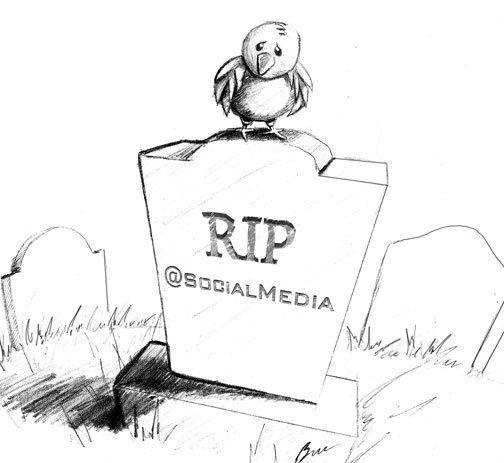
Death and Social Media – version 2.0

Illustration:  Bruce Crilly

The below is a follow-up to a post I wrote back in July 2010. First, the original post, then the follow-up:

Death and Social Media
This is a morbid way to discuss an idea, but let’s talk about death. And while we’re at it, let’s talk about social media. I was (briefly, fleetingly) thinking about what would happen after I die, and the kinds of things people would remember about me. (And more exactly, the kinds of things I hope people will remember about me.)

In my life, (and I’m not quite done yet,) I have created volumes of content in the social media world: blog posts, and blog comments, Facebook statuses and comments and likes and picture uploads and all those Tweets, reTweets and direct messages on Twitter! I’ve yelled about firing the head coach of my beloved Buffalo Bills on the fan forums on buffalobills.com, and helped people solve technical problems on support forums for Apple computers and some software platforms. I’ve written record and book reviews on iTunes and Amazon. I’ve uploaded and even commented on videos posted on YouTube! (Eeek. What a geek.)

So I wondered, will this become part of what people remember about me? Will there be people at my funeral saying, “yeah, nice guy…oh! And did you see his Tweets from the IAB mobile conference back in 2010? So insightful.” Instead of a collage of photos, will there be a screen somewhere with a streaming feed of my life’s digital output?

On one hand, I seriously doubt that these bits and bytes of my recommendations, forwards, hashtag snips and extemporanea will have any bearing on what people think about me. But on the other, there’s no getting around the fact that social media content is now a contributing editor to my legacy. I also submit that I think it would be an interesting, revealing and even fairly intimate way to chronologically peek into the ebbs and flows of my (mostly) professional life. Which makes me think: are we (am I?) Tweeting accordingly? Is the overall tone of my social commentary admirable/useful/honorable? Will my children be proud of what they read? Does it really matter how many check-ins I have, or if I’m the bloody mayor of some local bar? Jeez…maybe we better start looking at all of this in context.

In older days, we might have discovered a diary under a bed, or a journal tucked away in a closet somewhere, long after the departure of a loved one. But now, we have a digitized database of someone’s every thought and comment for years and years. And since most people in the world will never author a book, or write a professional article in a real journal, or be interviewed for television or radio, is the chronicling of social media verbiage a new means to endure? [Uh oh, I think I smell a new business model being hatched.]

Follow-up [September 2011]
So it turns out I was on to something about new business models being hatched, and people starting to talk about this morbid stuff with a more, um, opportunistic tone. A year after my blog post, a journalist named Adam Ostrow gave a TED talk that covered this topic – and outlined some new business models that are indeed being hatched at the intersection of death and social media as “opportunities for technologists.”

The first (and perhaps weirdest) is ifidie.net, a service that lets you create a message or video to be posted to Facebook after you die. Check out their website…kind of a wacky approach to a fairly serious topic.

“My Next Tweet” is a service that uses an algorithm to predict what your next (and perhaps last) bit of social output would be on Twitter by analyzing all your previous tweets and retweets.

Finally, Ostrow points out 1000 Memories, a service that allows you to organize, share and ultimately post a collection of photos, memories, writings and more to Facebook or an area of their site. Not just for the dead, apparently.

On the flipside of all that nonsense, there is a beautiful side-effect to digitizing one’s last days. I recently read a gorgeous narrative by Rebecca Armendariz chronicling a series of Gchats with her lover that is both heartwarming and gut-wrenching, and exquisitely written. Read it and (be prepared to) weep.

I suppose all of this does lend gravitas to the idea of self-monitoring your digital expressionism. Once you’re gone to the great mashup in the sky, you don’t want one of these dopey services misrepresenting your life’s social work. So if today is indeed the beginning of the end of your life, social-ize accordingly.