Super Bowl 59 Grins and Groans

Super Bowl 59 is in the books, and congratulations to the Philadelphia Eagles on an outstanding performance. If you were in the mood for a dominating defensive performance, you had a very good evening. If you were in the mood for great advertising, well…you certainly got a LOT of ads, but not sure if they were all great. Some high points, some low points, and some decidedly weird points. Let’s break it down.

Themes
Like last year, a lot of advertisers turned to the meta approach for their spots. This is when the ad is about making the ad. Dunkin, Homes.com and UberEats all took this approach, and it can be really funny (like the way Homes.com doubled down on the “it’s the best” meme with Morgan Freeman,) or it can get a little obtuse, like the Dunkin’ ad with actor Jeremy Strong trying to get into character by immersing himself in a barrel of coffee beans. (Right?)

Facial hair was another theme in this year’s ads. (There’s a sentence I never thought I’d write.) Both Pringles and Little Caesars decided that their best angle would be to have men’s facial hair – eyebrows and mustaches – fly off for some odd reason. Some of the gags were humorous (the caterpillars chanting “we’re not worthy” to Eugene Levy’s eyebrows made me chuckle,) and I think Pringles did it with a bit more context. After all, there’s a giant mustache on every package.

A surprising few amount of spots this year from car manufacturers. Polestar showed up in the pregame show, but not as an official Super Bowl commercial. Only Jeep and Ram appeared this year, which is odd, given the history of this game and some of the iconic spots that have run. If you’re counting, we had more spots with Matthew McConaughey than with cars.

HONORABLE MENTIONS:
A few ads played it safe, and still managed to deliver decent brand messages. Orlando Bloom and Drew Barrymore did a cute tete-a-tete on European vs American holiday/vacation expressions, and it painted MSC Cruises in a similarly cute light. Homes.com played at the idea of saying they’re “the best” while their legal counsel advised them that they can’t legally say that. Uber Eats continued their “the NFL is trying to sell you food” conspiracy theory with origin stories, and it gets especially funny when Martha Stewart laughs hysterically that the Super Bowl venue is “named after a salad!”

The last couple of years, Jesus has made an appearance at the Super Bowl, but this year’s was a bit more special because he brought along a better soundtrack. Note to aspiring creative directors: having Johnny Cash sing Depeche Mode in your spot is ALWAYS a good idea. Hat tip to Jesus’ creative team. Hailee Steinfeld and Wanda Sykes teamed up for a smart PSA that made me look, er, notice, er, appreciate their, I mean ITS, value. It’s for Novartis, and it’s aimed at getting more women screened for breast cancer. And Dove scores another hit with a female empowerment spot that was punctuated by the line “let’s change the way we talk to our girls.” Nice.

While we’re mentioning some ads, we have to talk about Seal playing a, well, seal in the Mountain Dew spot. If facial hair flying off faces, and tongues flying out of mouths (more on that in a moment,) wasn’t weird enough, a seal with the face of Seal, singing a jingle to the tune of “Kiss From a Rose” was basically a 12 on the weird-o-meter. Fun? Sure. But about 50 million Americans probably had a terrifying dream about that one last night.

GRINS
First off, golf claps to Weather Tech for finally listening to their agency and doing a concept spot instead of their usual “here’s a view of our factory where we prove they’re made in America” pandering. The grannies-go-wild approach offered lots of good laughs, and then quietly made a nice plug for their spill-proof floor mats. Much more memorable than the last few years.

Google Pixel 9 really tugged at the heartstrings with their dad-and-daughter vignette disguised as a “guy turns to Gemini AI for help preparing for his job interview.” The reason this worked so well is that it contextualized the product benefits while letting us in on the backstory. Really well-conceived, and really well-produced. You almost never want to go soft-sell on Super Bowl, but Google almost always has, and almost always wins.

Liquid Death literally made me LOL with its “drinking on the job” spot. Pilots, surgeons, school bus drivers, even the cops are pounding Liquid Death, and to an awesome theme song. The company has disguised their filtered water to look like small-batch beer cans, and this is exactly why: so they can misdirect and manipulate you right into the big reveal. Good stuff. Spots end with bold type: “Don’t be scared. It’s just water.”

It just isn’t Super Bowl without a Budweiser Clydesdale spot, and this one, “a horse walks into a bar,” is by far one of their best ever. It’s great storytelling, with virtually no dialogue. Our hero is faced with a choice, has to overcome difficult challenges along the way, and somehow, some way, prevails. For decades, Budweiser hasn’t even tried to sell beer with their Super Bowl commercials…they sell this version of Americana on which we can (almost) all agree.

Hellmann’s went retro with their “When Harry Met Sally” sendup. It features Billy Crystal and Meg Ryan back in Katz’s Deli, and wouldn’t you know it? Meg has another orgasmic experience (this time it’s REAL!) thanks to a shmear of Hellmann’s mayonnaise. Targeted at Gen X? You bet. Wrapped in a bow for Gen Z? Sure, and that’s why you have Sydney Sweeney deliver the punchline. So much better than their last several years of Super Bowl spots, which were big groans for me. Oh, and Hellmann’s signs off with the apt line “It hits the spot.”

Doritos proves that when you crowdsource your advertising (through their thankfully resurrected “Crash the Super Bowl” campaign,) really good things can happen. Here, an alien ship comes to Earth and tries to take a guy’s Doritos away. He fights them off – sort of – and then, by chance, the Doritos destroy the alien ship! The alien survives, and he/she/it (?) and the guy enjoy the chips together. What’s great about Doritos is that they ALWAYS put the brand front and center, and the motivation is consistent: get your hands on some Doritos.

I think my favorite of the night (and this is a bit of a critic’s pick, I’ll admit) was the ChatGPT “dots” ad. Again, no voiceover, just graphics, and magnificent ones at that. All of it based off ChatGPT’s “dot” prompt. So it’s a little “hello world,” and a little “IYKYK.” Anyone who has used ChatGPT will recognize the dot. During the spot, the dots sync up to go and create all kinds of interesting images, symbolizing progress through time, from fire to the wheel to the steam ship, to walking on the moon, to dial up modems to now. And then it delivers the line “all progress has a starting point.” I like this most of all. It says “AI is not the be-all and end-all. We’re just getting going, and let’s see where we might go from here.” A bit of a departure for Super Bowl advertising, but a simple and clear way to illustrate the power and potential of this particular AI engine.

GROANS

RED BULL: When I saw this spot come on, I immediately recognized the illustration style, and the classic setup. Boy penguin says to his father “I figured out how to fly!” Dad, suspicious, says “oh…really? And how exactly are we going to do that?” The boy responds that all they have to do is drink Red Bull, and they’ll be able to fly because, after all, Red Bull gives you wiiiiings. Up to this moment, this is a typical Red Bull spot. But then, the boy can’t fly, because the Red Bull he attempts to drink is frozen. (They’re penguins and it’s 40 below zero, according to Dad.) So…the product doesn’t work. The benefit is never realized. And we’re all disappointed. They try to make us think they’re in on the joke, because the voiceover says Red Bull gives you wings, “but only if you drink it.” No. No. No. Don’t do that.

SQUARESPACE: Look, I get that it’s hard to sell tech enablement as a Super Bowl spot. Squarespace is a platform that helps do-it-yourself-ers build and maintain their own websites. Last year, they tried aliens…with Martin Scorsese directing and starring in the spot. The year before that, it was an obtuse take on “the singularity” with Adam Driver. In 2022, they actually made a really GOOD spot with Zendaya, who portrayed Sally, who sold (you guessed it,) seashells by the seashore. That spot followed a simple narrative. Sally was not doing well. Then, she built a website with Squarespace, and things really took off! That’s generally how we like to portray our brands in our advertising: as aids in the hero’s cause.

This year, however, we have actor Barry Keoghan (the guy who went full frontal in Saltburn,) riding a mule through the Irish countryside, whipping laptops at people like a sedated and psychotic newspaper delivery boy. But they’re laptops! And they’re dangerous! And one smashes through the window of a pub. (Also, and even stranger, hardly anyone reacts to any of these near-death assaults.) And how, exactly, does this connect me to any understanding of their basic offering? Most Americans could hardly make out the brogue, let alone the value proposition.  

COFFEE MATE: So, let’s give props to Coffee Mate for shelling out the almost $8 million dollars and producing their first-ever Super Bowl ad! (Applause.) Aaaaand…let’s give it up for Shania Twain writing and producing a new song specifically for the commercial. Yay.

However, that song starts with the lyric “let’s go tongues.” And the young man in the ad, who has just had a taste of cold foam after adding it to his cold brew coffee (I guess?) goes into a trance, where his tongue (yes, you heard me right,) does various dances, makes heart shapes, plays the chimes, high-tongues (I just wrote that) the Coffee Mate logo, and then – are you sitting down? Jumps out of his mouth. And spins around in the air while fireworks go off, and then plunges back into the young man’s mouth as he awakes from this fantasy. Just as a reminder, we’re talking about his TONGUE!

Then the young man and his pal start chugging (question mark) the Coffee Mate foam together, as we cut to the closing shot of the line “a little foam a lotta fun” spelled out in, you guessed it, foam! I could have lived a very full life without having seen that. And hopefully, I never will again.

So…what were your favorites? Let me know in the comments.

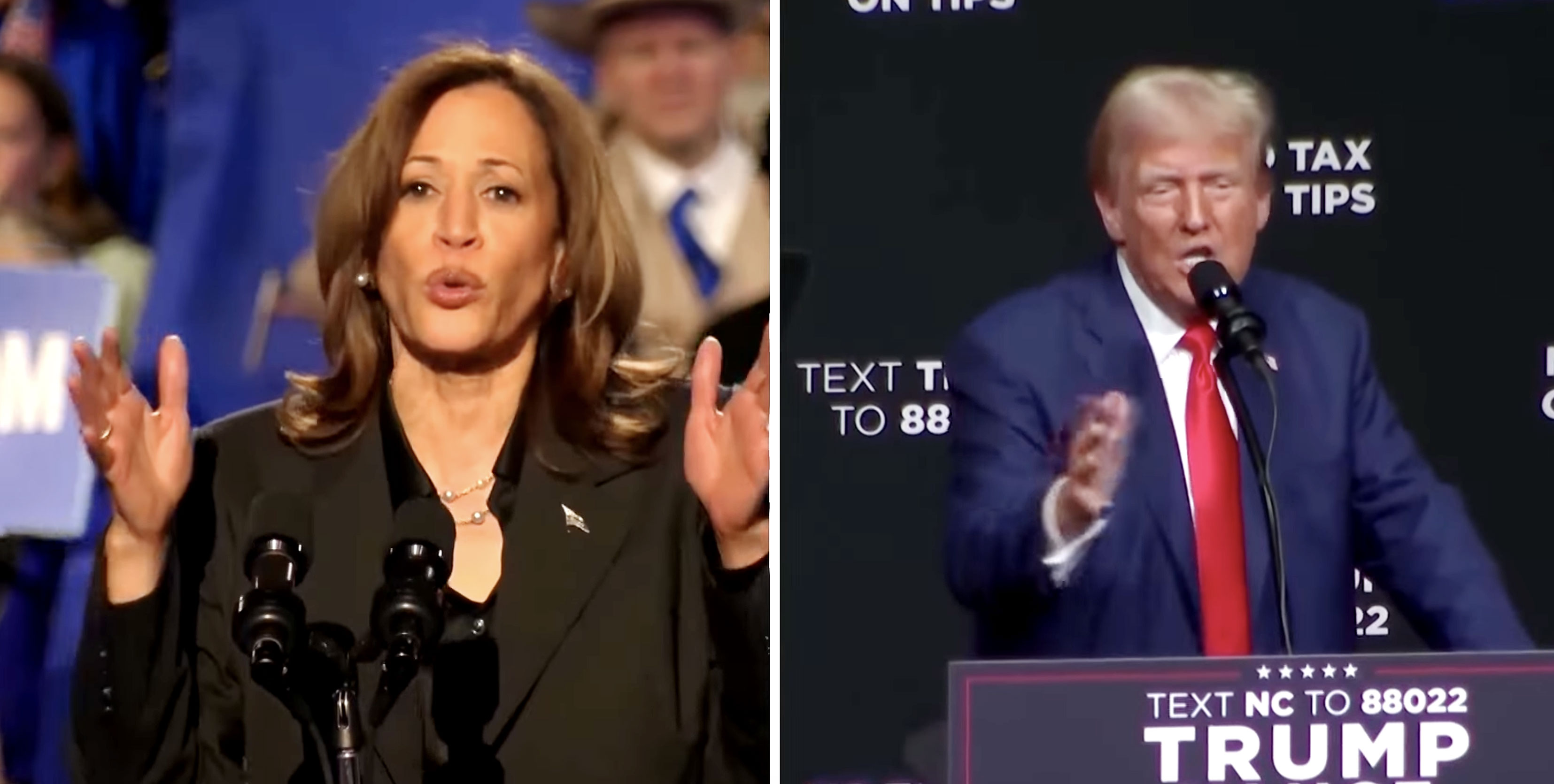
You want good* advertising? You won’t find it in the election media blitz.

Don’t you just love advertising in presidential election years? Aggressive, repetitive, and often un-creative ads in every commercial pod, whether you’re watching football, soap operas, or game shows. ‘Tis the season to be mud-slinging.

In the general election, The New York Times has reported that more than $500 million will be spent by the Harris and Trump campaigns, and that the Super PAC supporting Harris will pour $187 million into television and radio alone in the final 49 days. I’m not great at math, but that’s almost $4 million PER DAY from September 17th through November 5th. That’s not counting digital, social, texting, robo-calls, and whatever else each campaign’s AI-driven algorithms are cooking up.

But what about the ads themselves? Is there any tangible messaging going on beyond the “don’t vote for the other team, because they’re terrible” tropes? Sadly, not much.

The Trump campaign has struck gold with one spot called “They/Them” that’s running ad nauseam across cable networks, which focuses on a (decontextualized) message about Harris supporting gender reassignment in prisons, with the implication that American taxpayers are footing the bill. It ends with the line, “Kamala’s agenda is they/them. Not you.” However you feel about the issue and the message, (and the malevolent editing,) you gotta admit that’s a darn strong line to punctuate the spot. It’s creative and pithy, and rings a potent dog whistle for conservatives who bristle at all things trans.

Harris fires back with a spot focused on Trump and his anti-abortion influence, and his implicit ties to the mercurial Project 2025. The spot is called “Who He Is,” and is (again) focused on her opponent, and his previous (and likely future) inclinations as it relates to national policy.  The compelling aspect of this spot is that none of it is conjecture – Harris is highlighting actual changes that were affected during Trump’s actual presidency. It invites the viewer to draw their own conclusion (and the creative directors are betting on this,) that “if he did it before, he’ll do it again.”

So, what’s wrong with this advertising? Some would argue that the ads are fine, claim “that’s just what they do,” and that politics simply brings out the worst in strategists and creative directors. Hey, it’s a limited run, so attack, attack, attack, and it’s definitely rated R for rubbing just about everyone the wrong way.

But that isn’t the way most brands compete, is it? Most brands want to use the precious time they have with the consumer to connect to something positive, and special, and DIFFERENT about that brand. Most brands want to say good things (about themselves,) and let the consumer draw their preferences from there. Geico, as an almost on-par example, (they spend almost $3 million per day in advertising year-round,) doesn’t spend their time shitting on Allstate or State Farm. They use that time and all that money to drill simple, memorable messages into consumers’ minds: 15 minutes could save you 15% or more; so easy a Caveman could do it; etc.

Some strategists argue that you should NEVER mention your competition in your ads, because you’re essentially using YOUR media budget to promote THEM (to some degree.) Tell that to Coke v. Pepsi, or McDonald’s v. Burger King, or Apple v. PC. There are exceptions to every rule.

But marketing IS a conversation, and a campaign is an extended conversation that happens in short spurts over long periods of time. Brands use 15 or 30 or 60 seconds to get you to think something, believe something, and maybe even to do something over the course of several months or more. If they spend all their time talking about the other brands, what would you think about them? And more importantly, would you think about them at all?

That’s what’s disappointing about this unprecedented time in marketing history. The most money ever spent on presidential campaign advertising, and all we’re doing is rejecting the rules that all of us are taught about advertising, especially about being memorable, and about never misleading your audience.

I think we can do better. And I’m looking forward to November 6th, when we can go back to talking lizards, bunnies banging drums, and people getting their hands stuck inside potato chip containers. Ain’t advertising great?

What’s next. For text.

This week, it was announced that Apple is adopting RCS (Rich Communications Service) as a standard feature on its next iOS version. RCS is aptly named, as it does enable more rich forms of communication to be sent over the texting network. (Textwork? Nextext? Just spitballing.) Now, instead of just text in a blue – sometimes green – bubble, or the occasional animated GIF from friends or bit.ly link from brands, images and videos can now be shared, and even interactive features.

Obviously, this news is rife with marketing and business implications.  A survey from Juniper Research, a UK-based telecom research firm, found that “business messaging traffic will grow from $1.3 billion to $8 billion in 2025.” Wowzers. That’s a lot. And soon. Some of that growth is to be realized in no small way by Apple’s 900 million devices entering the fray.

RCS is also notable for providing end-to-end encryption so that messages can’t be intercepted. Apple, who has been prickly about privacy, especially as it relates to marketing via mobile devices, probably saw this is an opportunity to deliver more robust services to iPhone users while toeing the line of its newer, harsher security stance.

As it relates to marketing, the possibilities seem both endless and exciting. More rich media often holds the door open for more robust and interactive engagements. Surveys. Games. Direct app downloads. Oh my!

So, could this be a kind of renaissance moment for the oft-maligned outpost known as direct marketing? Methinks perhaps. Instead of just offering the standard “reply STOP to opt-out” or  “1 to reply YES” options, recipients of RCS messages can now explore the brands’ text-messaged offerings in private, low-risk interactions and decide (if the brands do this correctly) on a number of engagement pathways.

So everybody wins: brands get to design and deliver more interesting and more entertaining features directly to consumers to increase engagement and drive whatever metrics they’re chasing. Consumers get to engage with cooler marketing tactics while still feeling in control of the conversation (remember, you can opt out or just delete anytime you like.) Heck, direct marketing wins by getting a slick, new, digital shot in the arm.

But the real winners? It’s the carriers.

That’s right. AT&T, Verizon, T-Mobile. At least in the United States, they stand to gain most from this boon since they’ll be double-dipping their way to some of that 4X growth predicted by Juniper in their report.

For Dip 1, it will cost brands more to send these richer engagements across the texting network (Textnet? TheNextwork? Still working on ideas.) through the various third party mass texting platforms that enable them. Because the platform rates will go up on a per-message basis as well to cover the increased carrier fees. Hmmm.

And for Dip 2, carriers will quietly pass additional fees on to consumers on their monthly bills. That old “text and data fees may apply” disclaimer is now going to cost a titch more than it used to the more you start opting in for these newer, brighter, more colorful and more animated engagements. The fees will be nominal to each consumer, but across these networks of hundreds of millions of subscribers, it will amount to some delicious over-the-transom revenue from both sides of the marketing equation. And with no additional infrastructure costs.

Well done, you sneaky little bastards.

Facebook’s Meta transition. A mashup that proves hardware is the new tech.

Late last month, noted CEO Mark Zuckerberg announced that Facebook is changing its name to Meta, and changing its official stock ticker from FB to MVRS.  The name Meta is a shorthand for the metaverse, which is itself shorthand for an almost fully immersed online world, where people can play, work, and gather in groups in the virtual sense. Zuckerberg is betting big on building it, even though it’s been tried before. (More on that in a bit.)

That this massive shift away from one of the world’s most recognizable brand names comes amid a slew of scandals is indeed curious.  But let’s leave all the political soundbites and sexy headlines aside for the moment.  This is not about the Facebook Papers, nor about Russian disinformation, nor about Cambridge Analytica, or data collection, or facial recognition…man, they do have a lot of shit swirling around the campus out there, don’t they?

Nah, this smells like a big bet hardware play, plain and simple.

This whole Meta rename is nothing more than a cosmetic corporate restructuring that will now control Facebook and its other well-known brands, including Instagram, WhatsApp, Messenger and Oculus.  A lot like when Google changed their name to Alphabet, and rolled up all their brands, including Google itself, under the holding company.  (PS – only investors care about this stuff, and THEY still call it Google. And the stock ticker for the company known as Alphabet is…GOOGL.)

So why isn’t Zuckerberg saying that?

I have an idea. Maybe it’s because the metaverse isn’t a great idea.  Or, rather, maybe it isn’t a great idea to shelter it under the enormous loads of cash that the artist formerly known as Facebook has at its disposal.  It’s been widely reported that the year one budget is over $10 billion, and that 10,000 people, mostly in hardware, will be recruited to make it go.

When any entrepreneur wants to launch a new idea, especially a broad and ambitious one like the metaverse Zuckerberg envisions, it’s good practice to prove it can actually accomplish something on its own merits.  It’s a good practice to seek capital from investors and show milestones that prove the concept.  In the absence of that kind of oversight and objective grownups in the room that business incubator model provides, it’s just another lavish vanity project.  The Metaverse is to Zuckerberg what space is to Bezos, Musk and Branson: a vast unknown that he hopes to monetize.

And let’s remember two important things about Meta’s metaverse:
First, the road to the metaverse was paved by Second Life way back in 2003, a full year before Mark Zuckerberg’s “hot or not” turned into “thefacebook.” It is a metaverse full of avatars and provides an almost identical experience to what Zuckerberg envisions: an interesting alternative online environment, where you can have virtual meetings and other whatnots.  (Kinda mostly trying to ply a virtual shopping mall, though.)

Second, and far more interesting: Meta’s virtual world will require, not suggest, that you purchase some very real and very significant pieces of hardware to access it. Oculus VR goggles are currently retailing at around $300, and may not have the full range of capabilities to access what will eventually become the Meta metaverse. It’s a long way to go to sell a bunch of accessories, but it sure sounds like a hot hardware play, doesn’t it? Build the metaverse, get a lot of good press, then tell those who can afford it that the only way to get on board is to buy some rechargeable VR binoculars, now available in six avatar-worthy colors!  All of this is coming right on the heels of Facebook (can we still call it that?) inking a deal with Ray-Ban to sell some fancy Smart Wayfarers that take photographs and play tunes, also for about $300.

If I didn’t know better, I’d swear Zuckerberg was trying to emulate Steve Jobs in some way. After all, Apple’s most successful product was/is the iPhone, not the Macintosh, its former flagship. It required the purchase of a significant piece of hardware. It was an ambitious project and came decades after the company launched. And Jobs didn’t just have the phone developed with a base OS and software.  He outsourced the smartphone “experience” to third party developers via the app ecosystem so every user could customize their device to their liking and have a uniquely personal interaction with it. It’s what ignited the phone’s insanely fast global adoption, and may be a route that Zuckerberg is similarly exploring.  The metaverse will require the purchase of significant hardware.  It, too, is an ambitious project that will launch decades after the Facebook flagship. Let’s all pay attention over the next couple of years and take notice when third-party developers – under a watchful eye and strict guidelines, of course – are invited to curate and broaden the metaverse experience in various ways, like shopping, gaming, utilities, fitness, and others.

Other tech CEOs have also profited marvelously in various ways on and off the Internet, and have pivoted to hardware in the process. Brin and Page monetized consumer intent with paid search advertising. Then they sold us Pixel phones and Google Home and acquired Nest for broader reach with devices. (And they’re betting big on Waymo.) Musk made his money online with PayPal when it sold to EBay, then monetized major hardware with Tesla electric cars. Bezos is a retailer and monetizes markup. He also likes hardware – Kindle and Echo both do just fine, thank you very much. With Meta, Zuckerberg seeks to do all of the above, just in the opposite order. He’ll first sell hardware to access the metaverse. Then he’ll sell advertising (likely highly contextualized) with a new model that combines search history, affinity, and basic demographics to a mostly Gen Z audience. He’ll build in some exchange system (maybe crypto-based) in the metaverse that costs real offline dollars. And he’ll most definitely build some kind of online shopping component.

So…what color would you prefer for your new goggles?

Coronavirus CMO Checklist

marketing_thingy_checklist_image

As we’ve turned the calendar to another month of dealing with the uncertainty surrounding the COVID-19 pandemic, a lot of brands and agencies are wondering what’s next.  While many brands have pivoted to pandemic-related messaging (see a regularly updated list here,) most are taking a breath, and working hard to plan their next move(s.)

Believe it or not, this forced time-out can be an incredibly useful opportunity on many levels.  Whether you’re the CMO of a global brand that spends millions or an owner/manager of a small to medium-sized business that’s trying to edge out your competition on a regional level, this may be the best time to evaluate your brand and make structural moves to re-position it for success when the world wakes from its medically-induced commercial slumber.

Here’s a quick dos and don’ts checklist of items to consider while we’re all waiting for the refs to say it’s time to get back in the game:

ON POSITIONING

DO reinforce your strategic position, whatever it might be. If you’re the low-cost leader, then now is the time to forage for ways to maintain and even strengthen that position, perhaps by having new discussions with suppliers and distribution agents.  More importantly, if you don’t have a strategic position (or perhaps don’t know exactly what yours is,) you’ve now been given the gift of several weeks and even months to figure one out.  Huddle with your team – or better yet, a consultant or agency – and learn how to articulate who you really are in ways maybe you haven’t before.

DON’T waver.  If you do have a position and it helps the consumer/customer understand what makes you different, do not veer from your course.  You might hear of brands trying to “strategically pivot” into new areas and try to replicate what competitors do in an effort to grab short-term revenue gains or “narrow their gap.”  We’ll probably see a LOT of price manipulation once the markets begin to wake as competition for consumer attention will spike – but don’t be tempted.  If your position is built on quality, or prestige, or speed, or technology, or safety, or any other attribute that you can effectively “own” in the mind of the market, stay the course.  The consumer segment that desires your position will be more motivated than ever to seek it out when this is all over.

ON STAYING IN TOUCH

DO stay in touch with consumers/customers and stakeholders of all kinds. Be a friend in some way.  Be a lifeline if you can.  One of the most compelling aspects of this pandemic is the psychological toll it’s taking on people from all walks of life.  Routines are disrupted.  Rituals interrupted.  And we cannot forget that brands represent constancy and normalcy for so many Americans – perhaps the only two commodities that are in shorter supply than toilet paper. As long as your brand is reminding consumers that you’re still there, and will continue to be there to support them with what they expect of you, you should come out of this national hibernation in pretty good shape.

DON’T brag.  Even if you’re doing the most amazing things right now in your community or in your industry, no one wants to hear how great you are.  Do what you can to serve in this crucial time, but do those things quietly and let the results speak for themselves. Grandstanding is not a good look in a crisis.

ON ADVERTISING AND STAYING VISIBLE

DO advertise if it makes sense and you have something valuable to say. In my last post, I advocated strongly for advertising, and provided several reasons why it’s more important than ever.  I continue to recommend that you stay visible and adjust your messaging to take the current consumer environment into account.

DON’T disappear.  Find ways to stay relevant, even if you’re conserving major expenditures (like media costs.) This is a great time to get more social, expand or enhance your app, send timely email updates and so on.  AND DEFINITELY DO NOT use your advertising presence to take shots at competitors.  You should notice that there’s no “feuding” going on now, even among the largest brands.  No cola wars.  No chicken sandwich smackdowns.  Competitive advertising in the current climate is not only a waste of valuable ad dollars, it’s in poor taste. Consumers are paying rapt attention right now, so behave with your brand as though momma was watching you.  ‘Cause she kinda is.

ON PLAYING THE LONG GAME

DO be prepared (financially and otherwise,) to ride this situation out well into 2021.  It’s clear that some brands will falter during this time as consumers are also re-evaluating their priorities and allegiances.  Staying true to your brand ethos (and reinforcing/refining your position, see above,) can a.) cement the relationships you’ve already worked so hard to forge and b.) make you look darn attractive to those defecting from other brands.

DON’T rush your expectations.  Although confidence is virtually nonexistent at the moment, consumer motivation will be high and will likely surge for many months as the commercial rebound begins.  Expect a tentative but large wave of consumers re-entering the market with fresh perspectives and open minds.  Rushing to grab profits and short-term gains (in an attempt to recoup some recent losses) may preclude your brand from the much more substantial rewards of sustained success and new fans.