The Law of Constant Compromise

Why is it that marketers cannot simply declare what their objectives are and then go about the business of getting there in a swift and decisive fashion?

Similarly, why is it that agencies cannot simply declare what their solutions are (or will be) and then go about the business of executing them in a swift and decisive manner?

The answer to both is the same.  There are no “straight lines” in marketing.  Even the “shortest distance” between two points (such as problem and solution) will be pocked with turns and tumbles, sideswipes and stumbles.  We are in a near constant state of compromise, and until we recognize it, we will suffer losses in the face of it.  This is why I have coined the term “The Law of Constant Compromise.”

This law is simply stated as:  No matter what the plan is and what the solutions are, expect to compromise at virtually every intersection on your way to the finish line.  This is a great heuristic for those of us in the projection business, those of us in the creative business, and all of us in the marketing business.

In nearly every facet of marketing, we’re faced with challenges, changes and charges to improve on the last execution or set a tone of success if it’s our first time out of the gate.  We draw a straight line between where we are now, and where we want to be at the end of the program/project/contract.  And then the shitstorm begins:  major and minor mishaps that mire progress on any level:  the client wants the logo bigger.  The photographer thinks Oklahoma City is a better backdrop for this shot.  The media doesn’t quite have the inventory they promised you. Your software was just updated.  The new designer you hired may have exaggerated a titch on her resume.  The competition launched a new product and you didn’t see it coming. And those are just the obvious speed bumps.

And on and on it goes.  This is life in marketing.  So at each turn, you have to be quick on your feet, keep your objectives in mind, and come up with an alternate re-routing (or 12) of your original plan.  In other words, you must learn to constantly compromise.  And compromising is about retaining your original intentions while reacting to and managing the current obstacles.  We don’t give up, we don’t kick and scratch and demand to have it our way, we compromise our way into a workable solution.

I see it based on a simple equation: our original intent, divided by the nature of the current challenge, then multiplied by the value of the revised solution.

So, if the Law of Constant Compromise exists, how do we use it to our advantage?  Keep these five factors in mind:

  1. Remember why you’re compromising:  You had a big idea.  Or you have a great plan to introduce it to the world.  You don’t scrap the whole darn thing if you believe in the value of the original destination.  Hold on to your big idea.  Let the twists and turns add or remove certain features, or change the timeline, but don’t let it re-design or derail the entire program.
  2. Remember your prior mistakes, but don’t hold someone else accountable for them.  As you look to work around challenges and changes, make sure you remember your previous stumbles and take care to not repeat them.
  3. Be prepared for things to change. We spend a lot of our time dreaming of the perfect execution, the perfect campaign, the perfect dashboard to demonstrate how our metrics held up.  But the bottom line in our business is that things change hourly, pretty much.  Just know that things are coming that can blow out your tires, then be prepared to adapt – and quickly.
  4. Respect mandatories.  Every agency and every client has mandatories that must be honored.  Respect these, and let them be the guideposts as you create new solutions when necessary.  You may have to veer off the intended course for a while.  But as long as you end up at your point B, does it matter what route you took to get there (as long as nothing surreptitious was purported?)
  5. Get better at workarounds.  We can’t see every obstacle as a dead end.  Every time we’re faced with a challenge and we create a compromise, we do have the opportunity to make things better, make the solutions cooler, create something insanely greater.  Remember the equation: your original intent gets divided (therefore minimized) by obstacles.  But your original intent is also multiplied (thus maximized) by the value and power of your new ideas.  So bone up on quick-on-your-feet-how-about-this-instead skills.

Get a grip on the Law of Constant Compromise, and your experiences may be that the compromises along the way are actually what lead you to the greatest successes of all.  Challenges won’t seem so unwanted anymore.  You’ll welcome the opportunity to create better plans, craft better stories, build better relationships. And you’ll find out a lot about yourself– or your agency, or your business model–in the process.

Curation: The Magic Word for Marketers

Marcel Duchamp Cubist Painting 1912

I recently attended CES in Las Vegas to do some research for a client.  CES was huge and hyperactive and I hated it. My resistance was not due to the size or number or quality of exhibits, but rather the show’s inability to navigate me through any of it.

We live in a consumer-centric world, powered by immediacy and universality of choice (otherwise known as the Internet.) Today, we can shop for anything online, customize the features, and dictate how it’s delivered. Everything from clothing to cars to medicines to media.

And that’s pretty peachy. We all love choice. We all love control. But the surprising truth in many of our brand interactions is that we’re not all very good at it. Especially when the choices are overwhelming.

At CES, I longed for a GUIDE of some sort. I wished there was a handbook that outlined what I wanted to see if, for instance, I only had 2 hours to spend there. Or if I was only interested in “small, cool audio stuff.” Or if I just wanted to knock around and see celebrities. (There were many in attendance. I passed on Snooki and 50 Cent and took a front row seat at Earth, Wind & Fire. Call me old school.)

Such a guide would have still afforded me choice, but those choices would have been curated for me. And curation is the magic word for the new consumer world.

Curation is the antidote for a world of infinite choices. It relates to both content and the methods of its consumption. Those marketers who can provide guides or maps or recommendations for their consumers will have a much more fruitful relationship with them as a result. This is true in both the consumer and business-to-business galaxies. Some examples:

Museums curate exhibits. Of all the Duchamp cubist paintings, a certain museum might choose 30 of them. They would then arrange them in a distinct order, put them on certain walls, make you stand in directed spots to view them. Remember, content and the mode of consumption. The subtext here is “the museum strongly suggests you view Duchamp this way.” It’s a very specific experience. If I want some other experience, I can gladly seek it elsewhere.

Restaurants curate food experiences. The menu, by definition, is a curated presentation of food. The chef took all the ingredients available that day and culled them to eight appetizers, eight entrees and five desserts to choose from. Would going to a restaurant and just seeing a big buffet of basic ingredients (vegetables, fish, lettuces, meats, sweets) be the same? Not a chance. Here’s exactly where I DON’T want to have too much choice. (Sidebar: this was how the original “Craft” restaurant in New York started. Chef Tom Colicchio just presented the menu items, and left the pairing decisions to guests. In the June 2001 review of Craft,  New York Times Restaurant Reviewer William Grimes stated “…(the culinary arts,) function more efficiently as dictatorships.”)

Brands in virtually all categories curate personal experiences. Whether it’s how your clothes smell, or what your ringtone is, or what color the dashboard lights are in your vehicle or the editors of your favorite business magazine – we, as consumers or business customers, are seeking features and experiences that enrich our lives in some way. But for goodness sake, we want someone ELSE to tell us what those are.

We want Amazon to tell us it has “recommendations” for us. We want Google to auto-fill our search terms. We want the Gap to recommend a sweet belt to go with that sweater we just purchased. Sure, we ultimately want to make the buying choice, but what we need brands to do is present the pathways to making them.

Marketers, take note. Curate an experience for us. Stand for something. Deliver something specific, that no one else can deliver. Or deliver something that lots of other people can deliver, but do it in a way that’s unique, or cool, or fun, or hip or technologically cool or convenient. Because we all want choices…we’re just not all very good at making them.

This article first appeared on Technorati.

Brand Guidelines: Sometimes Ya Gotta Cross ‘Em

We’ve all heard a lot about brand guidelines, and how vital they are to the marketing success of your company.  And in most cases, this is quite true.  A strong brand structure can provide an incredible level of connective tissue between your company’s product or service and the consumers you have and, most importantly, those you hope to reach.

And while a lot of care and thought goes into brand development and brand representation, in some cases, we can overdo it.

Before we get into that, let’s make sure we’re clear on what brand guidelines are.  Many companies entrust their brands to experts to develop guidelines as to how the brand behaves, what it says, what it does, (in some cases what the company produces,) and very importantly, how that brand is represented visually and verbally across the landscape of media in which it may appear.

These guidelines, especially the visual and verbal ones, can get very specific and very detailed regarding how the brand (and the logo, or taglines or images) is reproduced and presented for public consumption.  If you’ve never seen a brand guideline handbook, it’s a cross between a diary of a madman and the exactitude of an aerospace engineer’s drawing book.  In some cases, they can be hundreds of pages long, and stipulate everything from specific color swatches to negative space to how NOT to reproduce the various design elements.

Ultimately, it’s a usage document, in that it instructs anyone responsible for pushing the brand out into the world exactly how the brand should be represented.  (This is true even if the brand is a person!)  All in the name of the venerable core objective:  consistency of perception.

However, this control issue can sometimes become, well, a control issue.  In many instances in my work with brands that my firm hasn’t created, we’ve been saddled with guidelines that have actually gotten in the way of – even obstructed – clear and consistent communications.

In one instance, we were working with a company who (inexplicably) had an extremely long, multi-word URL.  When creating a Facebook application for this brand (targeted to suburban soccer moms, by the way,) we suggested using capital letters to help guide the reader along.  Imagine this url:  thecompanyyoushouldvisitinyourtown.com.  We suggested TheCompanyYouShouldVisitInYourTown.com for clarity.  Our client came back and said “our brand guidelines instruct us to NOT use capital letters in the URL.”  When we reminded them that it was simply easier to read with the caps, (especially online in about 10pt type,) they pushed back.  Hard.  The brand guidelines were scripture, and were not to be messed with.

In another instance, we were working with an important media company whose brand is very well recognized in the consumer marketplace.  In designing a microsite that demanded a rich color background, (ironically, for consistency with the print campaign,) we opted to knock out (make white) their logo, just as we had done in print.  Knocking out was acceptable according to their brand guidelines, but not in digital applications.  So it was okay to trust printers to knock out the logo using ink, but not okay to use never-bleed pixels for the same brand representation.  Strange.

The reason I highlight these examples is because they were actually attempts to arrive at either clear(er) or more consistent communications between the brands and their intended audiences.  We were (we always are) striving to make it easier for the consumer to interact with the company, not the other way around.  But the brand guidelines were so stringent, these simplified communications were overlooked for standards that could not possibly have recognized these interactive objectives.

Don’t get me wrong – there ARE guidelines that are un-crossable. Stretching or tilting the logo is a no-no. Swapping out colors is a no-no-no.  Going off script is a no-no-no-no.  Inserting a new tagline is a triple-dog-quadruple-no-no. We’re clear that some lines shouldn’t be crossed.

Because it is important to have a voice.  It is important to have the brand represented consistently across all touch points.  But when adhering to your brand guidelines, we also have to consider: would it HURT the brand if you drop-capped a URL?  Would it HURT the brand if you didn’t honor the standards to the letter?  If crossing the line a little means engaging the consumer a little more, then maybe it’s time to consider a little tiny brand rebellion.

The Butterfly Effect of Marketing

Illustration:  Bruce Crilly

Have you heard of the Butterfly Effect?  It’s a chaos theory-based rubric attributed to Edward Lorenz for explaining the sensitivity of the dependence on initial conditions relative to widely dispersed outcomes.  The theory is expressed in the saying “the flap of a butterfly’s wings in Thailand can set off a tornado in Texas.”

Okay, so what does that have to do with marketing, especially for small to midsized companies? If you drill down into the Butterfly Effect statement, you learn that small, seemingly insignificant actions can, in time and to a great degree, affect or evolve into great, often extraordinary results not easily conceived in context of the original event.  And conversely, you see that the auspices of great outcomes can be found to have relatively benign provenance.

In marketing, we’re often overcome trying to “think big” and “make it rain” and “blow it out,” and a zillion other clichés of bigness.  The truth, however, is that we can sometimes reach these astonishing aims by applying the Butterfly Effect and initiating small actions and – this is the key – setting them on the right course.

Here’s a simple viral marketing example:  you put a status up on Facebook, for instance, and tell 10 of your friends to pass it to ten of their friends, and so on.  Perhaps you’re promoting a secret concert of a popular band.  How many times does this have to be passed on for your initial (small) action to have a great effect?  In just four repeats of your original action (tell ten friends,) you have 100,000 screaming fans show up at the concert.  Uh oh – only 20,000 seats! So, sure, there’s very little chaos there.  But you can see how quickly simple actions can scale outward to a great degree.

Social media is really the Butterfly Effect in action in today’s marketing world.  Brands are seeding conversations, and then setting them off into the ether.  And in an extremely democratic (and sometimes terrifying) manner, the brand is weaved into conversations by people, and expanded, and turned into recipes or planking videos or mashups or hashtags.  Who knows? It’s chaos, but it’s usually good for the brand.  Sometimes (see AdFreak’s recent post on ChapStick’s social debacle,) it’s not so much.

One last point.  It doesn’t have to be social media.  You can start generating big marketing effects through small actions in lots of ways.  It could be a new merchandising program, a refresh of your menu, seeking new talent, or adopting a cause, or a new partnership, or a next blog post.  It could be anything.  But it has to be something and it has to be started.

A few keys to applying the Butterfly Effect:

Chaos. An important aspect of all of this is that it’s painfully hard for mere mortals to calculate chaos.  [An easy task for a math-head.  Not for me.] So it’s easy to imagine outcomes that are too likely.  The Butterfly Effect is constantly evolving, ever shifting and morphing into outcomes that, while predicated on the action before it, often do not travel a predictive pathway.  Get with that.

Direction. Don’t think about the outcome, because you often have little or no control over it.  Just ensure that the initiating action is set off in the right direction, is well-intentioned and is aligned with your brand values.  The rest is the market’s work, with all its environmental and evolutionary vagaries. Indeed, the chaos is part of the fun of watching this theory in action.

Distance (whether it’s measured in time or space) is a necessary factor.  You can’t expect these great things to happen in sixteen minutes.  Be patient, and integrate the Butterfly Effect along with your other, more urgent, plans.  If you launch a rocket in the air, and then measure its effectiveness in six seconds, you’ve failed to reach the stars.  Measure again in four hours, and you’re dancing among them.

How does this apply to your brand?  What can you START today?  What ten things can you start today?  Even if it’s a small but pertinent action that can evolve, it’s probably worth it. So start flapping.

The Law of Failure

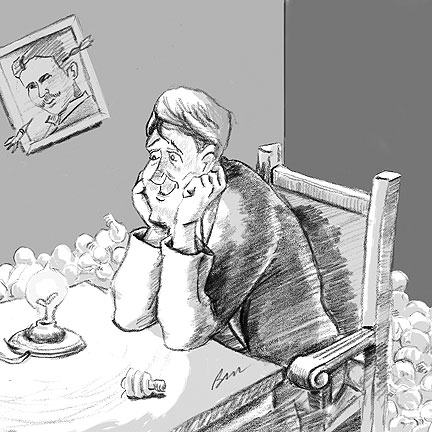
Illustration:  Bruce Crilly

It’s been noted in many places that Thomas Edison [caricatured above] may have failed as many as 1,000 times at inventing an electric-powered light bulb, and when asked about his string of failures, he turned the tables by saying (and I’m paraphrasing,) “I didn’t fail 1,000 times. I succeeded at inventing a light bulb, and it took 1,000 steps to arrive at it.”

A recent New York Times article asked the question “What if the Secret to Success is Failure?” when discussing education and character among school-age children. Do a search on “failure,” and you’ll find inspiring stories of heroes of history who have failed mightily on the way to great successes: Churchill, Einstein, Darwin, Pasteur, Ford and on and on.

And at the recent DMA International Conference in Boston, Biz Stone, co-founder of Twitter, turned failure on its head relative to social media, stating “if someone posts a negative comment about your product, it demonstrates a level of investment and passion about your brand.”

Okay, that’s a lot of fluffy and warm and puppies. But in business – and particularly in marketing – we’re trained otherwise. For most of us, “failure is not an option” for our next product rollout, or our next advertising plan, or our next event. However, if we embrace The Law of Failure, we might find that failing helps to reveal what success really looks like.

In almost every business, professionals fail their way into success, typically in a process of elimination continuum: try › fail › tweak › repeat until try ultimately leads to success. At which point, you test the snot out of that success to ensure repeatability and reliability. This is true in engineering; in medicine; in sports; in fashion; in entertainment; in technology; in a zillion other categories.

In marketing and advertising, (direct, media, creative,) we call it “testing.” But testing is simply an accepted euphemism for “financing failure to yield better strategies.” Why else would almost every big campaign be run through focus groups first?  Why test your spots on samples of your target demographic? It’s not so much that you can see what WORKS, but rather that you can reveal what DOESN’T.

My theory on why it is so vehemently avoided in the marketing/advertising arena is simply because of the money flow. When doing medical testing, for instance, the medical company has an R&D budget to cobble away in a lab for sometimes years at a time. In engineering or technology, all the sunk costs are stacked upfront – sometimes financed by venture capitalists – and millions or tens or hundreds of millions of dollars might be spent to arrive at a new design/product/solution that then gets recouped upon selling/distributing/launching.

But in advertising, the money flow is different. The typical relationship is an outsourcing model (company x hires agency y to develop the marketing program) that puts the pressure on the marketer to justify that spend and that agency choice. It’s our money, so you better spend it wisely. No marketer I’ve ever met wants to hear in the pitch “yeah, we’re gonna spend a percentage of the budget on failing.”

But that’s essentially what’s happening. Sure we do research, we do cluster analyses, we create predictive models. My colleague David Adelman at OCD Media is a media planner who creates predictive models in order to yield what he calls the most “testable propositions.”

The only problem (in advertising and marketing) is that those propositions are tested out in the marketplace, and failure is seen as a scarlet letter on the breast of the marketer (and in many high-profile cases, the agency, too.)

But I propose that failure is not a sad end to high hopes, but rather an intelligent investment in future successes.

When you fail at strategy X, you now have saved an innumerable amount of money because you KNOW that strategy X won’t work (under the current conditions.) You can instead pursue strategies Y and Z. And if they fail, you save proportional amounts, and so on. KNOWING is powerful.  Failure leads to knowing, whereas success is sometimes an intoxicating mix of planned well, guessed right, timed it right, chose a good director, etc.

This might not fly at your company if you’re a slave to the quarterly conference call with the board and have to explain that you’re failing. But if you’re a small to midsize marketer – you’ll never spend money any more wisely than by failing and KNOWING what to avoid in the future.