State of Emergency: Rhode Island Stumbles and Falls. But What Happens Next is Even Worse.

Have you heard about the marketing disaster happening in Rhode Island? It’s pretty bad, and it’s only getting worse. Instead of just recounting the disaster, let’s look at what happened, step by step, and point out the mistakes.

I assure you, we won’t do this to point fingers or tease, but rather to make it a teaching moment to help avoid similar setbacks in the future. Just in case you’re a state about to rebrand, and aren’t sure if you’ve got all your ducks in a row.

What happened first.
Rhode Island was set to invest approximately $5 million in a rebranding campaign. Naturally, they wanted to anchor the new direction around a central identity and theme. So they hired Milton Glaser, legendary designer and creator of the iconic ILoveNY theme and logo.

MISTAKE #1:
If you’re going to rebrand your state, and try to attract tourism, shouldn’t the creative come from a firm IN YOUR STATE? (Sure, there’s an argument to be made for going outside the borders…objectivity and all. But still.) Especially when you’ve got some pretty good agencies in the state, and one of the nation’s most respected and sought-after design schools in RISD.

What happened next.
Okay, so the new NYC-designed logo comes out (it’s pretty ok, I guess) along with the new NYC-written tagline (which I also think is pretty okay) and appears as part of a RI-agency-produced brand video to launch the new positioning.

Here’s the new logo with the tagline added:

RI_logo

And here’s the video:

MISTAKE #2:
Not easy to know unless you’re from Rhode Island, but apparently, there’s a scene in this video that is NOT shot in Rhode Island, but rather in Iceland. Yes, you read that right: Iceland. Probably a slip-up on the part of the editor…looking to put something “cool” in the video, he or she grabs a placeholder piece of stock footage of a skateboarder on a seaside pier doing some cool tricks. Unfortunately, the stock footage is shot in Iceland.

Stuff like this happens all the time, and unless some troll hadn’t pointed it out, no one would have noticed. But when you think of the essence of the assignment (to show off Rhode Island so people might become interested enough to visit,) it is kind of a big deal. I feel terrible for that kid.

Then the social media backlash happens.
Naturally, there are people out there who relish the schadenfreude, and go to great lengths for likes and shares. And boy did they have fun with this one. Here’s a particularly witty twitter post poking fun at the gaffe.

RI_twitter

Others had fun with the tagline and logo, and went out of their way to kick poor RI when it was down, right in the first hours of what was supposed to be its coming-out party. Ugh.

Then some really kooky stuff happens.
Amid the social media feeding frenzy, Betsy Wall, the CMO of the state (yeah, I didn’t know they had those either,) resigns amid the turmoil caused by the whole thing. This, despite having done her due diligence and run market research to uncover that the “cooler and warmer” tagline was the best (evidence-based) direction to take.

Then – are you sitting down? – the governor (yes, you read that right,) steps in and SCRAPS the tagline. For reals. And then (I’m serious, it gets worse,) is opening a studio and inviting the public to come and play with the logo to make it their own. The public. To play. With. The. Logo.

Sidebar: the state also recouped more than $120,000 from Havas (the PR agency) and IndieWhip (the agency that developed the video.)

MISTAKES # 3 through 1000:
Listen, I’m all in favor of crowdsourcing. But never, ever, EVER invite the public in to do the work of a professional. Madam Governor, you wouldn’t invite the public in to play around with your insides while you were having surgery, would you? No, because that’s the work of highly skilled, highly trained and highly experienced professionals. And so it is with the work of crafting identity, artwork and marketing messages.

In retrospect, we might assert that Rhode Island should have sucked it up and put its big-boy pants on and told the Twittersphere to piss off and deal with it. The tagline is kinda cool. The logo is meh, but it’s meh from Milton Glaser, so it’s better than most others might have developed on an off day.

And the truth is that a brand is more than simply its identity and its tagline. A brand is a cumulative sum of experiences and formed perceptions and continued delivery on a promise. It takes time and careful interaction to blossom, and it looks like Rhode Island simply ripped it out of the ground before it had a chance to grow into something tangible, and maybe even beautiful.
Wherefore art thou, Facebook?

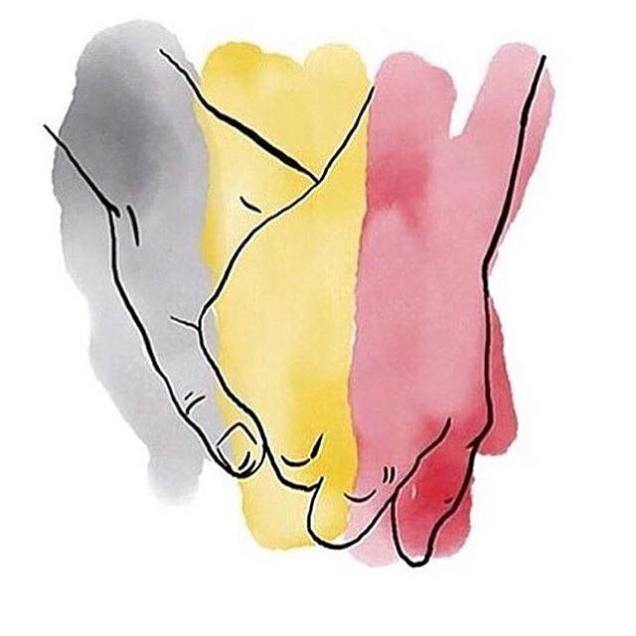
belgium_hands

By now, you’ve heard of the terrorist bombing attack that took place at multiple locations in Brussels. Awful news. And awfully reminiscent of the news that came out of Paris back in November of 2015.

And when major news events like this happen, people around the world are saddened, or maddened, confused or conflicted. Or all of those things. We can’t quite comprehend these monstrosities, and we yield, typically, to our softer human nature to offer support.

In the modern world, social media provides a forum for us to do this and tell our friends and our networks how we feel. We can demonstrate, protest, or mourn in many digital forms.

Back in November, after the Paris attack, Facebook quickly offered an opportunity to all its billion plus users to show solidarity and support for the French by offering a profile picture overlay of the French flag. This was offered at the top of your news feed.  Your usual mug shot was now overlaid with the red, white and blue stripes of the French flag colors. And millions upon millions of people rushed to switch their pics. Of course, it doesn’t change the horror, but it certainly helps people to know that others around the world are standing with them – whether in prayer, or in purpose.

This was not the first time Facebook enabled such a broad-based community alignment. Several months earlier – in June 2015 – Facebook offered a “pride overlay” where you could have your profile picture draped in rainbow colors, following the Supreme Court’s decision to allow same-sex marriage in all 50 states. Here, it was a more exuberant mood, and Facebook enabled its community of users (especially here in the United States,) to show support for the landmark decision. (See below.)

fb_pride_pic_maker

But, interestingly, Facebook has been conspicuously quiet following the Belgium attacks. There is no Facebook-offered profile pic overlay of the black, yellow and red bands of the Belgium flag. Why is this? Does Facebook hate Belgium? Does Facebook favor France over Belgium? Do Belgians matter less than Parisians or gay couples?

This seems odd, and ill-timed for Facebook to be so…selective. Surely, it’s not a DIFFICULT piece of code to offer the profile overlay. And surely, there’s no denying that the deaths of 31 innocent civilians and hundreds more injured don’t merit global support, especially since a terror group has already claimed responsibility.

It wouldn’t be an oddity if Facebook hadn’t done it – nearly immediately, I might add – for the two events I mentioned in June and November of 2015. Indeed, they have set a precedent for this kind of offering. And when they did those others, it was within the Facebook platform – you did NOT have to go to a third party to have it done. [An unofficial user-created page sprung up yesterday on Facebook called “Belgium Flag Overlay Tool.” ]

Why now, then – after something this important and impressive on a global scale – is Facebook so…absent? (And some may also argue, where was the overlay tool for Turkey, or for Mali?)

In my opinion, it’s sending a blurry signal. And blurry signals from a brand so ubiquitous and so central to so many people around the world are dangerous, if not deleterious, to the future of that brand.

Does Facebook hate Belgium?  Of course not.  But it kinda looks that way.  And in terms of brand image and management, that’s about all that matters.

[As a note of fact, if you do prefer to have your profile pic draped in the Belgian flag colors, you can visit the Rainbow Filter website, and choose from the preset “Belgium Filter.”]

The Curious Case of Apple and the FBI

apple_magnify

There’s a lot of talk going on right now in Silicon Valley about this case the FBI and Apple are grappling over: it’s an attempt to unlock the iPhone 5C of Syed Farook, the Pakistani-born terrorist who, along with his wife, killed 14 people in San Bernardino, California.

At the heart of the case is a request by the FBI, now filed into a court order, to impose upon Apple Computer to help the FBI unlock this device. As you know, iPhones can be locked with a numeric code, and after numerous attempts to unlock the device with the WRONG code, the software has a built-in “erase all” function. This is built into iOS, and it’s a protective device. The FBI is specifically requesting Apple to write NEW software that will override the built-in protections of iOS, so that the FBI can try 10 or 20 million different passcodes without erasing the contents of the device.

The first issue, of course, is how the FBI can’t figure out how to get into this device. You could probably throw a rock in Silicon Valley and find a dozen entry-level hackers that could circumvent the passcode to get into the device. How does the FBI not have 10 of these people on staff already?

Sure, the nature of this attack was awful, and would get even your garden-variety patriot up in arms about getting to the bottom of the crime, and especially finding out if anyone else was involved. It makes perfect sense, from an investigational perspective, to see what information that phone has on it.

However, I’m not sure that’s Apple’s responsibility. And as the Tim Cook-penned response indicated, it does set a dangerous precedent about privacy and the reach of government. He wrote:

“Opposing this order is not something we take lightly. We feel we must speak up in the face of what we see as an overreach by the U.S. government.

We are challenging the FBI’s demands with the deepest respect for American democracy and a love of our country. We believe it would be in the best interest of everyone to step back and consider the implications.”

But more than all that lofty ideology, this seems like a pretty cut-and-dry case of “it’s not our problem.”

In some sense, I think the FBI is confusing Apple with other tech giants like Google or Facebook. These companies DO have oodles of information about their users – usernames, passwords, location history and much more. But this is not the business Apple is in. Not by a long shot. They make their money on selling devices.

And that’s where I think this discussion hinges. All Apple did was sell a device to a consumer. What that consumer subsequently did with it is his business. Now, if that device was used in a horrible crime, (and that’s not a fact, but rather only an angle being pursued,) it certainly makes sense to see what information is on there. But how that is Apple’s responsibility seems, at the very least, confusing – if not downright dangerous.

From a brand perspective – this is a high-stakes game for Apple. If they capitulate (or are forced to,) then the risk of floodgates opening becomes a likely outcome – expect every country around the world (especially high-iPhone-penetrated countries like China and India,) to issue similar orders to the company.  And then expect similar orders to flood the executive offices of every technology company, social media company, e-commerce company and so on.

If Apple holds firm here, they could come off looking like heroes of privacy and vicars for establishing the boundaries between technology and civics. But at what cost? Is there a public backlash against the brand for “not cooperating in the war on terror?” Or is there a sentiment for honoring our rights to privacy that Apple would have stood steadfast to uphold?

This is dicey, indeed. And if I’m a brand manager for Apple, I would be constructing about 17 different contingency plans. Let’s stay tuned.

H&R Block’s Not-So-Ordinary Giveaway Gimmick

block_blog_image

If you’re a working American, you know it’s tax season. And for the first quarter of the year, the airwaves are awash in tax preparation advertising. Leading the charge is H&R Block, continuing its “get your billions back, America!” themeline, developed by their lead agency Fallon.

This year, they’re executing a major promotion, which started about a week ago. They’re giving away $1,000 per day to a thousand people who walk in to an H&R Block office over the course of 32 days. I’m not great at math, but that’s $32,000,000 in cash being given away by February 15th.

One of their spots is a fun, hip-hop themed, music-video-styled approach called “1,000 Washingtons.”

And they can afford it. The company earned approximately $2.3 billion in tax preparation revenue last year. They’re spending about 5% of revenue (which is right on target,) or roughly $100 million in US measured media in addition to the $32 million in given-away dollars.

This is a gimmick, pure and simple. And normally, that would be seen as a four-letter word on this blog, and among most practitioners. To be clear, a gimmick shifts the focus away from the consumer and on to the brand. When a brand runs a campaign and says “hey look at us! Look at what WE’RE doing! Look how cool WE are,” it’s generally considered cheesy, to use a technical term.

Under the surface, the brand is trying to induce early filing (on or before February 15th.)  It’s good for the company’s earnings, and doesn’t, um, tax the Block filers with a crush of returns in the last 60 days of the filing period.  So you can see how the gimmick is a convention set in place to serve the needs of the brand, not necessarily to serve the needs of the consumer.

However, this is a REALLY SMART gimmick, because, while the promotion is about what the BRAND is doing, the focus is squarely on the consumer, and what he or she might get if they use Block to file this year. So Block wins twice: they win on differentiating the brand from other tax prep companies, (nobody else is giving away this kind of coin,) and they win because the consumer is thinking ONE thing and one thing only: “I may get money if I file with Block.”

Did you hear that? The consumer is thinking “I may get money…” If you’re in the tax prep business, and you’re trying to lure consumers into a brick and mortar store to file their taxes early (which is done by only about slightly less than half of all filing Americans,) there is simply only ONE thing you want them to think: I may get money.  Forget the fact that the promotion will only award 32,000 in-store H&R Block filers out there:  a ratio of about 2 out of every thousand people.  Better odds than the lottery, but not a lock by any stretch of the imagination.

Marketing, and specifically, the promotion pillar of marketing, is mostly about managing perceptions of consumers. We can’t control what consumers do, or how they behave, or where they shop. But how they perceive the offerings, claims and other messages of influence is totally fair game, and why agencies who develop those messages are so critical to the success of brands.

In the big picture, then, Block is winning as a marketer by centering their advertising around a promotion that is focused on the simple meme “I may get money.” In the tax prep business, that’s what you want your consumer to think. (Even though millions of Americans will end up owing the government money.)

Add to this that the core theme of Block’s advertising (for the past two years) is “get your billions back America,” and you see how seamlessly this fits in with their overall messaging strategy. That’s a cohesive messaging plan at work. Nicely done, H&R Block.

The Law of Commonality

commonality_team_image

This morning, I saw two strangers meet on the street. One gentleman looked at the other, and in a language I couldn’t understand, seemed to ask the other: “do you speak this language?” The other replied with what I imagined was “OH HECK YES I DO!” and the two immediately began engaging. They smiled widely, embraced one another, and began to chat away.

They had something in common, and it was that commonality that broke down barriers and transformed these two strangers, for a moment at least, into fast friends.

I believe the same thing is going on with brands and consumers all the time – and I call it the Law of Commonality.

The Law of Commonality states that consumers are constantly striving to belong in some way, and will gravitate to people, communities, and brands with which they perceive a shared affinity or common origin.

Brands are constantly trying to appeal to consumers, based on the wants and needs that consumers present. And since brands are in competition with one another, they strive to reach consumers on a plane that sounds both appealing and differentiated.

You’ve seen and heard this in action a thousand times: “Are you looking for more free time?” “Is your hair thinning?” “If you’re looking for a different kind of family vacation…” All of these opening lines are obviously just a method of weeding out those that might not be interested in what the brand has to offer. But it’s also a method for the brand to implicitly achieve some kind of common ground with a consumer, based on what the brands ALREADY know about what the consumer desires.

On its own, that doesn’t sound too ground-breaking. But we have to remember how consumers are wired. Humans, by nature, are tribal. We look to join communities, and we favor those communities that are based on shared interests and common traits.

And it works equally in the opposite direction:  never do you feel more lonely or more isolated than when you perceive that you DON’T belong.  Ever been the guy wearing the only blue jersey in a stadium full of green ones?  I have.  Yeccch.  That is one looooooong walk back to the car.

This type of innate socializing activity (that occurs unconsciously for the most part,) serves a high level Maslow-ian need for belonging and puts us squarely on the path to that which we desire most:  affirmation (respect by and of others.)

Think about social media and its immense popularity. It’s not our extrovertedness that has transformed social media platforms into multi-billion-dollar behemoth corporations, but rather our need to belong, cloaked in a more socially-acceptable disguise of joining communities based on common interests and affinities.

Further, The Law of Commonality states that consumers are more likely to buy from a brand that they believe has something in common with them and/or their value system than from an equally qualified brand that does not.

If the consumer believes that a specific brand “really gets” who they are, or has “an interest in the same things I do,” that brand is already well ahead of its competition. And there are some pointed examples of brands that have done this very well, and made good on this simple human driver.

Harley-Davidson is one. Here’s a brand that recognizes a certain set of consumers and their deep-seated desire for freedom and exhilaration. The motorcycle is literally and figuratively a vehicle to take them to that special place. But more than that, the brand represents a bond of brotherhood with others who are a lot like you, even though they may look different.

Jeep has accomplished something similar with their unique auto designs, and a common interest in the outdoorsy lifestyle shared by most Wrangler drivers. American Express has achieved a level of common bond by referring to their customers not just as cardholders, but as “members.”

Belonging to the same club, enjoying the same activities, speaking the same language, having gone to the same college, rooting for the same sports team – any of these are more than good enough reason to create some kind of bond between people, and the same is true between brands and consumers.

It’s not the ONLY thing that fuels a purchase of these brands, but it’s certainly a tick mark on the invisible checklist that the consumer is invariably carrying around in his or her mind. And as consumers browse and compare, those tick marks that make us feel (a very important word here,) like we belong to something bigger – indeed a community of like-minded people that we can both respect and be respected by – usually add up to a level of preference and a favored status.

As you plan your marketing and brand initiatives, no matter how large or small, ask yourself how you can achieve commonality with your consumers. You’ll likely create a bond that goes way beyond just the first purchase.