Curation: The Magic Word for Marketers

Marcel Duchamp Cubist Painting 1912

I recently attended CES in Las Vegas to do some research for a client.  CES was huge and hyperactive and I hated it. My resistance was not due to the size or number or quality of exhibits, but rather the show’s inability to navigate me through any of it.

We live in a consumer-centric world, powered by immediacy and universality of choice (otherwise known as the Internet.) Today, we can shop for anything online, customize the features, and dictate how it’s delivered. Everything from clothing to cars to medicines to media.

And that’s pretty peachy. We all love choice. We all love control. But the surprising truth in many of our brand interactions is that we’re not all very good at it. Especially when the choices are overwhelming.

At CES, I longed for a GUIDE of some sort. I wished there was a handbook that outlined what I wanted to see if, for instance, I only had 2 hours to spend there. Or if I was only interested in “small, cool audio stuff.” Or if I just wanted to knock around and see celebrities. (There were many in attendance. I passed on Snooki and 50 Cent and took a front row seat at Earth, Wind & Fire. Call me old school.)

Such a guide would have still afforded me choice, but those choices would have been curated for me. And curation is the magic word for the new consumer world.

Curation is the antidote for a world of infinite choices. It relates to both content and the methods of its consumption. Those marketers who can provide guides or maps or recommendations for their consumers will have a much more fruitful relationship with them as a result. This is true in both the consumer and business-to-business galaxies. Some examples:

Museums curate exhibits. Of all the Duchamp cubist paintings, a certain museum might choose 30 of them. They would then arrange them in a distinct order, put them on certain walls, make you stand in directed spots to view them. Remember, content and the mode of consumption. The subtext here is “the museum strongly suggests you view Duchamp this way.” It’s a very specific experience. If I want some other experience, I can gladly seek it elsewhere.

Restaurants curate food experiences. The menu, by definition, is a curated presentation of food. The chef took all the ingredients available that day and culled them to eight appetizers, eight entrees and five desserts to choose from. Would going to a restaurant and just seeing a big buffet of basic ingredients (vegetables, fish, lettuces, meats, sweets) be the same? Not a chance. Here’s exactly where I DON’T want to have too much choice. (Sidebar: this was how the original “Craft” restaurant in New York started. Chef Tom Colicchio just presented the menu items, and left the pairing decisions to guests. In the June 2001 review of Craft,  New York Times Restaurant Reviewer William Grimes stated “…(the culinary arts,) function more efficiently as dictatorships.”)

Brands in virtually all categories curate personal experiences. Whether it’s how your clothes smell, or what your ringtone is, or what color the dashboard lights are in your vehicle or the editors of your favorite business magazine – we, as consumers or business customers, are seeking features and experiences that enrich our lives in some way. But for goodness sake, we want someone ELSE to tell us what those are.

We want Amazon to tell us it has “recommendations” for us. We want Google to auto-fill our search terms. We want the Gap to recommend a sweet belt to go with that sweater we just purchased. Sure, we ultimately want to make the buying choice, but what we need brands to do is present the pathways to making them.

Marketers, take note. Curate an experience for us. Stand for something. Deliver something specific, that no one else can deliver. Or deliver something that lots of other people can deliver, but do it in a way that’s unique, or cool, or fun, or hip or technologically cool or convenient. Because we all want choices…we’re just not all very good at making them.

This article first appeared on Technorati.

Five Rules of Engagement

For years, marketers, editors and bloggers have been volleying the marketing term “engagement” around like a taped up shuttlecock.  The term has also been denigrated by continuous contextual evolution.  “Engagement” means one thing when referring to customer loyalty programs, another in the context of your web analytics package, and something further afield in the complex mesh of social media.

So, to give engagement a better—or at least more consistent—name, I’ve attempted to identify some key principles of what customer engagement means in the context of marketing, and in the process, hope to help marketers use these principles to focus their efforts on engaging more customers.  This will be expanded into an intelligence paper with more detail, which I will post here later.

Just to be clear, three qualifiers and definitions:  first, I’m not talking about making sales, or generating leads, or providing entertainment.  We’re talking about moving a consumer (of just about anything:  soda, music, jet engines, etc.) beyond the initial sale, into an area of prolonged interaction and even ongoing communication.

Second, engagement does NOT necessarily have to follow a sale.  But it does follow the initial conversion from “I’m not interested” or “I’m not aware” to “I’m interested and want to hear/learn/see/do more with this brand.” For instance, I don’t buy anything from Mashable, but I’m deeply engaged with their content, and couldn’t imagine starting a day without visiting that site and consuming that information.  The same is true for almost a billion people and Facebook: nothing has been purchased, but the engagement level with that brand is incredibly high.

Finally, customer engagement tends to be transactional.  That is to say that it seems reserved for those brands that involve multiple interactions.  You might buy a coffee brand or read a certain blog every day, so the opportunity for repeated experiences—as you’ll see, one principle for engagement—exists.  On the contrary, you may only buy a funeral plot once in your adult life, if it all – there’s not much of an opportunity for that marketer to drive engagement with that customer.  (Not to say it doesn’t happen  – the singular experience may leave a lasting impression.)

The Five Principles of Engagement – in relative chronological order.

Principle 1:  It Starts with Triangulation. Although many marketers believe that they can engage customers in a linear, point a to point b fashion, this is actually quite difficult to sustain.  At some point, the customer needs more attention, and thus triangulation becomes a pivotal element of customer engagement.  When you and your customer can triangulate on outside interests—features like design or performance, affiliations like music, or sports, or a cause like the environment, or travel rewards like Broadway musicals—then the opportunities to engage multiply exponentially. Now you can offer your customer more of what they like/want/need, (while simultaneously creating a deeper bond, since you and the customer now have a common interest or two or six,) and tie the resulting benefits back to your brand.

Principle 2: It’s Fueled by Passion. Passion is the fuel for true customer engagement.  When you triangulate on something together, it’s based on both of your passions for it.  (That’s why you choose your triangulation points carefully. If you don’t have passion for that “other thing,” your customers will see right through your shoddy aims.) If your brand can demonstrate real passion for the industry, for the craft, for the process, or it continues to demonstrate passion in the form of your new products and services, that passion tends to be matched by your engaged customer. It’s in the nature of relationships to want to reciprocate what the other party is doing.  This in turn, leads to a process of ongoing exchange between the two parties that continues to amp up the interchange.

Principle 3:  It’s an Ongoing Relationship.  Many sales professionals (and I say this with the utmost respect for what they do) have an understandably myopic view of what marketing is about…they think lead>conversion>end.  Today, marketers know that the sale or conversion is just the beginning of a long and hopefully fruitful relationship where the initial conversion is an indication of some assent to continue communicating.  Brands that form relationships with their customers tend to provide a more enjoyable, and more sustainable experience for the customer, where each has their own voice, and after some trust is built up, can even begin to ask things of each other.

Principle 4.  It’s Based on the Experience.  Even if a marketer can provide every one of the above principles, engagement typically only occurs when the marketer can provide a certain (unique) experience to the customer.  It could be a benign feature, or something very personal, (but as we know from our brand training, the more emotional the benefit, and the higher up the ladder of self-actualization, the better.)

Great brands with deeply engaged customers provide a single certain, can’t-get-it-anywhere-else kind of feeling for those customers.  In many cases, those brands provide repeated experiences (even simple ones) that add up to something similarly special.  That leads to an unmistakable takeaway and a glowing perception of the interaction between the consumer and the producer.  Apple does that.  Wired magazine does that. The Ritz-Carlton does that.  And just to prove it doesn’t have to be some hoity-toity-Fortune-40 brand, the guy on the corner who sells you your bagels and coffee can do that.  And so can your private voice teacher.  And, likely, so did your best sports coach.

Principle 5.  It’s Gotta Be Consistent. Okay, so you’ve triangulated on something cool to create some commonality.  You’ve demonstrated passion with turning out great products that set or buck the industry trends.  You’ve forged a relationship with your customer that’s based on a unique and singular experience.  Now the challenge is sustaining this good will.  The easiest way to do that is to exploit the principle of consistency.  Be consistent with how often you’re communicating with customers.  Be consistent with how often you’re upgrading your products or services. Be consistent with your brand voice.  Because of all the things, this is most important.  Your customers fell for you because of something you did, or the way you did it, or the way you packaged it.  They remembered that experience and the feelings it created.  They came back for more, and continue to patronize—maybe even evangelize for—you and your brand.  Make a left turn on them, and you’ll likely lose all that good will.

Give the Gift of Anything: Three Keys to Overachieving with Customers

So, it’s the holiday season, and naturally, our thoughts turn to spending time with loved ones, eating (or over-eating in my case,) and the best part: sharing gifts. Whatever holiday you share, exchanging gifts is typically a part of it, and it adds an absolute level of joy, intrigue and excitement as we count down to the big day (or days, or geological phenomena, or whatever you celebrate.)

But what is it about gift-giving and gift-receiving that’s so special? Why do we bother with the fancy wrapping and the bows and the bags and the pomp and the circumstance?  As it turns out, there’s a marketing lesson in this process that’s worth evaluating.  I’ve found three keys that help keep my clients focused on delivering – and in some cases, overdelivering – on value.

The first key:  Surprise
Unless you’re one of those kids who makes a list and then GETS what you asked for, (and ewww if you do,) gifts, as we know them, are something typically UNEXPECTED.  At the very least, there’s a surprise element in the DNA of gifts that make them so enjoyable to receive.  (And as we get older, to give, too.)  In some cases, outside of the holiday construct, giving a gift can be an unexpected circumstance altogether.  Like when flowers arrive, or someone sends you a heartfelt greeting card or surprises you with something like a special dinner.

The second key:  Value
Another important ingredient that makes gifts so juicy is that they’re usually VALUABLE.  It’s not to say that they must be expensive, as much as having real value to the recipient.  That value could be monetary, could be sentimental, could be utilitarian, could be intellectual, could be sexy.

The third key:  Context
Finally, and this is the key, the cornerstone of a great gift experience is correlated to the level of CONTEXT on the part of the recipient.  When you give a gift that someone genuinely wants or really likes, there’s no limit to the value that can be put on it whatsoever.  Sure, unexpected and valuable gifts are nice, but give me something I really want, or have been searching for, or mentioned months ago, or is in a category I have enthusiasm for – that’s a gift I’ll always remember.

Now, let’s think like marketers.  When was the last time you created a structure where you could give a GIFT to your customer?  No, I’m not talking about a little box with a bow, but rather, when was the last time you gave something unexpected to your customer?  When was the last time you added real value to a transaction beyond what was agreed or expected?  When was the last time you took the time to find out what your customers really like, and then over-delivered it, or created a conversation around it that they could participate in or created an event based on that thing for them to attend?

This is what smart marketers do, on every level.  They first agree what the structure of the relationship is going to be:  I’m going to sell you gourmet food and wine in a fine dining atmosphere; I’m going to provide insightful television programming; I’m going to design clothes that you’ll want to wear; whatever.  But once that structure is set up, the smart marketer looks to add these three key ingredients:  surprise, value, context.  So the attentive marketer needs to watch his or her customers carefully, learn what they like, learn what they value, and then surprise them with something perfectly timed and perfectly tuned.

How can you add these three elements into your future marketing?  Whether you’re a small, local business or a multi-national corporation with thousands of employees, give your customers a gift every now and then, and you’ll find they give them right back in the form of deeper relationships, more referrals, maybe even brand loyalty.

The Butterfly Effect of Marketing

Illustration:  Bruce Crilly

Have you heard of the Butterfly Effect?  It’s a chaos theory-based rubric attributed to Edward Lorenz for explaining the sensitivity of the dependence on initial conditions relative to widely dispersed outcomes.  The theory is expressed in the saying “the flap of a butterfly’s wings in Thailand can set off a tornado in Texas.”

Okay, so what does that have to do with marketing, especially for small to midsized companies? If you drill down into the Butterfly Effect statement, you learn that small, seemingly insignificant actions can, in time and to a great degree, affect or evolve into great, often extraordinary results not easily conceived in context of the original event.  And conversely, you see that the auspices of great outcomes can be found to have relatively benign provenance.

In marketing, we’re often overcome trying to “think big” and “make it rain” and “blow it out,” and a zillion other clichés of bigness.  The truth, however, is that we can sometimes reach these astonishing aims by applying the Butterfly Effect and initiating small actions and – this is the key – setting them on the right course.

Here’s a simple viral marketing example:  you put a status up on Facebook, for instance, and tell 10 of your friends to pass it to ten of their friends, and so on.  Perhaps you’re promoting a secret concert of a popular band.  How many times does this have to be passed on for your initial (small) action to have a great effect?  In just four repeats of your original action (tell ten friends,) you have 100,000 screaming fans show up at the concert.  Uh oh – only 20,000 seats! So, sure, there’s very little chaos there.  But you can see how quickly simple actions can scale outward to a great degree.

Social media is really the Butterfly Effect in action in today’s marketing world.  Brands are seeding conversations, and then setting them off into the ether.  And in an extremely democratic (and sometimes terrifying) manner, the brand is weaved into conversations by people, and expanded, and turned into recipes or planking videos or mashups or hashtags.  Who knows? It’s chaos, but it’s usually good for the brand.  Sometimes (see AdFreak’s recent post on ChapStick’s social debacle,) it’s not so much.

One last point.  It doesn’t have to be social media.  You can start generating big marketing effects through small actions in lots of ways.  It could be a new merchandising program, a refresh of your menu, seeking new talent, or adopting a cause, or a new partnership, or a next blog post.  It could be anything.  But it has to be something and it has to be started.

A few keys to applying the Butterfly Effect:

Chaos. An important aspect of all of this is that it’s painfully hard for mere mortals to calculate chaos.  [An easy task for a math-head.  Not for me.] So it’s easy to imagine outcomes that are too likely.  The Butterfly Effect is constantly evolving, ever shifting and morphing into outcomes that, while predicated on the action before it, often do not travel a predictive pathway.  Get with that.

Direction. Don’t think about the outcome, because you often have little or no control over it.  Just ensure that the initiating action is set off in the right direction, is well-intentioned and is aligned with your brand values.  The rest is the market’s work, with all its environmental and evolutionary vagaries. Indeed, the chaos is part of the fun of watching this theory in action.

Distance (whether it’s measured in time or space) is a necessary factor.  You can’t expect these great things to happen in sixteen minutes.  Be patient, and integrate the Butterfly Effect along with your other, more urgent, plans.  If you launch a rocket in the air, and then measure its effectiveness in six seconds, you’ve failed to reach the stars.  Measure again in four hours, and you’re dancing among them.

How does this apply to your brand?  What can you START today?  What ten things can you start today?  Even if it’s a small but pertinent action that can evolve, it’s probably worth it. So start flapping.

The Law of Failure

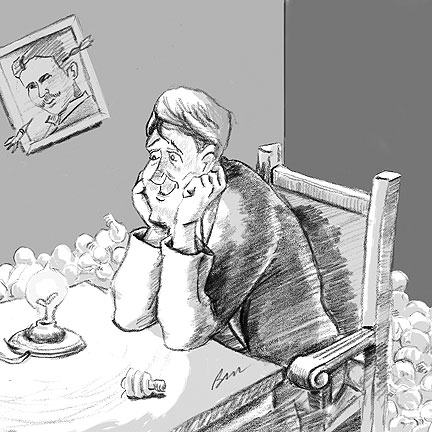
Illustration:  Bruce Crilly

It’s been noted in many places that Thomas Edison [caricatured above] may have failed as many as 1,000 times at inventing an electric-powered light bulb, and when asked about his string of failures, he turned the tables by saying (and I’m paraphrasing,) “I didn’t fail 1,000 times. I succeeded at inventing a light bulb, and it took 1,000 steps to arrive at it.”

A recent New York Times article asked the question “What if the Secret to Success is Failure?” when discussing education and character among school-age children. Do a search on “failure,” and you’ll find inspiring stories of heroes of history who have failed mightily on the way to great successes: Churchill, Einstein, Darwin, Pasteur, Ford and on and on.

And at the recent DMA International Conference in Boston, Biz Stone, co-founder of Twitter, turned failure on its head relative to social media, stating “if someone posts a negative comment about your product, it demonstrates a level of investment and passion about your brand.”

Okay, that’s a lot of fluffy and warm and puppies. But in business – and particularly in marketing – we’re trained otherwise. For most of us, “failure is not an option” for our next product rollout, or our next advertising plan, or our next event. However, if we embrace The Law of Failure, we might find that failing helps to reveal what success really looks like.

In almost every business, professionals fail their way into success, typically in a process of elimination continuum: try › fail › tweak › repeat until try ultimately leads to success. At which point, you test the snot out of that success to ensure repeatability and reliability. This is true in engineering; in medicine; in sports; in fashion; in entertainment; in technology; in a zillion other categories.

In marketing and advertising, (direct, media, creative,) we call it “testing.” But testing is simply an accepted euphemism for “financing failure to yield better strategies.” Why else would almost every big campaign be run through focus groups first?  Why test your spots on samples of your target demographic? It’s not so much that you can see what WORKS, but rather that you can reveal what DOESN’T.

My theory on why it is so vehemently avoided in the marketing/advertising arena is simply because of the money flow. When doing medical testing, for instance, the medical company has an R&D budget to cobble away in a lab for sometimes years at a time. In engineering or technology, all the sunk costs are stacked upfront – sometimes financed by venture capitalists – and millions or tens or hundreds of millions of dollars might be spent to arrive at a new design/product/solution that then gets recouped upon selling/distributing/launching.

But in advertising, the money flow is different. The typical relationship is an outsourcing model (company x hires agency y to develop the marketing program) that puts the pressure on the marketer to justify that spend and that agency choice. It’s our money, so you better spend it wisely. No marketer I’ve ever met wants to hear in the pitch “yeah, we’re gonna spend a percentage of the budget on failing.”

But that’s essentially what’s happening. Sure we do research, we do cluster analyses, we create predictive models. My colleague David Adelman at OCD Media is a media planner who creates predictive models in order to yield what he calls the most “testable propositions.”

The only problem (in advertising and marketing) is that those propositions are tested out in the marketplace, and failure is seen as a scarlet letter on the breast of the marketer (and in many high-profile cases, the agency, too.)

But I propose that failure is not a sad end to high hopes, but rather an intelligent investment in future successes.

When you fail at strategy X, you now have saved an innumerable amount of money because you KNOW that strategy X won’t work (under the current conditions.) You can instead pursue strategies Y and Z. And if they fail, you save proportional amounts, and so on. KNOWING is powerful.  Failure leads to knowing, whereas success is sometimes an intoxicating mix of planned well, guessed right, timed it right, chose a good director, etc.

This might not fly at your company if you’re a slave to the quarterly conference call with the board and have to explain that you’re failing. But if you’re a small to midsize marketer – you’ll never spend money any more wisely than by failing and KNOWING what to avoid in the future.