The Law of Commonality

commonality_team_image

This morning, I saw two strangers meet on the street. One gentleman looked at the other, and in a language I couldn’t understand, seemed to ask the other: “do you speak this language?” The other replied with what I imagined was “OH HECK YES I DO!” and the two immediately began engaging. They smiled widely, embraced one another, and began to chat away.

They had something in common, and it was that commonality that broke down barriers and transformed these two strangers, for a moment at least, into fast friends.

I believe the same thing is going on with brands and consumers all the time – and I call it the Law of Commonality.

The Law of Commonality states that consumers are constantly striving to belong in some way, and will gravitate to people, communities, and brands with which they perceive a shared affinity or common origin.

Brands are constantly trying to appeal to consumers, based on the wants and needs that consumers present. And since brands are in competition with one another, they strive to reach consumers on a plane that sounds both appealing and differentiated.

You’ve seen and heard this in action a thousand times: “Are you looking for more free time?” “Is your hair thinning?” “If you’re looking for a different kind of family vacation…” All of these opening lines are obviously just a method of weeding out those that might not be interested in what the brand has to offer. But it’s also a method for the brand to implicitly achieve some kind of common ground with a consumer, based on what the brands ALREADY know about what the consumer desires.

On its own, that doesn’t sound too ground-breaking. But we have to remember how consumers are wired. Humans, by nature, are tribal. We look to join communities, and we favor those communities that are based on shared interests and common traits.

And it works equally in the opposite direction:  never do you feel more lonely or more isolated than when you perceive that you DON’T belong.  Ever been the guy wearing the only blue jersey in a stadium full of green ones?  I have.  Yeccch.  That is one looooooong walk back to the car.

This type of innate socializing activity (that occurs unconsciously for the most part,) serves a high level Maslow-ian need for belonging and puts us squarely on the path to that which we desire most:  affirmation (respect by and of others.)

Think about social media and its immense popularity. It’s not our extrovertedness that has transformed social media platforms into multi-billion-dollar behemoth corporations, but rather our need to belong, cloaked in a more socially-acceptable disguise of joining communities based on common interests and affinities.

Further, The Law of Commonality states that consumers are more likely to buy from a brand that they believe has something in common with them and/or their value system than from an equally qualified brand that does not.

If the consumer believes that a specific brand “really gets” who they are, or has “an interest in the same things I do,” that brand is already well ahead of its competition. And there are some pointed examples of brands that have done this very well, and made good on this simple human driver.

Harley-Davidson is one. Here’s a brand that recognizes a certain set of consumers and their deep-seated desire for freedom and exhilaration. The motorcycle is literally and figuratively a vehicle to take them to that special place. But more than that, the brand represents a bond of brotherhood with others who are a lot like you, even though they may look different.

Jeep has accomplished something similar with their unique auto designs, and a common interest in the outdoorsy lifestyle shared by most Wrangler drivers. American Express has achieved a level of common bond by referring to their customers not just as cardholders, but as “members.”

Belonging to the same club, enjoying the same activities, speaking the same language, having gone to the same college, rooting for the same sports team – any of these are more than good enough reason to create some kind of bond between people, and the same is true between brands and consumers.

It’s not the ONLY thing that fuels a purchase of these brands, but it’s certainly a tick mark on the invisible checklist that the consumer is invariably carrying around in his or her mind. And as consumers browse and compare, those tick marks that make us feel (a very important word here,) like we belong to something bigger – indeed a community of like-minded people that we can both respect and be respected by – usually add up to a level of preference and a favored status.

As you plan your marketing and brand initiatives, no matter how large or small, ask yourself how you can achieve commonality with your consumers. You’ll likely create a bond that goes way beyond just the first purchase.

VW: follow-up to previous post

Back on November 11, 2015 I wrote a post entitled “Das Issues: What’s Next for Volkswagen?”    In it, I discussed the emissions scandal, and what I thought the brand could do to start the process of reconnecting with current customers and reaching out to prospects.

At the end of the post, I made a suggestion that went like this:

If I was a brand consultant for Volkswagen, (full disclosure: I’m not, but certainly available!) I would start by going back to what helped build their perception: The dorky little outsider that promised the moon and modestly delivered it. My very next ad headline (think full page insertions in The New York Times, Wall Street Journal and USA Today,) would probably read “11 million Lemons.” And the body copy would go on to overtly apologize for the transgression, and then outline the steps we were taking to make good on our (new) promises and deliver exceptional automotive engineering.

And then I’d invite consumers to come along for the (literal and figurative) ride to redemption. Das Step 1.

So I was just poking around today and saw this article about Volkswagen. As you can see, it’s written on November 17th.  It talks about how VW started running full-page insertions in The New York Times, The Washington Post and The Wall Street Journal.  The headline reads “We’re working to make things right.”  And the CEO apologizes for the transgression, and begins to outline some steps to make good.

Kooky, huh?

Das Issues: What’s Next for Volkswagen?

So you’ve heard about Volkswagen’s little problem, yes? Just in case you haven’t, here’s a quick recap: they installed software into millions of cars to “beat” emissions tests. This software was built around an algorithm that essentially “knew” when it was being tested. The algorithm kicked ON for tests, and then shut OFF in typical driving conditions. When it was off, the cars were not very clean at all, pumping out up to 40X the legal limit of nitrogen oxide emissions. Yikes. Word on the street is that VW has been up to this kind of “engineering” for as long as six years. And now, details are emerging about nearly a million more manufactured cars with carbon dioxide emissions issues. Das problems indeed.

And the getting-it-fixed part actually exacerbates the problems the brand faces. If you own one of the affected VW models, you can return it to an authorized dealer, and they will fix the problems free of charge. However, when those problems are fixed, your car will not perform as it had before. That’s because there’s a trade-off between emissions and fuel efficiency. (Trust me on that one.) So the car you bought, well, is not the car you bought.

As a result of this debacle, VW is facing up to $18 billion in fines and penalties under the US Clean Air Act. They may also face criminal charges. The CEO Martin Winterkorn has resigned, and new CEO Matthias Mueller (previously CEO of Porsche,) has made it his mission to regain consumer trust in the brand.

And that’s really where the damage is done. Sure, the share price has taken a hit (it was trading in the mid $160’s, and then plummeted to around $100 when news of the scandal broke. It’s at $96.17 at the time of this writing.) But the value of the BRAND has all but disappeared.

Brands, and especially automotive brands, are positioned and marketed around very small, scarcely perceptible differences. That’s because they all pretty much do the same thing. If you look at the automotive category, you’ll see that all the brands share about 99% of the exact same DNA. Tires, engines, doors, windows, airbags, radios, seats, etc. So, the only way to be remembered is to make claims around features (or feature sets) that create some tangible benefits to consumers. Benefits like safety, or fuel-efficiency, or exhilaration, or performance.  VW was promising a benefit set of clean air AND fuel efficiency on many of the models in question.

The best way to understand a brand is to think of it as a PROMISE. That’s it. I’ve been beating this into the heads of my graduate students at NYU for years. Brand=promise. So when a brand like Volkswagen openly violates laws and is caught in surreptitious software shenanigans to charge premiums to deliver benefits and it all ends up to be a money-grabbing meister-manipulation, it’s done irreparable damage to the brand that has built equity in its “little outsider that could” position for more than five decades.  Because it breaks the promise.

I’ve often said that brands are like a house of cards. It takes time, patience, skill and a delicate hand to build into something impressive. And just one clumsy bump to have it all come tumbling down in an instant.

Brands are built largely on the advertising they execute. And Volkswagen sits in the pantheon of the “greats” in advertising history. Doyle Dane Bernbach helped put this brand on the map, and paved an entirely new road with their ground-breaking Koenig-penned, Krone-designed, Bernbach-driven “Think Small” back in 1959. They literally shape-shifted the industry with this ad. Partly because it was revolutionary (we’ll tackle that one in another post,) and largely because the brand actually delivered on the promise!

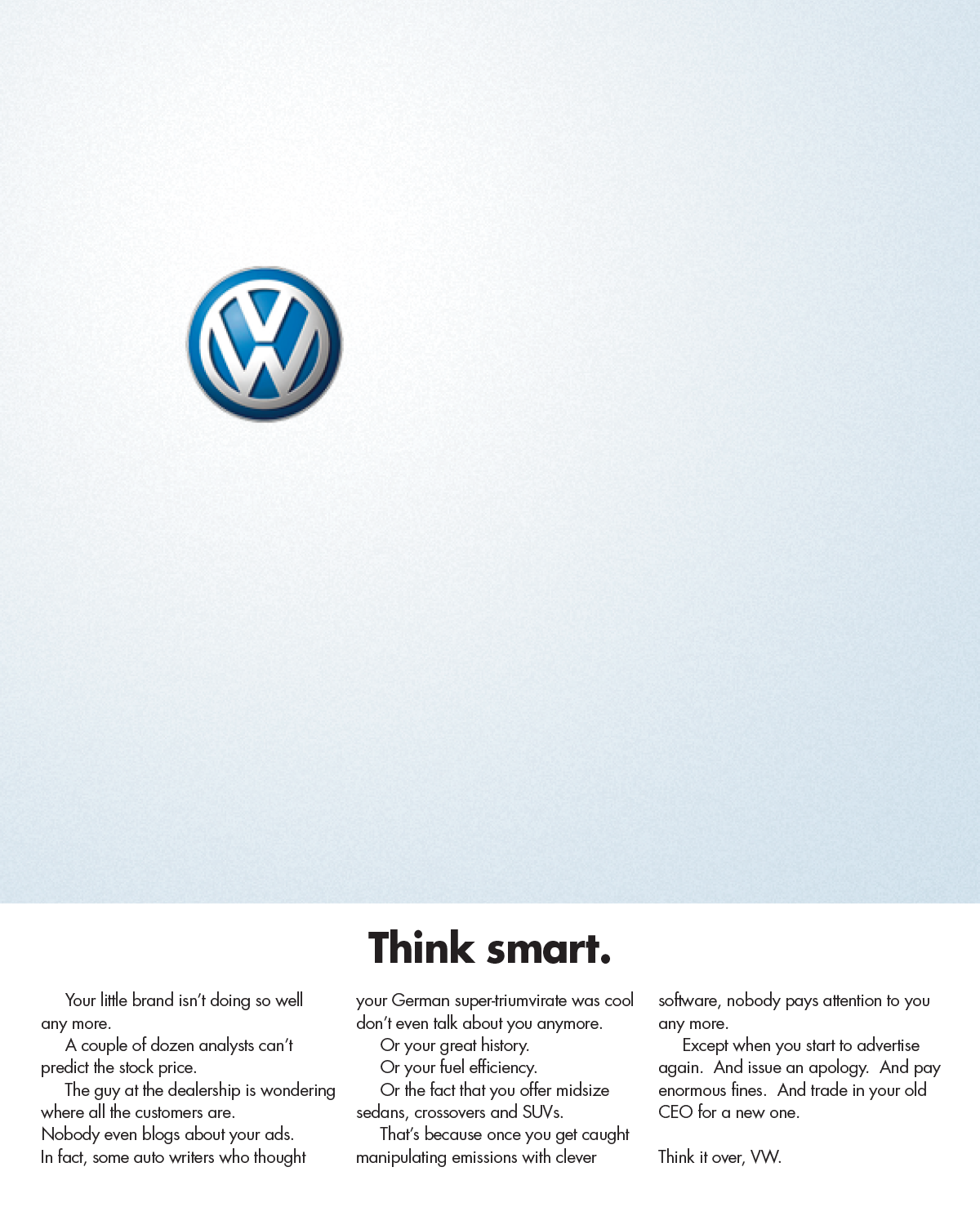
Here’s a modern riff, based on VW’s current position:

VW_thinksmart_ad

So what’s next for VW? How do they go about re-initiating the conversation with American consumers about its brand? How do they recapture the glory and modesty and wry humor of “Think Small” and “Lemon” and that gorgeous “Darth Vader” Super Bowl spot?

Whatever they do, it will have to be an organization-wide mission that every person from the CEO down to the guy who washes the cars at the dealership in Duluth all share.

If I was a brand consultant for Volkswagen, (full disclosure: I’m not, but certainly available!) I would start by going back to what helped build their perception: The dorky little outsider that promised the moon and modestly delivered it. My very next ad headline (think full page insertions in The New York Times, Wall Street Journal and USA Today,) would probably read “11 million Lemons.” And the body copy would go on to overtly apologize for the transgression, and then outline the steps we were taking to make good on our (new) promises and deliver exceptional automotive engineering.

And then I’d invite consumers to come along for the (literal and figurative) ride to redemption. Das Step 1.

Taco Bell’s Cool (but weird) World Series Breakfast Promotion

taco-bell-logo

If you’re following baseball, you know the New York Mets are in the world series (yay!) to face the Kansas City Royals, who are returning to the Big Show for the 2nd straight year. The games will air on Fox, who will be selling advertising at the average cost of $450,000 per 30-second spot. A far cry from the $3.5 million that the Super Bowl generates for the same airtime, but remember that the World Series has the potential to stretch out over 7 games. So advertisers are lining up in droves to get their brands in front of sports fans, and also to tie in promotions with the game.

One such marketer is Taco Bell, who is running a promotion called “Steal a Base, Steal a Breakfast.” The promotion parameters are as follows: if a base is stolen during games one or two, anyone can walk into a Taco Bell on Thursday, November 5th between 7:00 am and 11:00 am (in your local time zone) and receive a FREE A.M. Crunchwrap. If no player steals a base during those games, but a base is stolen in games three through seven, then the free offer will stand and be available on Tuesday, November 10th.

This is not the first time Taco Bell has run this promotion – it first ran in 2007, returned in 2008 and then once again in 2012.

But…why?

What does a Tex-Mex fast food chain, and in particular, their breakfast service, have to do with baseball and stolen bases? According to the press release issued by Taco Bell, Marisa Thalberg, the Chief Brand Engagement Officer, “we are encouraging the whole country to root for a stolen base in the Series – from either team – because the player who steals that first base will have thereby “stolen” a free breakfast, our A.M. Crunchwrap breakfast sandwich, for all of America.”

Okay. From a marketing standpoint, it’s always a good idea to piggyback off the momentum of a highly attended/highly viewed sporting event. No argument there. But why is Taco Bell doing THIS?

Well, for one, it’s a pure exposure/awareness play. They’ll run television ads throughout the world series promoting the promotion (that sounds funny,) and through a lot of reach and frequency, they’ll get viewers excited to watch for a stolen base. [To be clear, it’s highly unlikely that they’ll convince non-baseball-fans to tune in with any significance to “root” for a stolen base.] There will also be social media marketing run around the promotion (the hashtag is #StealABreakfast,) that will likely garner a bump in new fans/followers on their various social feeds.

Of course, this is a sales promotion, so they will likely also see a significant lift in their morning traffic on the day when the promotion runs – and most of that lift will be coming from visitors who are not typical Taco Bell customers. So it’s a sampling/trial play. The thinking is “if we can get a million new people walking in to a Taco Bell this one morning, we might be able to convert some percentage of them into return business.” Good solid marketing thinking.

I like this promotion on principle, but the details of it strike me as, well, weird. The “steal” theme is a bit of a stretch, and doesn’t really align the brand conceptually or contextually with the game for the long run. The “steal” is very much a “one-time” or at least relatively rare phenomenon. (Major League Baseball statistics show that the median number of stolen base ATTEMPTS per game, per team is .70.  That’s not a lot.  (Also note that Taco Bell has not run this promotion year in and year out…it hasn’t run for three years, so as far as the average consumer is concerned, it’s NEW.) I’d much rather align my brand for the long term with a concept that has lasting power, and maybe some appreciable repetition involved that continues to remind consumers of the brand.

As a rule, we don’t associate baseball with breakfast. (It’s an afternoon or evening game, in terms of general perception.) Generally, we don’t associate baseball with “southwestern” or “tex-Mex” food styles. (The National Hot Dog and Sausage Council (NHDSC) estimates that more than 30,000,000 hot dogs and sausages will have been sold in baseball stadiums alone this year.) And generally, we associate the word “stealing” with something bad or wrong, (in fairness, unless you contextualize it around the offensive game in baseball.)

So this promotion is offered by a Tex-Mex fast food restaurant that sells tacos and burritos, centered around a game that makes a good living selling tens of millions of hamburgers and hot dogs, is promoting breakfast during what will be all night games, is built around a phenomenon that happens rarely, and is associated with a word that we all perceptually agree is something wrong.  That’s why I find it a bit weird. Oh, and if no bases are stolen during the World Series, then, well, no hay desayuno gratis para usted, mis amigos.

Taco Bell has been on a downward slide in the recent period, (according to MarketWatch, its parent company Yum! Brands’ shares are down 18.6% over the past three months,) so it makes sense to do SOMETHING to draw attention to the brand.

And I think the brand will likely see some good numbers coming out of this promotion. But, based on the transiency, I’m not sure it will have the lasting effect they’re hoping for. The cost/benefit analysis will likely allow the marketing executives to keep their jobs for the next quarter, but then you’ll probably see the next “one-off” event/promotion thingy happening.

If you’re going to call attention to your brand with any kind of promotion, remember to do so in a fashion that bonds consumers to it for more than just a “quick hit” and that makes sense with your brand values and your category positioning. Think about alignments that have perennial value, and you’ll roll up fans and maybe even loyal customers for years to come.

Marketers: Get in the game!

Whether you’re a mega-global-brand-giant or a small regional player trying to get noticed, marketing can be a complex enterprise, indeed. So many factors to consider. So many competitors. Choosing the right channels. The nuances in the target segments. What are the right objectives? Which daypart? Oooh! And our social feeds need to be updated, too. Yikes!

All of these complexities pre-suppose that marketers of all shapes and sizes are active in the consumer (or b-to-b) arena, each taking their shots at the proverbial goal – often missing, and occasionally scoring a heart-stopping buzzer beater. But the unspoken truth is that very often, and in some cases with alarming number, marketers are simply sitting on the sidelines, waiting for the right time to “get in” in the hopes of maximizing their scoring opportunities. (Alright, I’ll quit it with the sports lexicon, but you get the idea.)

Why in the world would a marketer choose to NOT market?  What we see in many cases is the symptom of “analysis paralysis.” You’re bunched up with budgets, message, partners, coordinating schedules with holidays or industry-important trade shows. You’re waiting for approvals or certifications. In the meantime, other marketers in the category are gaining ground simply by being visible.

One familiar refrain: “we can’t afford to do marketing right now, so we’re waiting it out.” The simple truth is this: you cannot afford to NOT be marketing. It’s become more critical now than ever before, since we live in an “always-on” socially connected world. In your absence, your competitors are making impressions, driving conversations, making conversions and building engagement. Sure, sometimes it’s on a small scale, and sometimes they may misstep. But the consumer segment you’re all after is being “trained” that your competitor is a brand that’s ready to be engaged with. Your brand, even if it’s empirically “better” in some respects, is invisible in the meantime, and therefore not considered at all as a player in the category. Now that’s costly.

Another recurring pattern is that marketers are tentative, afraid to go out with a “less-than-perfect” iteration of their materials: the website isn’t quite there, or the first cut of the spot was a little rough and could use some cleaning up.

While we all strive to get it as right as possible every time, you’re perfectly allowed to make a misstep here and there in terms of presentation. Not every performer has his or her best night every night of the tour, and not every marketer is going to nail it on every impression. As long as your misstep is not of the “off-brand” or “off-message” variety, you’ll be fine. Every major brand started modestly, and built off their small successes to improve their messaging and put a more shiny coat on their advertising.

So get off the bench, lace up your briefcase, and get out there with your marketing! Who knows? You might even score a few points with your audience.

Here’s a quick checklist:

  1. Do you have a product or service that can be sold to a consumer [or intermediary] right now?
  2. Do you have a brand promise associated with that product or service that can be turned into a compelling marketing message?
  3. Is that brand differentiated from competitors in your category?

Then YAY! You’re ready to go! You can basically start marketing immediately. How much, or how aggressively, is up to you.