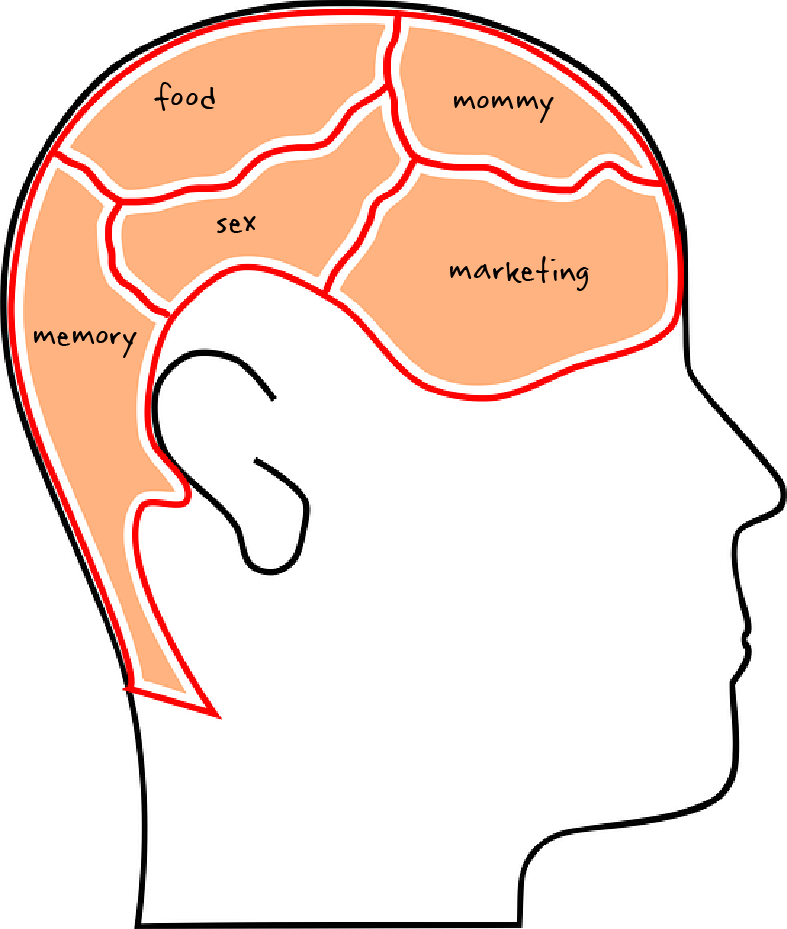
Is your marketing intuitive?

Over the last year, I’ve become fascinated – okay, maybe even a little obsessed – with cognitive psychology.  As a result, some of the principles of understanding the mechanics of how the mind works have found their way into our agency’s plans and presentations.  What we’re trying to uncover are the automatic mechanisms of the mind, and how to appeal to those functions with specific marketing messages.

One way we’re doing that is by embracing what we call intuitive marketing.  There’s no set formula.  There’s no best practices guide.  And it’s even more complicated in that it’s different, not just for every category, but for every marketer.

What does it mean to be intuitive anyway?  To (over)simplify, the human brain has two basic types of reasoning functionality.  Some of those are complex, multi-step functions.  Like a difficult math problem, or recalling a song in your memory, with the guitar riff and the drum intro and the lyrics, and the harmonies, all at once.  The other kinds are automatic functions.  These are the immediate perceptions of facts and concepts that happen instantaneously, and that don’t require other thoughts or substantiations.  Like walking outside and recognizing that it’s cold.  Or even having an insight while someone is talking.  It’s not something you think about thinking about.  It’s just an immediate mental perception that typically happens in an instant.

And as marketers and the agencies that serve them, we’re all trying to simplify the choices for our customers.  To make it easy (even instantaneous) to CHOOSE US!

Sometimes, it’s the package design.  Sometimes, it’s the media choice.  It could even be the distribution channel.  But in any case, if your marketing doesn’t make contextual sense and simplify the cognitive conversation in some way, try thinking more intuitively. Here are a few cornerstone idea-starters:

Do (or be) the thing that makes the most sense and simplifies the engagement.
Did you ever notice how when you walk into a room, the light switch is almost always just inside the door opening, and at about chest height?  Or how the toilet paper is almost always within arm’s reach of the toilet itself?  Wouldn’t it be weird, and downright silly to have the light switch (or the toilet paper) across the room somewhere?  That would not only not make sense, but it would make your life – or at least that particular experience – harder in some way.

Apple revolutionized the mobile phone industry with their iPhone design through a number of powerful features.  Whether it was combining a phone with an email device and an internet device and a music player, or introducing the touch-screen features to a broad audience, they just made it EASIER to engage with your communications needs on one handsome mobile device.  Once it was introduced, it made every device that preceded it seem clunky, limited and insensible.

Anticipate the customer’s usage environment.
I was recently traveling on business, and stayed at the grandest ole’ resort in Nashville.  When I got in the shower, I noticed something really curious:  the mini shampoo bottles had twist-off caps.  Having already been soaked with water, it was nearly impossible to unscrew those things!  It was a good laugh, but it proved that they hadn’t really thought the usage scenario through quite completely.  A flip-top design would have been much more intuitive.

My colleague and partner and a fellow blogger, David Adelman, brought to my attention an especially curious case:  while riding the subway, he was reading the ads on the train car, and noticed that one of them featured a QR code.
On the subway.
Where there is no mobile service.

As far as intuitive goes, that’s an epic fail.

Don’t design features into your product or service that its consumers will never need.
My life as a frequent traveler is made more enjoyable by the fact that I love airplanes.  One of the reasons I love them is that they’re super streamlined in their design. Many people don’t even realize that airplanes are not outfitted to go in reverse.  It seems silly, but it’s true. EVERY facet of an airplane is built to optimize one thing:  going forward and fast.

The same is true of Instagram.  Many people don’t realize you can’t go to an “instagram.com” and upload photos.  (There are third party web access points, but that’s what happens when an ecosystem evolves around a successful platform.)  Instagram is wholly designed to enable a singular and contained experience:  point, shoot, edit, upload and tag all through your mobile device.

The best products and services are built the same way:  hyper-optimized to accomplish the simple tasks they’re built for.  Think Dyson vacuum cleanersKeurig single-cup coffee brewers. Staffing companies that focus on specific job titles. Tax attorneys.  Singular specialization can be intuitive.

Elevate the experience on a rational and emotional level.
Finally, think about all these cornerstones, and then take it to the next level.  That’s what the great marketers do.  BMW automobiles are designed to appeal to the driver in a specific way, and to the passengers in a different – but also specific – way.  The dashboard instruments that are critical to the driving experience are pitched in to the driver so he or she has an elevated driving experience.  Amazon.com built an algorithm that monitors your purchase behavior to make intuitive recommendations for future purchases.  Then it goes a step further to create bundle recommendations and even offer you the most optimized shipping choices.  That makes your shopping experience more than just a shopping experience.  It makes it an Amazon experience.

Start with these cornerstones and then go further to create the most intimate and rewarding experience for your customers.  If you do that, you don’t have to be too intuitive to know that success is right around the corner.

Distribution: The Inconvenient Truth for Brands

marketing thingy blog image - distribution

I was having a conversation recently with a woman who is SERIOUS about fashion. She dresses impeccably, and cares pretty deeply about the name on the tag inside every skirt, blouse and shoe she wears. I posed a question: “what if you could get (insert uber brand here, like Christian Louboutin, for instance) at a discount retail outlet like Costco? Would you do it?”

She shot back: “NO WAY.”

Now, pardon the “focus group of one” here, but this seemed to shed some light on an interesting sub-topic of marketing, which seems especially important considering it also impacts one of the four cornerstones of our entire industry.

As our conversation went on, it turned out that even a significant savings of 10-15% wouldn’t be enough to convince her to go to a discount retailer for the toppermost brands she so covets. She also believed that most people (men AND women) who are serious about fashion would agree.

As it turns out, “where” may be as equally important as “what” when it comes to the experience of brands, and not just fashion brands. Distribution strategies (also known as “Place” in marketing 101) help consumer brands reach customers, typically creating a factor of convenience or an experience of excellence, depending on the brand and the target audience. But this paradox seems to touch so many aspects of marketing, such as price, product, place, brand ethos and even consumer perceptions. Let’s examine.

The Price Question
Many brands are sold at retail outlets and also online through many e-tailers, which may include the brand’s own website. (This is true in almost every category: fashion, appliances, electronics, home goods, food and beverage, health and beauty, etc.) In some cases, price shopping is a driving factor. In other cases, it’s not. Some brands don’t discount because they built their brand to own the high price position, or (with a case like Apple) the prices are simply non-negotiable. (You can’t get a “cheaper” iPod anywhere – the prices are fixed.) So unless the price is steeply discounted for a brand at one outlet over another, the consumer will likely choose to shop at a distribution point (online or offline) that is either a.) convenient or b.) preferred.
So, regarding price, the distribution strategy matters.

Brand and Perception
For a high-end brand (like Louboutin,) there is a perception that it can’t possibly be sold at places other than the most selective boutiques. That’s part of the brand’s equity. But for mass market brands, and even discount brands, the locations still have to match up with the brand personality. The distribution center, then, becomes a very important aspect of building the brand. (You won’t hear THAT much from your agency!) It’s just as weird to find Louboutin in Costco as it is to find Wrangler or Lee jeans at Nordstrom. It’s just a disconnect that can impact the brand, and for that matter, the brand perception of the retailer, too!

Note: In other cases, the brand and the distribution center are inextricably linked to cement the brand and its perception. Think Old Navy.
So, regarding brand perception, the distribution strategy matters.

The Consumer Experience
Finally, in some cases, the consumer experience gets folded into the overall brand offering. If you’re a high end fashion brand, you want to manage the entire experience of how the consumer goes about acquiring their next piece of your clothing: the way the store looks, the way the salesperson greets and works with the consumer, the fitting room experience, the checkout and most certainly the bag or packaging she’ll walk out of the store with. (Note, this is different than product packaging, which is a discipline unto itself.)
So, as it turns out, where DOES matter to consumers, across almost all points of concern.

It’s time for more marketers and agencies to get with this inconvenient truth, and start building brands to include the distribution ecosystem as a key brand building block and cornerstone of brand maturity.

The Law of Constant Improvement

In marketing, most brands that are enjoying success are likely doing so because they created something that WORKS. Whether it’s a consumer product like a vacuum cleaner that never loses suction, or the standard-setter in smartphones or a business-to-business service like an ad network or a social media platform or even a service provider like an ad agency or web development firm, something is WORKING. It could be the product design, or the solution to a common problem, or a specific process or a recipe or even an algorithm.

But what’s the secret sauce that KEEPS brands thriving? How do we move from enjoying just a modicum of success to relishing a systematic pattern of victories and enduring prosperity? While some may chalk it up to luck or a charismatic CEO or market timing, I assert that the most successful and most profitable brands in every corner of the marketing world all share a similar trait: they employ the Law of Constant Improvement.

When brands (in virtually any category) are thriving, it’s typically due to a combination of factors that include the basic food groups: an ability to deliver [manufacture/write/uncover/sing/whatever] something of value, an understanding of the market environment, an understanding of the target consumer needs, an understanding of limitations and mandatories, and so on. But the lasting effects of excellence are usually garnered by a sustained and even obstinate desire to continue improving on current successes.

The Law of Constant Improvement states that you are never quite “there” yet. While you may be enjoying success (and profits,) there is no qualifying reason to halt the process of improvement. And in this law, improvement is not one-sided. Normally, we would focus on the consumer audience, and how to make the product/experience/service better for them. But brands can constantly improve internally, [financially, operationally, culturally, philanthropically] as well. This is true if you run a small business, a large corporation, a non-profit or a community. It’s especially true if you’re in marketing.

A healthy side effect of The Law of Constant Improvement seems to be a proclivity towards extended tenure. It becomes evident when you review success stories in almost any category: a technology leader like Apple; an online leader like Amazon; a consumer leisure brand [or is it a retail experience? or is it a coffee shop?] like Starbucks; a band like Coldplay.  All seem to factor a common denominator: they are constantly striving to improve. And it doesn’t have to be big, blue-chip brand business: local and regional marketers can employ the same law, and alter their DNA to replicate success. The evidence seems to suggest that brands who continue to improve with a near-obsessive regularity become leaders.

Another aspect of The Law of Constant Improvement is its ability to permeate into the corporate culture. It’s clear that brands who adopt a process of constant improvement don’t do so as a line item operational procedure, but rather because it’s embedded into the personality of the company, and into the personality of each employee. It turns out that constant improvement is less a thing to do, and more a thing to be.

Also note that in the inner gears of today’s consumer-centric commerce machine, the market has come to DEMAND constant improvement. That’s just the new rules at play. There’s so much competition and customization out there that brands have to continue to evolve each product and feature to keep their audience(s) engaged and entertained.

It would likely be a lot easier to happen on a formula and then just keep churning it out for eternity. (Note, for some brands, that’s a solid strategy – see Coke vs. the New Coke debacle.) But for the vast majority of brands, The Law of Constant Improvement is the new mandatory to continue to engage your original audience, to roll up new fans, to outperform expectations and if you fit into this category, to satisfy shareholders.

So start improving today. And be prepared to never stop.

Five Rules of Engagement

For years, marketers, editors and bloggers have been volleying the marketing term “engagement” around like a taped up shuttlecock.  The term has also been denigrated by continuous contextual evolution.  “Engagement” means one thing when referring to customer loyalty programs, another in the context of your web analytics package, and something further afield in the complex mesh of social media.

So, to give engagement a better—or at least more consistent—name, I’ve attempted to identify some key principles of what customer engagement means in the context of marketing, and in the process, hope to help marketers use these principles to focus their efforts on engaging more customers.  This will be expanded into an intelligence paper with more detail, which I will post here later.

Just to be clear, three qualifiers and definitions:  first, I’m not talking about making sales, or generating leads, or providing entertainment.  We’re talking about moving a consumer (of just about anything:  soda, music, jet engines, etc.) beyond the initial sale, into an area of prolonged interaction and even ongoing communication.

Second, engagement does NOT necessarily have to follow a sale.  But it does follow the initial conversion from “I’m not interested” or “I’m not aware” to “I’m interested and want to hear/learn/see/do more with this brand.” For instance, I don’t buy anything from Mashable, but I’m deeply engaged with their content, and couldn’t imagine starting a day without visiting that site and consuming that information.  The same is true for almost a billion people and Facebook: nothing has been purchased, but the engagement level with that brand is incredibly high.

Finally, customer engagement tends to be transactional.  That is to say that it seems reserved for those brands that involve multiple interactions.  You might buy a coffee brand or read a certain blog every day, so the opportunity for repeated experiences—as you’ll see, one principle for engagement—exists.  On the contrary, you may only buy a funeral plot once in your adult life, if it all – there’s not much of an opportunity for that marketer to drive engagement with that customer.  (Not to say it doesn’t happen  – the singular experience may leave a lasting impression.)

The Five Principles of Engagement – in relative chronological order.

Principle 1:  It Starts with Triangulation. Although many marketers believe that they can engage customers in a linear, point a to point b fashion, this is actually quite difficult to sustain.  At some point, the customer needs more attention, and thus triangulation becomes a pivotal element of customer engagement.  When you and your customer can triangulate on outside interests—features like design or performance, affiliations like music, or sports, or a cause like the environment, or travel rewards like Broadway musicals—then the opportunities to engage multiply exponentially. Now you can offer your customer more of what they like/want/need, (while simultaneously creating a deeper bond, since you and the customer now have a common interest or two or six,) and tie the resulting benefits back to your brand.

Principle 2: It’s Fueled by Passion. Passion is the fuel for true customer engagement.  When you triangulate on something together, it’s based on both of your passions for it.  (That’s why you choose your triangulation points carefully. If you don’t have passion for that “other thing,” your customers will see right through your shoddy aims.) If your brand can demonstrate real passion for the industry, for the craft, for the process, or it continues to demonstrate passion in the form of your new products and services, that passion tends to be matched by your engaged customer. It’s in the nature of relationships to want to reciprocate what the other party is doing.  This in turn, leads to a process of ongoing exchange between the two parties that continues to amp up the interchange.

Principle 3:  It’s an Ongoing Relationship.  Many sales professionals (and I say this with the utmost respect for what they do) have an understandably myopic view of what marketing is about…they think lead>conversion>end.  Today, marketers know that the sale or conversion is just the beginning of a long and hopefully fruitful relationship where the initial conversion is an indication of some assent to continue communicating.  Brands that form relationships with their customers tend to provide a more enjoyable, and more sustainable experience for the customer, where each has their own voice, and after some trust is built up, can even begin to ask things of each other.

Principle 4.  It’s Based on the Experience.  Even if a marketer can provide every one of the above principles, engagement typically only occurs when the marketer can provide a certain (unique) experience to the customer.  It could be a benign feature, or something very personal, (but as we know from our brand training, the more emotional the benefit, and the higher up the ladder of self-actualization, the better.)

Great brands with deeply engaged customers provide a single certain, can’t-get-it-anywhere-else kind of feeling for those customers.  In many cases, those brands provide repeated experiences (even simple ones) that add up to something similarly special.  That leads to an unmistakable takeaway and a glowing perception of the interaction between the consumer and the producer.  Apple does that.  Wired magazine does that. The Ritz-Carlton does that.  And just to prove it doesn’t have to be some hoity-toity-Fortune-40 brand, the guy on the corner who sells you your bagels and coffee can do that.  And so can your private voice teacher.  And, likely, so did your best sports coach.

Principle 5.  It’s Gotta Be Consistent. Okay, so you’ve triangulated on something cool to create some commonality.  You’ve demonstrated passion with turning out great products that set or buck the industry trends.  You’ve forged a relationship with your customer that’s based on a unique and singular experience.  Now the challenge is sustaining this good will.  The easiest way to do that is to exploit the principle of consistency.  Be consistent with how often you’re communicating with customers.  Be consistent with how often you’re upgrading your products or services. Be consistent with your brand voice.  Because of all the things, this is most important.  Your customers fell for you because of something you did, or the way you did it, or the way you packaged it.  They remembered that experience and the feelings it created.  They came back for more, and continue to patronize—maybe even evangelize for—you and your brand.  Make a left turn on them, and you’ll likely lose all that good will.

Ten Apple Traits Every Small Company Should Emulate


Illustration:  Bruce Crilly

With the recent resignation of Steve Jobs, I began contemplating the company he built more than 30 years ago with a Woz and a dream. Apple Computer, which recently (briefly) overtook Exxon/Mobil as the world’s most valuable company, has had its share of ups and downs. Just a little over a decade ago, they were teetering on the edge of irrelevance, losing ground to new manufacturing and software entrants. Today, however, the company has a total value close to $350 Billion, legions of loyal evangelists and, despite Jobs’ recent announcement, a very bright future under new CEO Tim Cook as the sitting-architect-in-residence of modern computing and electronics.

They didn’t get there by accident. At Apple, Inc., there is a culture of progress, and businesses at the micro level can learn a lot by examining Apple’s behavior. Sure, most of us may never get to their size or influence, but that doesn’t mean small and midsize businesses – in virtually any category – can’t wield the same traits and characteristics and, hopefully, realize similar successes.

Here, the top 10 fundamental traits of Apple that any small and midsize company can emulate:

1. Embrace Innovation. Apple has embraced innovation in virtually every aspect of their business. Not just in the products they develop, but in how they manufacture them, ship them, sell them, update them, service them and finally obviate them with new and improved models. Embrace technology, look for avenues to optimize performance from your team, and adopt a culture of “what can we do next, what can we do better?” at your company to emulate this enviable trait.

2. Anticipate (and even create) Consumer Needs. One thing Apple does very well is think ahead, and think deep into the hearts and minds of their consumers. No one ever thought that they needed a telephone, AND an Internet browser, AND an email client AND an iPod AND an app player, all in one simple device. But when Apple created iPhone, everyone suddenly NEEDED one. Why just give your customer base what it wants, when you can give them more than that, or better yet, something they don’t know they want yet? It’s a great way to bond to consumers and, in strategic terms, to immediately dominate the category in which you operate.

3. Form Smart/Strong partnerships. Apple has done this in many different ways. From manufacturing partners to content partners to the legendary App Store developer partners. Sure, they may dictate the terms of how things will go, but they leverage the talents and abilities of innovative companies that operate well outside of Cupertino. Look around in and outside your category – who can your business partner with to emulate this trait that helps you to grow or helps you improve in some way?

4. Never Forget Your Entrepreneurial Spirit. It’s a classic story: Jobs and Woz in a Silicon Valley garage, building machines from scratch, selling on credit, scrounging for parts and never wavering on their dream to build something new, something special. And that spirit is still evident in every new product launch with Jobs smiling, bragging and still trying to out-geek every geek out there. Sometimes, in our businesses, we tend to forget why we started, how much we love what we do, how good we have it and more. Maybe it’s time to re-kindle that passionate spark?

5. Push Into New Categories. At one point, Apple only offered two core products: a slick operating system and the machines it ran on. Then, about a decade ago, they had an idea to use their skills and optimize their DNA to create a different kind of device that played music. The iPod pushed Apple into a new category (music/entertainment,) that then exploded into the iTunes revolution, that gave way to even more categories (movies, telephones, tablets, etc.) The key here is that even with iPhone and iPad, they have never strayed too terribly far from their core capabilities: intuitive operating systems, running on elegantly designed devices. Think about it. What’s driving your business? And how can you use your skills/your team/your assembly line/your supply chain to push into a new category…or two…or four?

6. Embrace New Channels for Your Business. It’s hard to believe, but for a while, you could only get Apple products (and they were basically only computers) from “authorized resellers” who were few and far between. But Apple realized that retail was a viable channel, especially since their product offering was now appealing to a more mass audience. By embracing retail, they also created new opportunities to expose more people to Apple’s core line of devices and software. Think about your business: can you sell through an intermediary? Can you create a direct dialogue with your core audience? Can you segment or discover a new audience altogether? It might be a viable opportunity to create new revenues without much more overhead.

7. Have a “Cool Factor.” One of the most defining characteristics of Apple is that their products are simply cool. The devices are cool-looking, they play or display cool content (like music and movies and apps and games,) and through a combination of factors (like smart partners – see #3 above – and elegant design; see #8 below,) the company has managed to basically de-position all or most competitors as stodgy, or clunky, or un-hip, or simply, (despite a strategic partnership) as “Windows.”

8. Commitment to Design. One of the key players at Apple is Jonathan Ive, Senior VP of Industrial Design. His influence on clean, elegant, sometimes teeny-weeny product design at Apple has given the entire company a new complexion. While other computing companies are still trying to figure out the “liquid” look for their laptops, Apple presses forward on countless innovations, including the all-in-one desktop computer, the “flywheel” on iPods, the “anti-flip” telephone device, the “it feels so easy in my hand” iPad, the famous “earbuds,” and on and on. A recent article in The New York Times outlined several of the 313 patents Apple has filed for, and one of them is for the iPhone packaging. (Seriously, the packaging is patented.) Even if your company isn’t in the devices business, have a designer look at your business from top to bottom and see if you can’t match your company DNA to an aesthetic and interactive sensibility that elevates the experience of doing business with you.

9. Simple, Effective, and Consistent Advertising. Throughout Apple’s history, advertising has played a central role to how the company promotes its products and disseminates product feature information. And with its (almost unheard of) longstanding relationship with TBWA/Chiat Day, there has been a driving force of simple, features-based, single-concept advertising. From the moment Apple introduced itself to the world with the Ridley Scott-directed
“1984,”
through the “Think Different” campaign of the mid 1990’s to the “Hello, I’m a Mac” spots of recent years, Apple and their agency have always kept it simple and pithy. Any company can learn a lot about how to promote just on the basis of Apple’s advertising track record. Not just what they do, but that they do so much in so many channels (print, radio, tv, outdoor, direct, institutional, one-to-one, etc.) with such consistency.

10. Make Brand Matter. Of all the items listed above, or perhaps as the sum of all items listed above, the most important of all is that Apple has had a very strong commitment to their brand. The products stand for something that is tied to the ethos of the company and its founders. The collective perception of most people around the world is that Apple IS cool, and that’s not by accident. “Designed by Apple in California” is more than just a copyright line, it’s nearly a profession of faith. NONE of this is happenstance or coincidence. It’s been a carefully scripted, scrupulously architected vision of what the company wants to MEAN to its consumers, its competitors and its out-of-category passersby. Of all things, use this as a compass for your company, and work to create a relationship with your consumers that transcends what you do and what you sell. It will carry your business across virtually any obstacle, any economic condition, any CEO resignation. Think Different.

Article first published on Technorati.