Pokemon GO reveals 5 important marketing truths you can’t underestimate

pokemon_GO

Unless you’ve been living on another planet for the last several weeks, you’ve no doubt heard of the Pokemon GO craze that’s sweeping the globe. 50+ million downloads later, and people are still out walking the streets, through parks and even into closed spaces like stores and stations to throw a virtual PokeBall at virtual fictitious creatures.

It’s a powerful shift in the gaming world, and integrates many tech categories, including mobile, AR, GPS, and more.

But beyond the tech itself, what’s most interesting are the marketing implications. (What would a good fad be without in-app purchases, right?) And the Pokemon GO craze reveals some deep-seated marketing truths that should not be underestimated.

Never underestimate the power of brand bonds.
While Pokemon GO is a 2016 phenomenon, its roots go back more than 20 years, to the Pokemon game developed for the original GameBoy console by Nintendo. This collecting game centered around fictional creatures called Pokemon, and was a huge hit, eventually spinning off six generations of gaming updates and more than 700 “species” of Pokemon.

The original games captured the attention of young children and tweens prior to 2000 – the group we now fondly call millennials – and those children lived and breathed the games, the anime series and feature films. There’s a complete mythology that children became immersed in, memorized, and fantasized about as a result of all the media pushed out around the brand (not unlike some other franchises you may have heard of, like Star Wars or Harry Potter.) It’s no surprise, then, that when the brand resurfaces decades later with a new iteration, that the barriers to entry are virtually non-existent, and the familiar faces (who can resist a Pikachu?) bring back deeply embedded fond memories and feelings of a bygone youth.

Never underestimate the power of new technology
The tech involved with bringing Pokemon GO to market is pretty hefty, especially in its integration of several complex technologies into one robust platform. There’s a gaming component, of course – objectives, scoring, playing against others, battles in PokeGyms and reloads at PokeStops. There’s full mobile integration (iOS and Android compatible,) with GPS into a hyper-animated GoogleMaps application. And central to its appeal is the AR (augmented reality) built into the experience, that “hides” Pokemon into your normal environment when viewed through your device’s camera. Oh, and a wearable device for playing the game (line extension anyone?) is set to be released in September of 2016.

It should be noted that tech is at the heart of this whole thing, and that Niantic, the company who developed Pokemon GO, was at one time an internal Google startup that spun off (with $30 million in pledged investments) back in October of 2015, right around the time Google restructured as Alphabet.

Never underestimate the power of fads
It’s hard to resist the appeal of seeing scads of young people laughing, working together, laughing, running around the streets, laughing and having tons of fun. Did I mention laughing? Fads capture attention, typically of a specific group, and gain popularity due to their exciting or enticing nature. That is happening here on a grand – indeed a global – scale, and a great many participants have the Pokemon history to fall back on. To be noted, the Pokemon universe is rolling up new fans as a result of Pokemon GO’s popularity as well. Also of note is that fads typically don’t last – some turn into trends, and I suspect that we’ll see that in this case, because of the copycat phenomenon…see below.

Never underestimate the copycat syndrome
How many brands right now do you think are huddled in their war rooms, feverishly discussing the Pokemon GO craze and asking the inevitable question “how can OUR BRAND do something like this?” Naturally, when a craze sweeps the nation (and in this case, the developed world,) competitors and non-competitors alike recognize the opportunities and rush to develop their own versions to grab attention and attempt to capitalize on the appeal.

Once it becomes viable that there’s a WILLINGNESS on the part of millions of people to participate in a specific type of activity or behavior, brands rush in with their own versions. Expect to see at least a dozen new AR-oriented applications, games, and extensions within 6-18 months. Some may find traction (if they can bring their own appeal to the engagement,) but most will typically fail – either because the appeal will fall on deaf ears, or because the offering won’t be actually cool, or because it will become too overtly commercialized.

Never underestimate the power of community
One of the most critical elements of the Pokemon GO craze (and it was likely unintended,) is that it brings people together. You see groups of 2, 3, 4 or more people walking around with their phones and working together to find new Pokemon. They’re young, they’re laughing, and it looks like they’re having a great time. (Seriously, who wouldn’t want to be involved with that?)

This part of the phenomenon speaks to a deeper truth about consumers and brand adoption behaviors – we’re far more likely to adopt a brand if we think we can be affirmed or liked in some way as a result – especially by our peers. Pokemon GO has done that in a unique way: with the backdrop of a well-established brand familiarity, with the integration of emerging technologies and through the power and comfort of a large peer community.

So…if you’re one of those brands who are considering launching your own version of Pokemon GO, don’t underestimate these important elements. And more importantly, don’t OVERestimate the appeal of your brand to extend into this realm. If you’re gonna do it, do it right, and do it in context with what your consumers really want. After all, you gotta catch ‘em all!


CNN and its gentle social approach

As the events of the horrific June 12th mass shooting in Orlando unfolded, news outlets around the country shifted their attention and coverage accordingly. CNN was covering it non-stop, from initial reports, through law enforcement and elected official press conferences and on to background information that emerged in the hours and days that followed.

But now, as the investigation continues and other stories begin to grab attention, CNN is using its social platforms – Twitter in particular – to continue coverage in a new and interesting way.

CNN’s Twitter feed is now featuring vignette Tweets about EACH deceased victim. Each tweet is designed and presented differently so that it stands out in the feed and features the name, age, a photo when available, and a short background of the person.

cnn_twitter

It’s a considerate and fitting tribute to what would have otherwise been a personality-less list of death. Instead, CNN is focusing on attributes of the victim’s personality, or sharing a brief description of what that person was up to in his or her life.

CNN has taken heart-wrenching news coverage, packaged it for social media, and has maintained what appears to be a healthy respect for the deceased. In the process, they’ve done more to add to the story of those people’s lives beyond where they were the night they were senselessly shot by a madman.

In the category of “I really like and respect this approach,” I think CNN has provided an object lesson for how a media enterprise can comport itself at the intersection of journalism and social media. Well done, CNN.

Sprint and Verizon: balls to balls, toe to toe

Coke and Pepsi. McDonald’s and Burger King. Mac and PC. Hertz and Avis. In the history of advertising, there have been some pretty great one-on-one battles waged for attention and preference in various categories.

In the recent battle for supremacy among wireless service providers, the conversation has seemed to focus on network performance. Verizon’s work with Ricky Gervais pokes fun at how the other networks’ “coverage maps” are a joke.

Then, things heated up when Verizon launched their “colorful balls” spot, which then garnered near-immediate responses from both T-Mobile and Sprint. (Almost simultaneously.)

In the latest skirmish among these two rivals, Sprint has fired the loudest shot against Verizon in a long time – employing Verizon’s long-time “can you hear me now” pitchman Paul Marcarelli.

Back in 2002, Verizon launched this campaign to make the case for their “go-everywhere” coverage, and in the process, made Marcarelli a household face and voice. (It was widely reported that for the nine years he was employed by Verizon – and their agency – he was both handsomely paid, and severely restricted from pitching ANY other brands.)

However, Verizon abandoned that campaign around 2012, and Marcarelli faded into the advertising shadows.

That is, until Sprint decided to bring him back this week.

Sure, this is a gut shot at Verizon, only because Marcarelli was SO recognizable as the “Verizon guy.” Plus, the script is written specifically around him – a fictitious character, I may remind you – first, and around network coverage second.

A couple of things are interesting about this spot, especially in the way it’s channeling the legendary “we’re #2” ethos. Sprint never says “we’re the best” or “we’re the fastest.” In fact, they say they’re about 1% smaller than Verizon, but that Verizon costs nearly twice as much. Pretty good claim if that means anything to you.

Here’s the important question we should be asking: Why isn’t any one of these brands (not just Sprint and Verizon, but T-Mobile and AT&T as well,) looking to differentiate on some other attribute? Is “network performance” really that important? (Some select research must say yes, otherwise we wouldn’t see billions spent against it.)

If you look back at the classic examples (like Coke and Pepsi or McDonald’s and Burger King,) the brand that came out on top was the one who changed the conversation. Coke and Pepsi beat each other’s brains in for years about “taste,” and then Pepsi took their biggest leap forward when they altered their position to “the choice of a new generation.” (Shifting the conversation away from taste and focusing it on WHO drinks.)

For the big wireless networks, they’re going to continue beating the snot out of each other on “wireless network performance” to the same ends…a ¼-point bump in quarterly performance here, a year-on-year nominal profit margin spike there.

When one of these brands finds a new “voice” and a new position, (hint: it has to really matter for consumers,) I think you’ll see the conversation in the advertising world really start to shift. One of these marketing teams ought to be working on finding that path. Sure, the other brands will follow (almost immediately,) but there will never be a substitute for being first…for zigging when the market zags, and for creating new connections with consumers.

Why would Amazon rush up to a #2 position in a category? (Hint: it’s the money.)

amazon-com-logo

One of the basic tenets of marketing, (and what almost all of my students are sick of hearing about already,) is that brands need to strive for a leadership position. You may not always be able to achieve category leadership, but you can certainly attain positional leadership: quality, price, availability, etc. Heck, leadership is so important, the concept of loss leaders is a thing.

And while leadership is the coveted spot, there happens to be some pretty cushy seats in the #2 position as well. Just ask Avis, Burger King, and Pepsi how they’re doing. Avis is the quintessential case study here, having turned their #2 status into a promote-able benefit nearly 50 years ago, and successfully positioning themselves in their category. (It turned into some pretty great advertising from Doyle Dane Bernbach, too.) Sure, these companies have never beaten out their category leaders on the key metrics, (revenue, profits, number of locations, etc.) but they have consistently beaten out EVERY OTHER player in the space.

I’m most interested in this positioning battle model since hearing the news that Amazon is entering the video content space with a new platform called “Amazon Video Direct.” This platform will allow users to upload their own content, and will even have revenue-sharing models for those who upload premium content that other users may be willing to pay for. If it sounds familiar, that’s because it’s YouTube under a different name. [PS – if you think you can be a video star, this may be your big chance to get in on the ground floor.  Just sayin’.]

Amazon has made a history (and quite a good living, thank you) by exploring opportunities outside its core competency as an online retailer. While purchases of companies like Audible and Zappos make perfect sense as extensions, development of electronics devices (like Kindle and more recently, Echo,) cellular enablement services (like Amazon Wireless,) and original content (Amazon Studios) really didn’t. That those products may have performed fairly or even very well is beside the point.  T

Just as a sidebar, let’s think on that for a moment:  Amazon, an online retailer, delivers original programming content. Could you imagine if, 30 years ago, K-Mart (a one-time very successful retailer,) launched a dramatic series on television? Who would have ever taken that seriously? So yay for the tech revolution and skewed boundaries!

Video content is really far from what we might consider Amazon’s sweet spot. Sure, Amazon Studios may have a mild hit with “Transparent,” as a piece of original content, but they’re not going to catch Netflix any time soon. And that may be precisely the point.

Nor is Amazon Video Direct going to catch YouTube and its billion-user infrastructure any time soon. But with Amazon’s 130 million unique visitors per month (just let that sink in a moment,) they can rush right up to a cozy #2 spot in the category, maybe disrupt a few long-held market beliefs, and add a few more zeros to their bottom line and their $700 per share stock price.

Chevy Hits a Little Red Home Run

Here’s a simple question. Why do a “brand ad?” You know, the kind with very little copy, no call to action, no URL…just sort of a “this is us” statement.

The obvious answers, of course, are “to build awareness,” or “to support the other integrated efforts with frequency or broader reach.”

But what happens when that “brand ad” doesn’t hardly mention the brand, and only a certain segment of the population will even understand the headline?

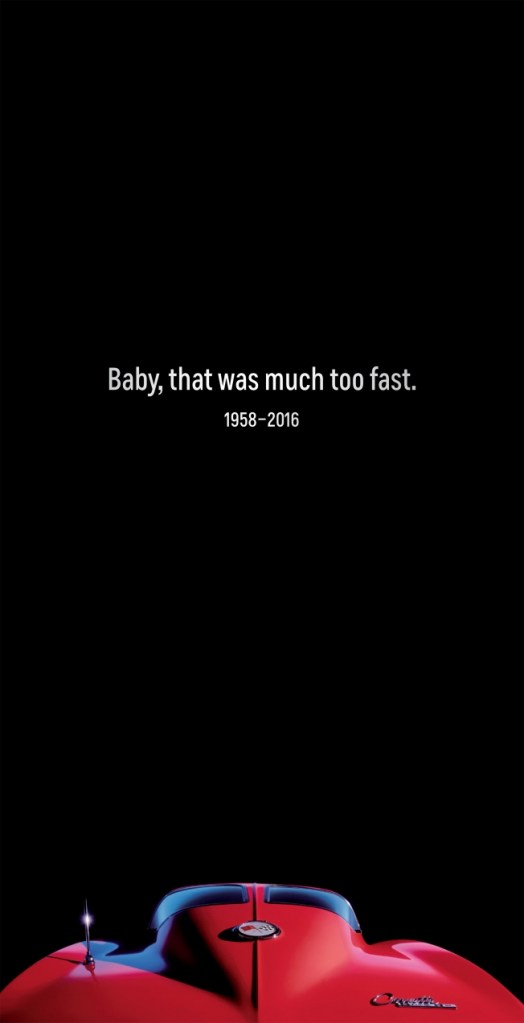
Such was the case recently when this ad appeared the day after the news of Prince’s passing broke.

prince-tribute-chevy-hed-2016

To borrow a phrase, this ad is insanely great. It’s smart. It’s sexy. It was perfectly timed. There’s no waste there. It appeared as a full page in multiple newspapers, including USA Today and The New York Times.

But there are people that might ask: why bother? It won’t sell any more Corvettes, and not everybody will “get it.”

That’s exactly the point. It’s not meant for everybody. It’s aimed entirely (and only) at people who do get it – in order to say something very purely and very simply.

A couple of things to note about this ad:

1 – It’s brilliantly executed.  The derivative use of the lyric from the song is so perfect, and gives this ad a strong emotional overtone.  (It also alerts people in the know that Chevy, too, is in the know.  Wink, wink.)  The 1958 – 2016 tells you it’s a tribute.  And have a good look at the art direction – all that black space creates not only a sexy mood, but also an appropriately somber one.  Note how the curvaceous rear view of the car creates a gorgeous and vivid topography to anchor the otherwise colorless page.

2 – It’s not self-serving.  There’s no logo here.  No URL.  No Twitter handle.  Sure, there’s a Corvette nameplate in the lower right corner, but it’s not retouched or enlarged so you’ll notice it.  Neither Chevrolet nor GM used this as a platform to say “hey, look at us!  We loved Prince too! Now go buy our shit.”  You’ll also note that Chevy used a 1963 body type, with the identifiable split rear window, and NOT the 2016 body type.  Instead, they used the space (and the money it cost) to make a genuine statement and to quietly share in the collective sadness along with all the other fans.  Too many other brands used this as an opportunity to call attention to themselves, and in some cases, it backfired pretty badly.

My compliments to CMO Tim Mahoney for having the guts to do this ad, and of course, the folks at Commonwealth/McCann for coming up with it.

These days, we place so much emphasis on goal-meeting, sales benchmarks, quarterly returns, and year-on-year improvements. (Especially in the auto industry!) Add to that the relentless testing and measurement protocols now afforded via digital, and we’ve exact-ified ourselves into a dark marketing corner.

And here comes Chevy, the pride of behemoth General Motors, with a small statement that has nothing to do with sales goals, or a dealer group, or a competing nameplate. A simple, elegant statement to honor the passing of a musical legend.

Stop scratching your head. I can see you there, reading this, saying to yourself “yeah, but WHY do an ad that won’t sell any more cars today than yesterday?” Your left brain hurts. You want accountability, returns. You want it to DO something.

But that’s just the thing about brand building. This IS doing something. It’s furthering a sense of alignment. An orientation around the coolness of Prince, and around the collective grief we all share when an icon like this passes away.

If you got your hands on the Corvette brand book, I’d bet the word “cool” appears in there more than a dozen times. Remember, a brand is simply a stand-in for a promise of value. Corvette is about the promise of cool. The promise of sexy. The promise of fast. The promise of classic American indulgence. [Listen to the lyrics of Little Red Corvette, and you’ll see those same themes. Heck, Prince was all those things!]  This ad, very simply, synthesizes all those same themes into one elegant execution. And I would argue that this one ad does more to build the brand essence than the last decade of stuff combined.

When “Little Red Corvette” came out in 1982, it probably didn’t sell any cars, either. But it sure built awareness! So, Chevrolet is simply repaying a small favor that was done some 34 years ago.

Good on ya, Chevy.