CBS’ branded content mishap

frank_endorsements

In the words of Howard Mittman, a colleague of mine, and current publisher of GQ, “branded content sucks…basically because it’s branded.” He said this quite directly to a group of marketers and agency creatives during an event I hosted back in 2012 discussing the future of creativity. His words never rang so true as they did last night, when CBS broadcast a 2-hour special to commemorate the 100th anniversary of Frank Sinatra’s birthday.

The broadcast was neither a celebration of Frank Sinatra’s birthday (that’s next week, on December 12th,) nor was it simply a network broadcasting a program of entertainment tailored to its slightly older demographic audience. It was simply (and sadly,) a bloated bit of branded content.

The broadcast bill was (likely) shared between The Grammys® and Steve Wynn, both of whom were on full display during the event. In short, the variety-format music program was basically a 2-hour commercial with paid talent and a sorely lacking bit of licensed footage strewn throughout.

If you’re a real Sinatra fan, this program was a letdown. There was very little actual Frank Sinatra footage, and the lineup of talent was, well, suspect. Seriously. Adam Levine is very good at what he does. And that is NOT singing standards.

Instead, it was a 70-day prequel to “music’s biggest night,” which airs on CBS on February 15th. Hence the lineup of Grammy sweethearts: John Legend, Carrie Underwood, LL Cool J, Zac Brown. And some kind of weird choices, like Nick Jonas, Adam Levine, and, well, isn’t that enough? The only surprise is that Taylor Swift and Bruno Mars weren’t on stage to sing “Me and My Shadow.” (You’re welcome, CBS. And see what I did there?)

According to Nielsen, the show was viewed by 8.74 million people. My guess is that was enough of an audience for these two “producers” to foot the bill for the ad time (and likely a hybrid time-buy,) to gain broad exposure for both of their properties. The Grammys would like the world to tune in on February 15th, and Steve Wynn would like at least 1% of the world to visit his hotel and casino.

It’s perfectly acceptable to promote your properties, and perfectly fine to do it with entertainment content. Brands do it all the time, and most of the time, they do it well. But last night was a prime example of getting it wrong. Mostly because the core audience was ignored, and the subject matter of the program was somewhat mistreated.

Frank Sinatra fans probably tuned in last night to see and hear FRANK. But they didn’t. They got…Adam Levine. So it ends up coming off like a bait and switch. If you’re going to attempt to push your brand through content (it’s an excellent idea,) then remember – as with all aspects of marketing – to keep the consumer at the center of the conversation. Last night could have been something special, but it wasn’t, precisely for that reason.

My thoughts on how they could have gotten this right:

  1. MORE FRANK. When you say you’re celebrating Frank Sinatra at 100, you should probably spend more than six total minutes on your subject matter, and maybe slightly less on pop stars and benefactors.
  2. LESS WYNN. A simple “coming to you live from the world famous Wynn Resort” and a couple of well-timed commercial spots would have been just fine. Cutting to camera shots of Mr. Wynn and his wife approximately every four minutes might have been overdoing it.
  3. CONNECTIVE TISSUE. Sure, CBS wants to promote the Grammys, and Frank Sinatra and music and awards are all connected at the hip. Frank is a Grammy hall-of-famer, with 13 Grammy Awards, and 32 nominations. Grammy could have celebrated Grammy by celebrating Frank’s Grammys.
  4. CONTEXT.  Instead of people simply singing standards that Frank made famous, they could have done vignettes about how Sinatra influenced them, and how they’ve tried their best to emulate his success.
  5. THE ARRANGEMENTS. I’ll give props where they are due. Whoever it was that had the idea to honor (mostly) the original Nelson Riddle arrangements should get a healthy pat on the back. This was a GREAT way to connect the dots and wrap the target consumer in a warm robe of familiarity. Nice work there.

Das Issues: What’s Next for Volkswagen?

So you’ve heard about Volkswagen’s little problem, yes? Just in case you haven’t, here’s a quick recap: they installed software into millions of cars to “beat” emissions tests. This software was built around an algorithm that essentially “knew” when it was being tested. The algorithm kicked ON for tests, and then shut OFF in typical driving conditions. When it was off, the cars were not very clean at all, pumping out up to 40X the legal limit of nitrogen oxide emissions. Yikes. Word on the street is that VW has been up to this kind of “engineering” for as long as six years. And now, details are emerging about nearly a million more manufactured cars with carbon dioxide emissions issues. Das problems indeed.

And the getting-it-fixed part actually exacerbates the problems the brand faces. If you own one of the affected VW models, you can return it to an authorized dealer, and they will fix the problems free of charge. However, when those problems are fixed, your car will not perform as it had before. That’s because there’s a trade-off between emissions and fuel efficiency. (Trust me on that one.) So the car you bought, well, is not the car you bought.

As a result of this debacle, VW is facing up to $18 billion in fines and penalties under the US Clean Air Act. They may also face criminal charges. The CEO Martin Winterkorn has resigned, and new CEO Matthias Mueller (previously CEO of Porsche,) has made it his mission to regain consumer trust in the brand.

And that’s really where the damage is done. Sure, the share price has taken a hit (it was trading in the mid $160’s, and then plummeted to around $100 when news of the scandal broke. It’s at $96.17 at the time of this writing.) But the value of the BRAND has all but disappeared.

Brands, and especially automotive brands, are positioned and marketed around very small, scarcely perceptible differences. That’s because they all pretty much do the same thing. If you look at the automotive category, you’ll see that all the brands share about 99% of the exact same DNA. Tires, engines, doors, windows, airbags, radios, seats, etc. So, the only way to be remembered is to make claims around features (or feature sets) that create some tangible benefits to consumers. Benefits like safety, or fuel-efficiency, or exhilaration, or performance.  VW was promising a benefit set of clean air AND fuel efficiency on many of the models in question.

The best way to understand a brand is to think of it as a PROMISE. That’s it. I’ve been beating this into the heads of my graduate students at NYU for years. Brand=promise. So when a brand like Volkswagen openly violates laws and is caught in surreptitious software shenanigans to charge premiums to deliver benefits and it all ends up to be a money-grabbing meister-manipulation, it’s done irreparable damage to the brand that has built equity in its “little outsider that could” position for more than five decades.  Because it breaks the promise.

I’ve often said that brands are like a house of cards. It takes time, patience, skill and a delicate hand to build into something impressive. And just one clumsy bump to have it all come tumbling down in an instant.

Brands are built largely on the advertising they execute. And Volkswagen sits in the pantheon of the “greats” in advertising history. Doyle Dane Bernbach helped put this brand on the map, and paved an entirely new road with their ground-breaking Koenig-penned, Krone-designed, Bernbach-driven “Think Small” back in 1959. They literally shape-shifted the industry with this ad. Partly because it was revolutionary (we’ll tackle that one in another post,) and largely because the brand actually delivered on the promise!

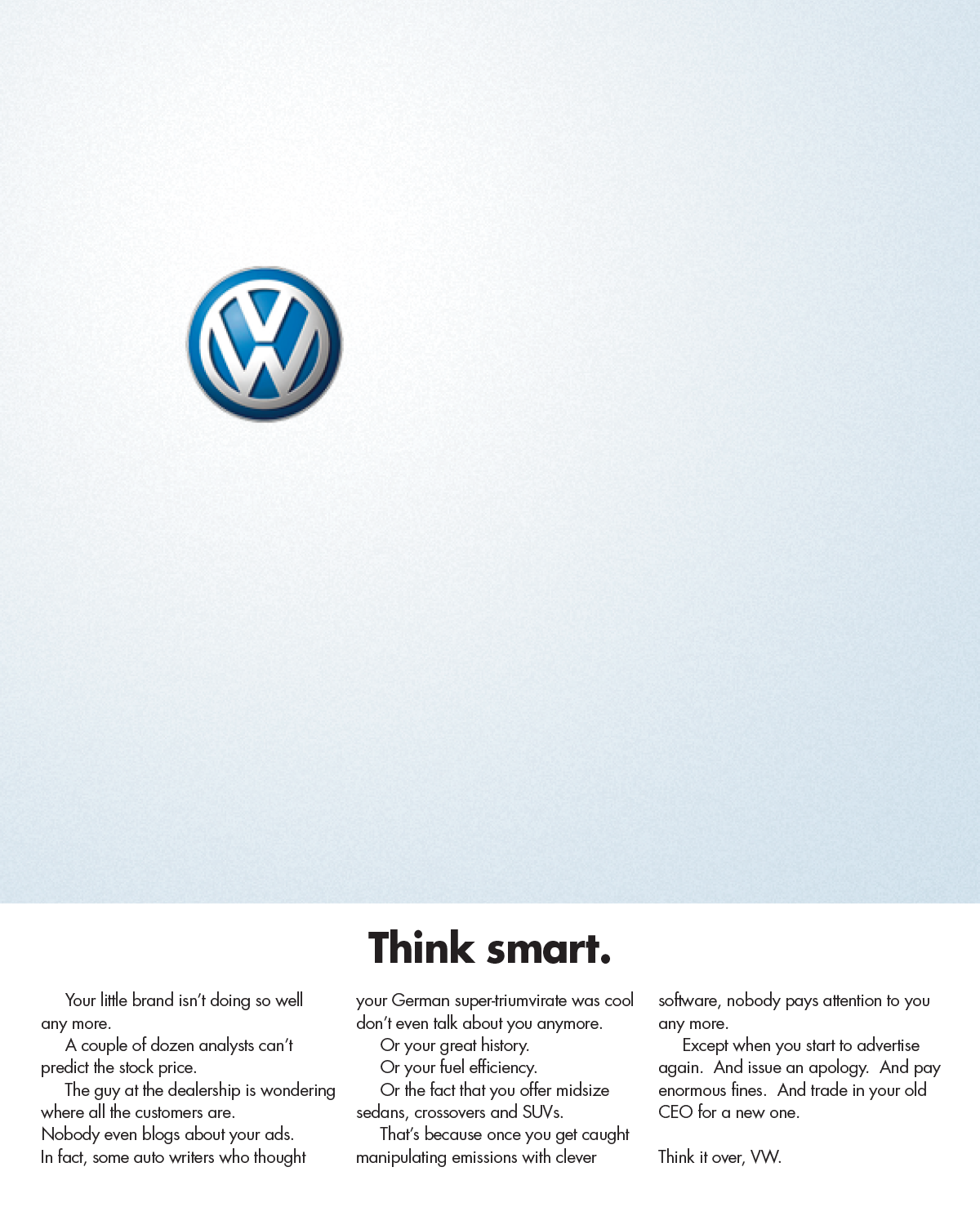
Here’s a modern riff, based on VW’s current position:

VW_thinksmart_ad

So what’s next for VW? How do they go about re-initiating the conversation with American consumers about its brand? How do they recapture the glory and modesty and wry humor of “Think Small” and “Lemon” and that gorgeous “Darth Vader” Super Bowl spot?

Whatever they do, it will have to be an organization-wide mission that every person from the CEO down to the guy who washes the cars at the dealership in Duluth all share.

If I was a brand consultant for Volkswagen, (full disclosure: I’m not, but certainly available!) I would start by going back to what helped build their perception: The dorky little outsider that promised the moon and modestly delivered it. My very next ad headline (think full page insertions in The New York Times, Wall Street Journal and USA Today,) would probably read “11 million Lemons.” And the body copy would go on to overtly apologize for the transgression, and then outline the steps we were taking to make good on our (new) promises and deliver exceptional automotive engineering.

And then I’d invite consumers to come along for the (literal and figurative) ride to redemption. Das Step 1.

Taco Bell’s Cool (but weird) World Series Breakfast Promotion

taco-bell-logo

If you’re following baseball, you know the New York Mets are in the world series (yay!) to face the Kansas City Royals, who are returning to the Big Show for the 2nd straight year. The games will air on Fox, who will be selling advertising at the average cost of $450,000 per 30-second spot. A far cry from the $3.5 million that the Super Bowl generates for the same airtime, but remember that the World Series has the potential to stretch out over 7 games. So advertisers are lining up in droves to get their brands in front of sports fans, and also to tie in promotions with the game.

One such marketer is Taco Bell, who is running a promotion called “Steal a Base, Steal a Breakfast.” The promotion parameters are as follows: if a base is stolen during games one or two, anyone can walk into a Taco Bell on Thursday, November 5th between 7:00 am and 11:00 am (in your local time zone) and receive a FREE A.M. Crunchwrap. If no player steals a base during those games, but a base is stolen in games three through seven, then the free offer will stand and be available on Tuesday, November 10th.

This is not the first time Taco Bell has run this promotion – it first ran in 2007, returned in 2008 and then once again in 2012.

But…why?

What does a Tex-Mex fast food chain, and in particular, their breakfast service, have to do with baseball and stolen bases? According to the press release issued by Taco Bell, Marisa Thalberg, the Chief Brand Engagement Officer, “we are encouraging the whole country to root for a stolen base in the Series – from either team – because the player who steals that first base will have thereby “stolen” a free breakfast, our A.M. Crunchwrap breakfast sandwich, for all of America.”

Okay. From a marketing standpoint, it’s always a good idea to piggyback off the momentum of a highly attended/highly viewed sporting event. No argument there. But why is Taco Bell doing THIS?

Well, for one, it’s a pure exposure/awareness play. They’ll run television ads throughout the world series promoting the promotion (that sounds funny,) and through a lot of reach and frequency, they’ll get viewers excited to watch for a stolen base. [To be clear, it’s highly unlikely that they’ll convince non-baseball-fans to tune in with any significance to “root” for a stolen base.] There will also be social media marketing run around the promotion (the hashtag is #StealABreakfast,) that will likely garner a bump in new fans/followers on their various social feeds.

Of course, this is a sales promotion, so they will likely also see a significant lift in their morning traffic on the day when the promotion runs – and most of that lift will be coming from visitors who are not typical Taco Bell customers. So it’s a sampling/trial play. The thinking is “if we can get a million new people walking in to a Taco Bell this one morning, we might be able to convert some percentage of them into return business.” Good solid marketing thinking.

I like this promotion on principle, but the details of it strike me as, well, weird. The “steal” theme is a bit of a stretch, and doesn’t really align the brand conceptually or contextually with the game for the long run. The “steal” is very much a “one-time” or at least relatively rare phenomenon. (Major League Baseball statistics show that the median number of stolen base ATTEMPTS per game, per team is .70.  That’s not a lot.  (Also note that Taco Bell has not run this promotion year in and year out…it hasn’t run for three years, so as far as the average consumer is concerned, it’s NEW.) I’d much rather align my brand for the long term with a concept that has lasting power, and maybe some appreciable repetition involved that continues to remind consumers of the brand.

As a rule, we don’t associate baseball with breakfast. (It’s an afternoon or evening game, in terms of general perception.) Generally, we don’t associate baseball with “southwestern” or “tex-Mex” food styles. (The National Hot Dog and Sausage Council (NHDSC) estimates that more than 30,000,000 hot dogs and sausages will have been sold in baseball stadiums alone this year.) And generally, we associate the word “stealing” with something bad or wrong, (in fairness, unless you contextualize it around the offensive game in baseball.)

So this promotion is offered by a Tex-Mex fast food restaurant that sells tacos and burritos, centered around a game that makes a good living selling tens of millions of hamburgers and hot dogs, is promoting breakfast during what will be all night games, is built around a phenomenon that happens rarely, and is associated with a word that we all perceptually agree is something wrong.  That’s why I find it a bit weird. Oh, and if no bases are stolen during the World Series, then, well, no hay desayuno gratis para usted, mis amigos.

Taco Bell has been on a downward slide in the recent period, (according to MarketWatch, its parent company Yum! Brands’ shares are down 18.6% over the past three months,) so it makes sense to do SOMETHING to draw attention to the brand.

And I think the brand will likely see some good numbers coming out of this promotion. But, based on the transiency, I’m not sure it will have the lasting effect they’re hoping for. The cost/benefit analysis will likely allow the marketing executives to keep their jobs for the next quarter, but then you’ll probably see the next “one-off” event/promotion thingy happening.

If you’re going to call attention to your brand with any kind of promotion, remember to do so in a fashion that bonds consumers to it for more than just a “quick hit” and that makes sense with your brand values and your category positioning. Think about alignments that have perennial value, and you’ll roll up fans and maybe even loyal customers for years to come.

Has WordPress Lost Control?

wordpress

Think about this: the average American technology user is interacting with as many as 100 different apps per day or more. Weather, texting, stock quotes, sports scores, e-commerce, navigation and countless other productivity enablers. And a zillion or so games! While there is plenty of enviable tech along that continuum, (not to mention scores of teenage millionaire developers,) there is little to no consistency in tone, or in brand or in experience.

Each app you thumb around with is developed somewhere around the world by some team of coders who are sort of winging it until they get it just un-buggy enough to release (slightly more stringent if it’s an iOS app, but still…) And users of this experience – that’s you and me – are trained to just search for the next cool thingy to while away the hours on the train.

What’s been created with the smartphone revolution over the past eight years or so is a complex and hyperactive ecosystem of near-chaos to provide all of us with a vast environment of choice. We basically live in a technology supermarket where every aisle is stacked with packages of flashing lights and angry piggies. And at a buck 99 or so per experience, we are shopping until we drop. And why not? It’s fun, it’s personalized, and it can be controlled.

What many people don’t know is that most web experiences today are conceived and constructed in very much the same way. Take WordPress, for instance. The world’s most popular blogging platform got smart a few years ago and opened up their platform to outside developers to provide full website functionality – including social connectivity, video embedding, e-commerce, data aggregation and more. But WordPress doesn’t actually DO any of that. They simply provide the framework, and developers build site themes and other functionality on it.

When you land on a WordPress site, you’re being tended to by anywhere from 10 to 100 different independent software companies who have created snippets of functionality. (WordPress calls them plugins.) You’re not so much “on a website” as you are smack in the middle of a technology rodeo where each activity you perform or engage with is being served to you remotely while it runs wild in its side corral. Want to fill out a form? Plugin. Want to see a company’s latest Tweets? Plugin. Want to buy stuff? Plugin.

For the average consumer, it seems to be working. You never leave the site (at least as far as you know,) and you’re confident in that it’s relatively secure. (WordPress did get that part right.)

But when you’re an administrator on one of these sites, and your job is to keep the site updated and add content and make it interesting for consumers, you’ve got 99 problems, and the login ain’t one.

That’s because each component in the code circus is either buggy on some level, or it’s being updated with “new features” or the theme developer changes the core code (rendering ALL plugins that work with that theme near-useless,) or WordPress itself updates the framework software and shuts the whole system down for a week. And any time that happens, something goes wrong with your site. It’s tiring, really.

Sure, these problems do get remedied and add new features and functionalities, but the “getting there” part is bumpy. (Especially when people come to your site and pieces of it are missing, or the menu doesn’t show up, or they fill out a form and just get an eternal spinning wheel.)

The app world can continue expanding outward at whatever pace it sets for itself, because apps are self-contained, single function experiences. When the developer wants to change something in the code, the user gets a notice to “update” and everything works just fine.

But to try and app-ify the web experience, and in particular, the way content is managed from the administrator’s perspective the way WordPress has, is a management nightmare that’s becoming more and more evident as the system expands. You can’t control multi-function experiences in the same way you can manage a single-function app. The minute one developer changes a piece of their code, (say with a theme update,) he or she can throw hundreds of the plugins that are supposedly “compatible” with that theme out of whack, and in some cases, for an extended period of time.

For all intents and purposes, WordPress has lost control.  For an expansive ecosystem like that to work, there needs to be oversight, and it should be administered much more carefully to keep all these independent contractors in line and on time. And it should be the primary objective at WordPress headquarters. I hate to say it, but they should start acting more like Apple.  Even though some decry Apple’s “rule with an iron fist” mentality when it comes to how they handle third-party developers, the proof is in the pudding.  WordPress needs to set some stricter standards, put time restrictions and “windows” on updates, and manage the relationships between theme developers and plugin developers.  Because each time a WordPress site acts wonky, nobody says “oh, I’m sure it’s that Yoast SEO plugin.”  They simply think WordPress is kind of crappy, and nothing could be further from the truth.

It’s no surprise that companies like Wix and SquareSpace have popped up to start serving intermediaries and DIY-ers with newer, easier, less-out-of-control content management systems. (Not surprisingly, they have spurned the “open it up to developers” mentality, and are attempting to keep everything tightly under control.) And don’t forget about SilverStripe – the new, new content management platform that’s turning a lot of heads.

Right now, WordPress sits on top of the content management food chain.  But if they don’t watch out, they’ll soon be the old dinosaur in a market space that’s about to get hit by the proverbial meteor.